
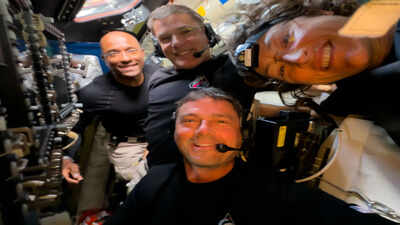
In the quiet expanse beyond our atmosphere, four astronauts—NASA’s Reid Wiseman, Victor Glover, and Christina Koch, joined by Canadian Space Agency’s Jeremy Hansen—achieved what no human had before.
On April 6, 2026, aboard the Orion spacecraft during NASA’s Artemis II mission, they slipped past the Moon’s far side and reached a distance of 252,756 miles from Earth, eclipsing the 1970 Apollo 13 record by more than 4,000 miles.The crew photographed ancient lunar basins, witnessed Earthrise in its fragile splendour, and conducted manoeuvres that tested the limits of deep-space navigation. Commander Wiseman captured the moment’s gravity: “There is nothing normal about this.
Sending four humans 250,000 miles away is a herculean effort, and we are now just realizing the gravity of that.”Gravity, it turns out, is not only physical. It is civilizational. What Artemis II represents is not merely distance travelled, but chaos mastered. Daniel Holkes wrote on X: “Somebody had to work out a path where the Moon’s gravity is pulling you in, the Earth is pulling you back, and you’re moving just fast enough not to get trapped by either.
They had to figure out the exact angle to come back into Earth’s atmosphere. Too steep, you burn up.
Too shallow, you bounce off and drift into space. And they had to get all of that right at the same time, for real people sitting in a small metal capsule 400,000 kilometres from home. Nothing in that system is standing still. The Moon is moving. The Earth is moving. Even the Sun is pulling on everything. And still, some people looked at all of that motion, all of that chaos, and turned it into numbers you can follow.”It is the kind of precision that should humble us.

Two events, separated by mere hours and the thin veil of orbital mechanics, crystallised a paradox that has shadowed our species since the dawn of tools and fire: we can be builders of wonders and architects of ruin at the same time.
Now contrast that crystalline achievement with the hell unfolding below. Less than twenty-four hours later, on April 7, President Donald Trump issued a stark warning on Truth Social amid escalating tensions over the Strait of Hormuz: “A whole civilization will die tonight, never to be brought back again.” The rhetoric, aimed at Iran, evoked the spectre of military action capable of extinguishing millennia of cultural and human continuity.Two events, separated by mere hours and the thin veil of orbital mechanics, crystallized a paradox that has shadowed our species since the dawn of tools and fire: we can be builders of wonders and architects of ruin at the same time. While the astronauts marvelled at Copernicus crater from lunar orbit, ballistic missiles were carving fresh craters into the Earth. Iranian strikes hit Israeli cities; US and Israeli jets answered with precision strikes over Tehran, Isfahan, and Bandar Abbas.
The record-breaking distance of Artemis II is a measurement of our potential. The civilizational threat over Iran is a measurement of our peril.
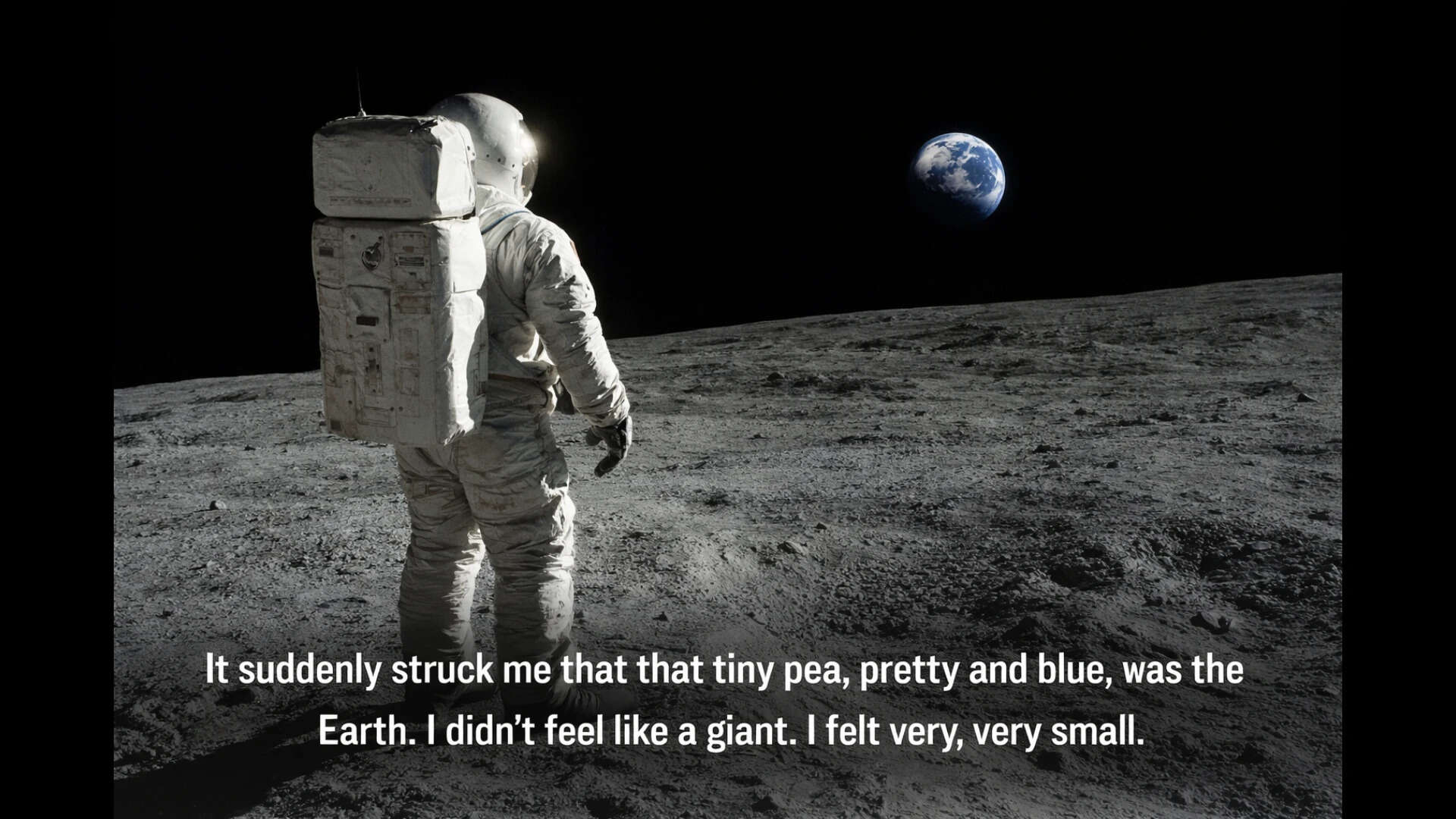
From the vacuum of space, none of this is visible. Earth appears not as a stage for empires or ideologies, but as a solitary, luminous mote. Neil Armstrong, after his moon landing, had said something on the same lines: “It suddenly struck me that that tiny pea, pretty and blue, was the Earth. I put up my thumb and shut one eye, and my thumb blotted out the planet Earth. I didn’t feel like a giant. I felt very, very small.” Apollo 11 command module pilot Mike Collins echoed him: “Oddly enough the overriding sensation I got looking at the earth was, my god that little thing is so fragile out there.
” These observations prefigured the Overview Effect — the cognitive shift reported by nearly every astronaut who has seen our world suspended in the void, a shift that dissolves borders and underscores interdependence.This duality between creation and destruction is as old as ambition itself. The rockets that propelled the Artemis crew are the descendants of wartime missiles. History’s great explorers — from Vasco da Gama to Columbus — arrived with curiosity and left with conquest.
Even those who began as pathfinders often ended as architects of erasure. Friedrich Nietzsche captured the tension plainly in Thus Spoke Zarathustra: “whoever must be a creator always annihilates.
” Yet Nietzsche also wrote that one must “have chaos within you to give birth to a dancing star” — suggesting that destruction and creation are not opposites but accomplices.
Carl Sagan understood both the beauty and the burden of the view from afar.
In Pale Blue Dot, he wrote: “Look again at that dot. That’s here. That’s home. That’s us… it underscores our responsibility to deal more kindly with one another, and to preserve and cherish the pale blue dot, the only home we’ve ever known.” His words, forged in the era of nuclear standoffs, resonate anew. The Artemis crew’s feat was enabled by decades of engineering, international collaboration, and unyielding curiosity — the best of humankind’s collective intellect.
Trump’s invocation of civilizational erasure reminds us that the same species is capable of rendering such achievements moot.Public reaction to this convergence captured the dissonance sharply. One observer on X wrote: “The pride I feel as a human watching Artemis II is combating sickness for our country. The president is threatening nuclear war and destroying ‘a whole civilization’ tonight. Nobody deserves this – our hands are stained red with blood and this will surely be the end of the US empire.”
These reactions reveal a collective unease: the recognition that our species teeters between cosmic ambition and tribal regression.History offers scant comfort but useful patterns. The Apollo programme unfolded against the backdrop of the Cold War, with mutual assured destruction keeping fingers hovering near buttons. Yet that same era produced the Outer Space Treaty, banning nuclear weapons in orbit and framing space as a domain for “all mankind.”
Crisis and cooperation have always coexisted. The question is which one we choose to amplify.J. Robert Oppenheimer, the physicist who built the bomb and then bore its weight, reached for the Bhagavad Gita in that moment of reckoning: “In battle, in forest, at the precipice in the mountains / On the dark great sea, in the midst of javelins and arrows / In sleep, in confusion, in the depths of shame / The good deeds a man has done before defend him.”
It is a verse about the persistence of what is built – against the entropy of what is destroyed.No one expressed the astronaut’s indictment of earthly pettiness more viscerally than Edgar Mitchell, the sixth person to walk on the Moon: “You develop an instant global consciousness, a people orientation, an intense dissatisfaction with the state of the world, and a compulsion to do something about it. From out there on the moon, international politics look so petty.
You want to grab a politician by the scruff of the neck and drag him a quarter of a million miles out and say, ‘Look at that, you son of a bitch.
‘”Mitchell’s fury was not anti-politics. It was anti-pettiness. It was the anger of perspective, and perspective, history suggests, is the one thing power consistently resists. From space, there are no borders. From Earth, there are only targets.The record-breaking distance of Artemis II is a measurement of our potential. The civilizational threat over Iran is a measurement of our peril. The four astronauts will splash down, their mission a bridge to future landings. Earth will continue its indifferent spin, its thin biosphere the sole known cradle of consciousness. The species that reached farthest from home must now decide whether to secure that home or squander it.
The pale blue dot awaits our answer.