
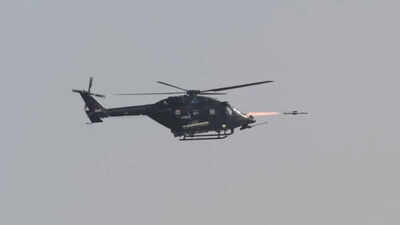
The Indian Army is on a modernisation drive, a part of this drive is the focus on inducting attack helicopters. The Indian army has so far inducted six US origin AH-64E attack helicopters and 5 indigenously developed Light Combat Helicopter (LCH) Prachand.
The army is awaiting delivery of 90 additional Prachand helicopters. Army chief General Upendra Dwivedi, flew in the LCH earlier this week at Hindustan Aeronautics Limited’s facility in Bengaluru. The army chief was in the city for the second edition of the Ran Samwad seminar.The addition of ninety additional Prachand helicopters will increase the army’s aerial hitting power. This would also take the number of army’s combined Apache and Prachand attack helicopter fleet to a total of 101 attack helicopters.
The air force on the other hand has ten LCH in service and has ordered another 66 choppers to augment its fleet. This will bring the total number of these helicopters to 171 air frames in service.
The air force also operates another 22 Apache attack helicopters.
Exercise Brahmastra: Indian army’s first firing from the AH-64E Apache attack helicopters
This means that the two services plan to operate a grand total of dedicated 199 attack helicopters. Both the army and the air force also operate nearly 90 Rudra armed helicopters.
These helicopters are similarly armed as the Prachand, as they both carry the same 20mm automatic cannon and rocket pods.The Prachand and the Rudra were designed to fire the Dhruvastra (for the air force choppers) and Helina (for the army helicopters). Both these missiles are variants of the indigenously developed third-generation Nag Anti-tank Guided Missiles (ATGM). Both the rockets and the missiles are tom be carried externally on stubs. The Defence Acquisition Council (DAC) has cleared 200 Dhruvastra missiles for the Indian Air Force‘s Rudra helicopters. These missiles
Helicopters in air-to-air role
Recently Helicopters have been used innovatively as an air defence platform against Iranian drones.
The defence ministries of both Israel and UAE have released videos of their attack helicopters taking down these drones. Ukraine too has been using helicopters to shoot down Russian drones. Helicopters are successful in this role as they fly low and slow. This is the same flight regime in which helicopters usually operate.
At the same time loitering munitions such as the Geran and Shahed series of drones fly at speeds of around 300 km/h.
At the same time this is near the take off speed of many fighter aircraft, making it difficult for fighters to shoot them down with their guns. While air-to-air missiles, the cheapest of which will cost around $4 lakh against a $20,000 drone is not always feasible.
Helicopters lacking air-to-air punch
While both the attack helicopters in Indian service can engage these drones, they lack missiles to take on these drones and loitering munitions. The Prachand and Rudra were initially supposed to carry the air-to-air French origin Mistral missile, but this hasn’t materialised.The Indian army is seeking an air-to-air missile for its helicopters that can not only take on drones, but should also be able to destroy fighter air craft and other helicopters. The document states that the army requires a heat seeking missile with a range of 7 km. The fire and forget missile should also have a single shot kill probability of at least 90%.More in order to beat a drone saturation attack, the missile should be able to be fired in a salvo to take down multiple targets.The army and the air force are expected to get 156 additional LCH Prachand from next year onwards and the deliveries are expected to end in 2033, as reported by India Today. These aircraft will be a major element of India’s aerial arsenal. The armed forces should ensure that as the fleet expands, so should the capability of these platforms.

