
Ancient Sahara was once a green land with rivers and lakes. Now, a new cave discovery shows this humid period ended suddenly. The Sahara transformed into a desert in just a few centuries. This rapid change forced people and animals to move. Evidence of this past life remains in rock art.
About 8,000 years ago, the Sahara was not the endless sea of sand we know today; it was a green, rainy land threaded with lakes and rivers. Animals such as hippos and elephants roamed where only dust and heat reign now, and human communities thrived in the middle of what would later become one of the planet’s harshest deserts.
Sounds just like another bizarre theory right?
But a recent discovery sheds light on what might tell about the desert giant’s past!For decades, fossil bones, pollen, and ancient rock art hinted at this “Green Sahara,” but scientists struggled to pinpoint exactly when this humid world began, how long it lasted, and just how quickly it disappeared.But with a recent discovery of a Saharan cave, researchers have a much sharper timeline. By studying mineral deposits built up over thousands of years inside a cave deep in the desert, a team led by Samuel Hollowood from the University of Oxford has mapped one of the Sahara’s most recent humid periods with unusual precision. According to the new study, published in the journal Earth and Planetary Science Letters, the African Humid Period did not fade slowly over millennia; it snapped into a desert within a few centuries.
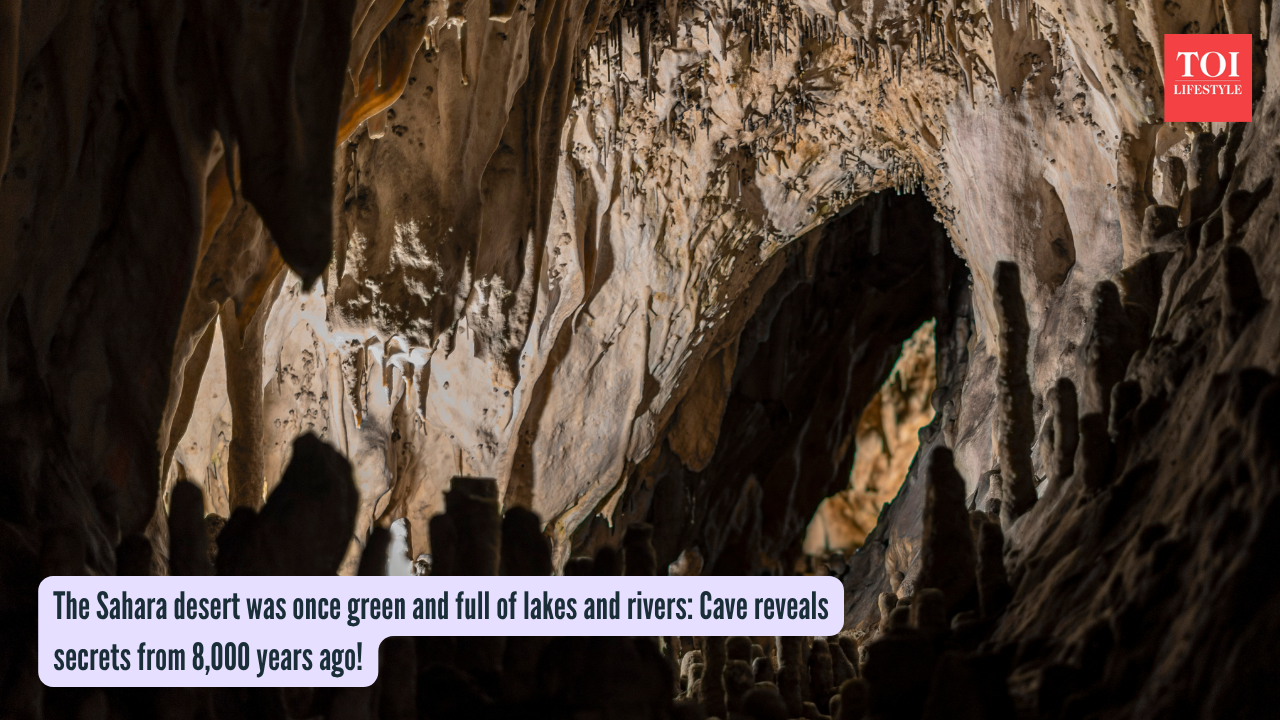
Representative Image
What the cave tells us about a green Sahara
Scientists have long known that the Sahara cycled between green and dry states many times over the last several million years, but the timing of the most recent “greening” has been fuzzy.According to the study, these humid phases line up with 21,000‑year shifts in Earth’s orbit called “precession,” which push more summer sunlight into the Northern Hemisphere and strengthen the West African monsoon.The new cave study, led by Samuel Hollowood of Oxford’s Department of Earth Sciences, focuses on thin layers of calcite (commonly called “speleothems”) formed by dripping water inside a remote Saharan cave.
“Speleothems document temperature and precipitation of the past,” notes a Max Planck Institute‑linked summary, because these deposits form only when enough rainwater seeps through the rock above, gaps in the mineral layers mean droughts, while continuous bands mark wetter periods.By measuring trace elements and stable isotopes locked in each layer, the team reconstructed how much rain fell and how quickly the environment dried out.
The data narrow the African Humid Period to a specific window, confirming that the Sahara was consistently green and rainy for thousands of years before an abrupt climate crash.
How fast did the Sahara turn to desert?
A big question in paleoclimatology has been whether the Green Sahara faded gradually over thousands of years or collapsed in a sudden “tipping point.” The cave record now points strongly to the latter. According to the study, the geochemical shift from wet to dry conditions took place in roughly 200 to 300 years, less than a tenth of a millennium in geological terms and only about seven or eight human generations.
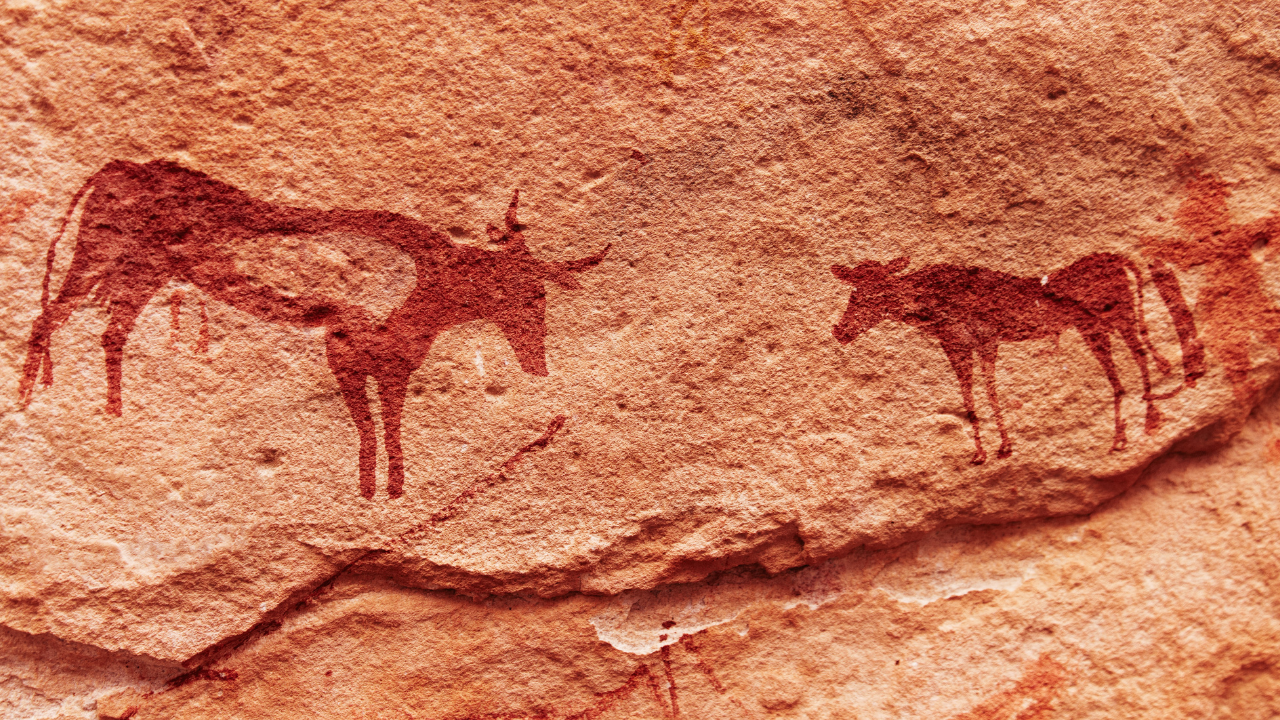
Rock paintings in Sahara Desert (Photo via Canva)
This rapid desertification would have been devastating for people and animals. As the monsoon retreated southward in uneven pulses, lakes and rivers in the central Sahara shrank or vanished, and communities that had depended on this inland water network had to move. The Smithsonian notes that the transition between 8,000 and 4,500 years ago left behind rock art of giraffes and swimming scenes, followed by a silence of abandoned settlements as populations crowded toward the Nile and the desert’s edges.

