
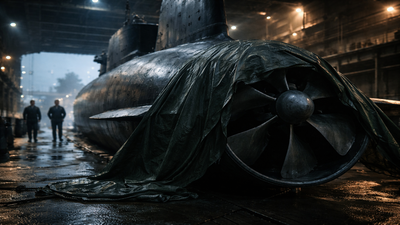
In modern naval warfare, few details are as tightly protected as a submarine’s propeller design. While it may seem like a simple mechanical component, the propeller — often referred to as the “screw” — is central to a submarine’s stealth, survivability, and combat effectiveness.
Countries go to extraordinary lengths to conceal its design because even minor insights can compromise an entire fleet’s operational advantage.
Stealth begins with silence
The primary reason propeller designs are kept secret is acoustic stealth. Submarines operate by remaining undetected, and noise is their biggest vulnerability. The propeller is one of the main sources of sound underwater due to a phenomenon known as cavitation — the formation and collapse of tiny bubbles when blades move through water at high speeds.If cavitation occurs, it produces distinctive noise signatures that can be picked up by enemy sonar systems from long distances. Advanced navies invest heavily in designing propellers that minimise or delay cavitation, allowing submarines to move faster without becoming acoustically visible.Even subtle differences in blade curvature, spacing, or edge design can drastically alter noise levels. That is why these designs are treated as top-tier classified information.
Acoustic signature: A submarine’s fingerprint
Every submarine has a unique acoustic signature, much like a fingerprint. This includes noise from the propeller, engine vibrations, and hull flow dynamics. Among these, the propeller plays a dominant role.Navies maintain vast underwater databases of acoustic signatures. Once an adversary records and analyses a submarine’s propeller noise pattern, they can identify not just the class of submarine but sometimes even the specific vessel.This makes secrecy critical. If a rival nation understands the acoustic profile of your submarines, it can track them more effectively, negating their stealth advantage — which is often their primary defence.
Lessons from the Cold War
The importance of propeller secrecy was dramatically demonstrated during the Cold War. One of the most famous intelligence coups was carried out by the Central Intelligence Agency in collaboration with the US Navy, which managed to recover parts of a Soviet submarine’s propeller.This allowed American analysts to study Soviet quieting technologies and refine their own anti-submarine warfare tactics. The incident underscored how a single component — the propeller — could reveal critical information about a nation’s naval capabilities.Since then, navies have tightened security around submarine design, especially propulsion systems.
Design complexity beyond appearance
Modern submarine propellers are far more sophisticated than traditional marine screws.
Some use skewed blade designs, where blades are swept back to reduce pressure fluctuations. Others employ pump-jet propulsion systems, which encase the propeller within a duct to minimise noise and improve efficiency.Countries like the United States Navy and the Royal Navy are believed to use advanced pump-jet systems on their latest submarines, significantly reducing acoustic signatures.The exact geometry, materials, and manufacturing processes behind these systems are closely guarded secrets.
Even high-resolution images of propellers are often classified or deliberately obscured.
Manufacturing precision and materials
Another reason for secrecy lies in manufacturing techniques. Producing a low-noise propeller requires extremely high precision — even microscopic imperfections can generate detectable noise.Specialised alloys, advanced casting methods, and ultra-fine polishing techniques are used to ensure smooth operation. These processes are often as valuable as the design itself.If adversaries gain insight into these methods, they can replicate or counter them, eroding a technological edge that may have taken decades and billions of dollars to achieve.
Counter-detection and anti-submarine warfare
Understanding an enemy’s propeller design also helps in developing better detection systems. Sonar operators are trained to recognise specific acoustic patterns associated with different propeller types.For instance, the number of blades, their spacing, and rotation speed can all influence the sound profile.
With enough data, analysts can reverse-engineer aspects of the propeller design and optimise sonar algorithms to detect it more easily.This is why navies treat propeller information as strategically sensitive — it directly impacts both offensive and defensive capabilities.
Strategic deterrence and nuclear submarines
The stakes are even higher when it comes to nuclear-powered submarines, especially those carrying ballistic missiles. These vessels form the backbone of a country’s second-strike capability, ensuring retaliation even after a nuclear attack.If such submarines are detected and tracked due to identifiable propeller noise, their survivability is compromised. This, in turn, weakens the credibility of a nation’s nuclear deterrence.For countries like the Indian Navy, which is expanding its submarine fleet, maintaining acoustic secrecy is essential to strategic stability in the region.
Beyond propellers: The broader stealth ecosystem
While the propeller is crucial, it is part of a larger stealth ecosystem that includes hull design, vibration isolation, and onboard machinery quieting.
However, the propeller remains one of the most exposed and acoustically significant components.This is why even satellite images or dockyard photographs of submarines often blur or conceal the propeller section. In some cases, dummy covers are used when submarines are in port.A small component with outsized importanceIn essence, the secrecy surrounding submarine propellers is not about the component itself, but what it represents — stealth, survivability, and strategic advantage. In underwater warfare, where detection often determines victory or defeat, even the smallest acoustic detail can have massive consequences.By guarding propeller designs, nations protect not just engineering secrets, but the effectiveness of their entire submarine force.