
 Another day, another bomb. Another headline flashes – children dying, buildings reduced to rubble, sirens echoing through cities somewhere in the world.
The images are stark, the urgency real.
Yet, somewhere between these moments of devastation, we find ourselves scrolling through reels, liking posts, debating movie reviews, moving from one world to another in seconds. The contrast is jarring—global tragedy unfolding in real time, while daily life, on our screens at least, continues almost uninterrupted.For the past few years, global news has felt less like interruptions and more like a continuous state of emergency with pandemic waves, the Russia–Ukraine war, Israel–Gaza escalation, rising tensions in the Middle East, leading to now, the war in Iran.
Each crisis arrives with urgency. Each competes for attention. Each, in time, fades into the background of the next.In this backdrop, however, the question is no longer just what is happening, but how much we can still feel.Are we witnessing growing numbness or apathy? Or is this the mind’s way of coping with sustained exposure to overlapping crises, where emotional bandwidth becomes a limited resource?In an era of constant alerts, rolling updates, and unending conflict cycles, crisis may no longer be an exception.
It may be the normal, and the human response to it is becoming just as complex.So, let’s dive deeper to answer the question – Are we becoming desensitised to global crises?
Defining the phenomenon: What is crisis fatigue ?
Crisis fatigue is a term used to describe the emotional, cognitive, and physical strain that can develop from prolonged exposure to stressful or traumatic events. It is commonly associated with sustained situations such as wars, pandemics, natural disasters, political instability, and economic disruptions, where people remain exposed to ongoing uncertainty or perceived threat over extended periods.
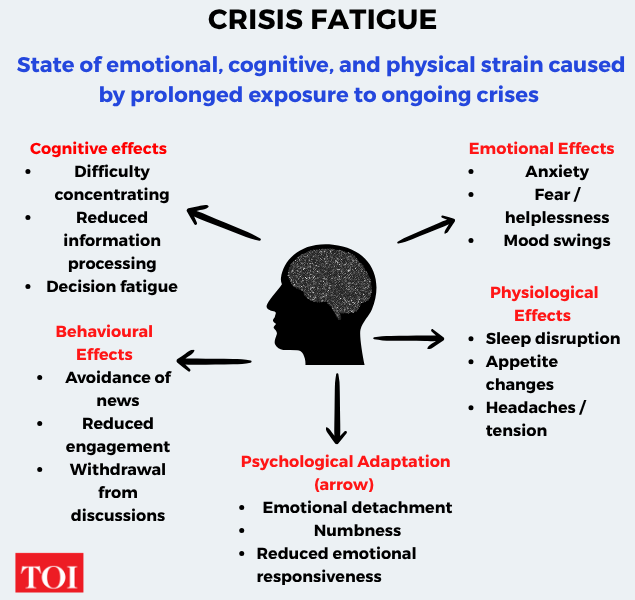
While widely used in discussion and analysis, crisis fatigue is not a formal medical or psychological diagnosis. Instead, it serves as a descriptive framework for understanding how the human body and mind respond to continuous stress beyond short-term limits.The phenomenon is closely tied to the body’s stress response system. In the face of danger, the body activates the “fight, flight, or freeze” response, releasing hormones such as cortisol and adrenaline.
This response is adaptive in short durations, but when stress persists without adequate recovery, the body can remain in a prolonged state of alert.According to Kanika Jindal, Founder and Director of Harmony Therapy World, talking to TOI, “Crisis fatigue can lead to emotional exhaustion, people often report struggling to process new information, it can lead to decision fatigue, attentional difficulties, sleep-wake cycle disruptions, intrusive thoughts/images, helplessness, fear, irritability, apathy and so on.”Crisis fatigue can affect anyone exposed to continuous stress, though it is often more pronounced among individuals who are directly involved in or repeatedly exposed to crises, as well as those with pre-existing vulnerabilities such as prior trauma, financial instability, or underlying mental health conditions.Dr Radhika Goyal, Psychologist with PhD further explained , while talking to TOI, how it “shapes collective behaviour.”
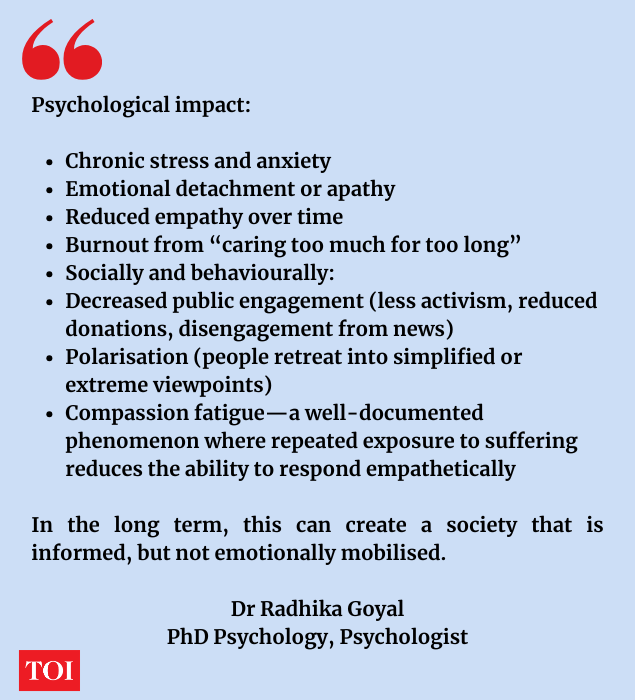
In today’s information environment, where global crises are frequently reported and continuously visible, crisis fatigue has become symbolic of the challenges of sustaining emotional and cognitive engagement when exposure to distressing events becomes persistent rather than episodic.
Global crises that define the recent times
Global crises today are not experienced as isolated, time-bound events, they’re unfolding in parallel, often overlapping across geographies and timelines.Earlier eras of crisis reporting were typically defined by slower news cycles and limited real-time dissemination. A major development would dominate attention, run its course, and gradually recede before the next significant disruption emerged.In contrast, the current information environment is continuous and instantaneous. With 24/7 news coverage, social media updates, and live reporting, multiple crises are visible at the same time, each competing for attention while still evolving. So, let’s understand the crises have defined the recent times.
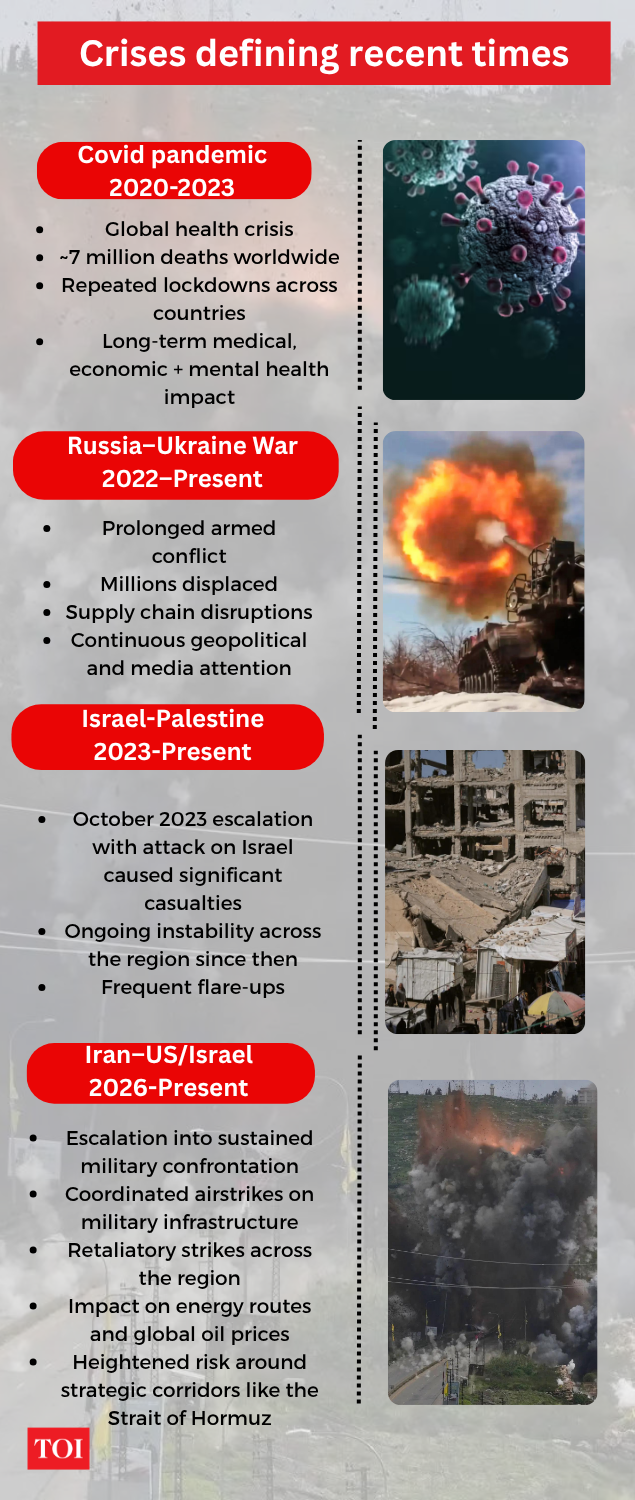
- The Covid-19 Pandemic (2020–2023) marked the first prolonged global crisis of the decade. The virus disrupted everyday life across continents, causing over 7 million deaths worldwide, overwhelming healthcare systems, and triggering repeated lockdowns.
Unlike short-term disasters, the pandemic’s effects were long-lasting: economic instability, mental health challenges, and social isolation compounded the initial shock.
- Russia–Ukraine War (February 2022–present) added another layer of sustained stress. What began as a sudden invasion quickly escalated into a protracted conflict with devastating humanitarian consequences. Millions were displaced, supply chains were disrupted, and global energy and food prices surged, creating ripple effects that were felt far beyond Eastern Europe.
News coverage was continuous, with daily reports on territorial battles, civilian casualties, and diplomatic negotiations.
- Israel–Gaza conflict and Middle East tensions have also become recurring crises. For instance, in October 2023, a significant escalation saw hundreds killed in Gaza and Israel, while previous flare-ups in 2021 and 2022 had already normalised media coverage of violence in the region.
For viewers and readers worldwide, these repeated outbreaks contributed to a cumulative sense of crisis, rather than a single, isolated event.
- More recently, the situation in Iran (February 2026- present) has escalated into a full-blown military confrontation, not a peripheral tension. On 28 February 2026, a coordinated military campaign by the United States and Israel unleashed hundreds of airstrikes on Iranian military infrastructure, missile production sites, air defenses and leadership targets. These strikes have continued in the weeks since, inflicting significant damage on Iran’s ballistic missile infrastructure and degrading key facilities, even as Iran’s military capacity remains resilient.
In response, Iran had been launching waves of strikes at Israel, US military bases across the Gulf, and critical infrastructure in the region. Currently, the nations have agreed to a two-week ceasefire since April 8, but tensions persist as the first direct round of US–Iran peace talks in Pakistan failed. This confrontation has not only had direct military implications but also significant global economic impact with disruptions to energy infrastructure and a sharp surge in oil prices.Thus, the cumulative effect is clear: crises are no longer sequential, they are concurrent. The constant stream of overlapping news, real-time social media updates, and live broadcasts keeps people in a state of sustained alert. Emotional and cognitive bandwidth is stretched, leaving little room for reflection or recovery.
The embedded psychology
As global crises become more frequent and overlapping, the psychological response is not just emotional—it is structural.
The human mind is not essentially designed for sustained exposure to high-intensity, distressing information without interruption. What appears outwardly as detachment or reduced concern is often rooted in deeper cognitive and emotional processes.“What looks like “desensitisation” is often not indifference—but psychological self-protection. Human beings are not designed to process a constant stream of distressing, global-scale information.
With 24/7 news cycles and social media exposure, we are repeatedly witnessing suffering that we cannot directly control or resolve,” explained Dr Goyal.
Cognitive overload
Too much information reduces our ability to process deeply
Dr Radhika Goyal
At the most basic level, crisis fatigue is linked to cognitive limits. Human attention is finite, and the brain constantly prioritises information based on perceived relevance and urgency. In an environment where distressing updates are continuous, the volume of information can exceed what the mind can meaningfully process.To cope, the brain begins to filter. Repeated exposure to similar distress signals like images of conflict, reports of casualties, warnings of escalation gradually loses its immediacy. This does not necessarily mean the individual is unaware; rather, the mind is selectively allocating attention to avoid overload. Over time, this filtering can create a sense that crises feel distant, even when they remain ongoing.
Emotional regulation and habituation
Alongside cognitive filtering, the mind also regulates emotional response. Initial exposure to a crisis often triggers strong reactions—shock, fear, empathy. However, with repeated exposure, one can resort to habituation, which means “repeated exposure that reduces emotional intensity over time,” as explained by Dr Goyal.
Survival mechanism vs desensitisation
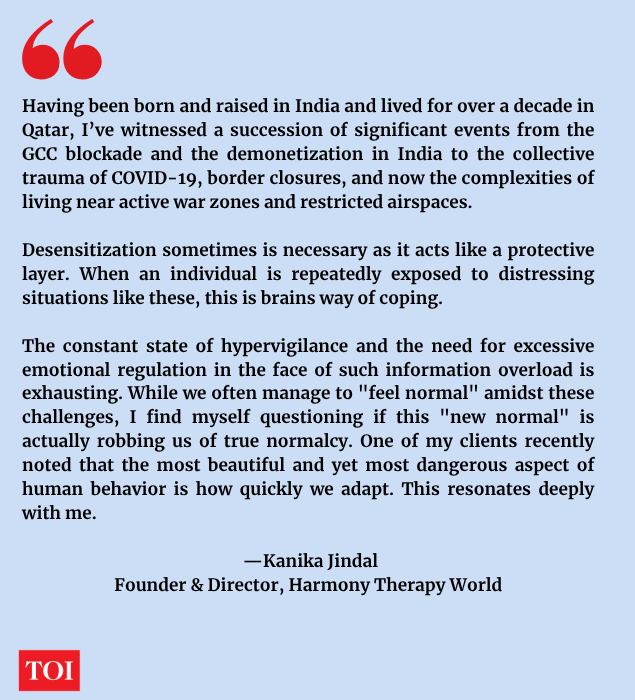
This raises a critical question: is this desensitisation, or is it a form of psychological survival?In many cases, what is perceived as desensitisation is actually a protective mechanism.
The mind creates a degree of emotional distance—what can be understood as a form of “buffering”—to prevent burnout. Without this, continuous exposure to distress could lead to overwhelming anxiety or emotional exhaustion.Kanika Jindal explains this extensively on how continuous “crises” can have massive psychological toll and that the brain essentially has to “normalise it”.
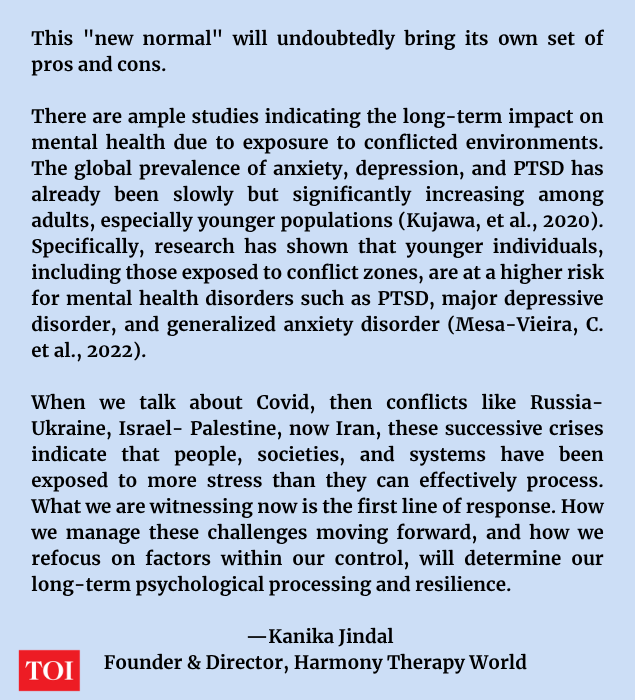
At the same time, this protective adaptation carries a trade-off.
While it helps individuals function in a high-information environment, it can also reduce sustained engagement and emotional responsiveness over time. The line between coping and disengagement becomes increasingly blurred.
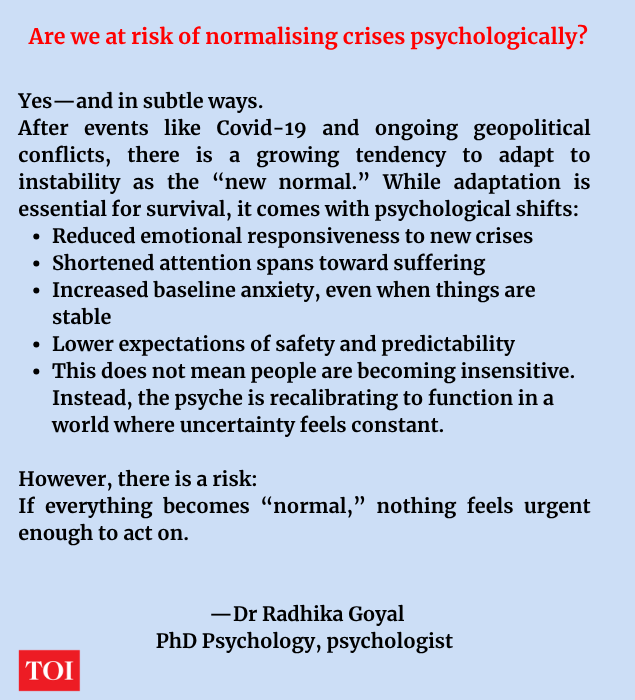
In this context, the psychological response to continuous crises is not a simple loss of empathy, but a complex balancing act—between staying informed and staying emotionally intact.
Crisis fatigue in everyday life
While the psychology explains the why, the lived reality of crisis fatigue is far more immediate. For most people, it is not experienced in big clinical terms, but in small, everyday shifts like how often they check the news, how deeply they engage, and how much they allow themselves to feel.Across responses given to TOI, for most awareness remains high, but emotional engagement is uneven. Many describe feeling overwhelmed by the sheer volume of negative news, while others admit to consciously stepping back—not out of indifference, but as a way to cope. The instinct to stay informed is often in tension with the need to protect one’s mental space. However, an interesting perspective was also shared by a respondent on how the global world order can be seen more than just simple conflicts and more of building a “new world”
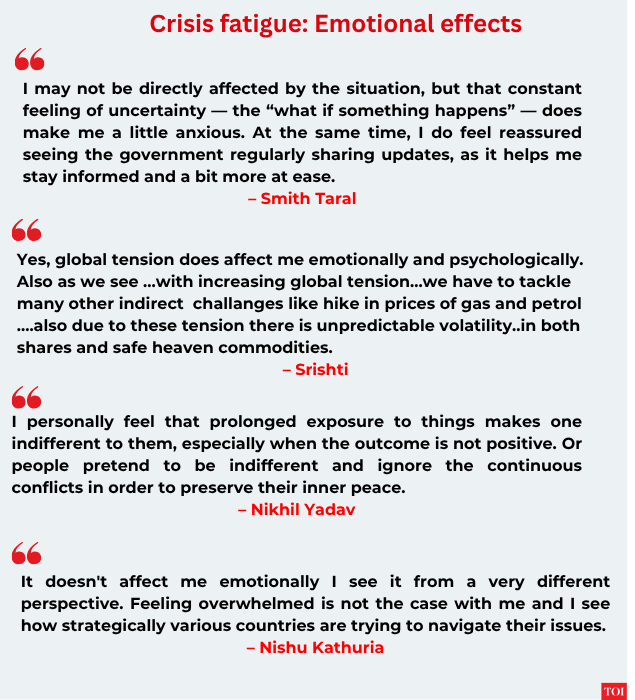
These responses reflect a subtle but significant shift. People are not necessarily disengaging from global events; they are recalibrating how they engage with them. The emotional intensity that once accompanied each crisis is harder to sustain when crises themselves have become constant.In this sense, crisis fatigue in everyday life is less about withdrawal, and more about adjustment—finding ways to remain informed without becoming overwhelmed.
Finding ways to cope
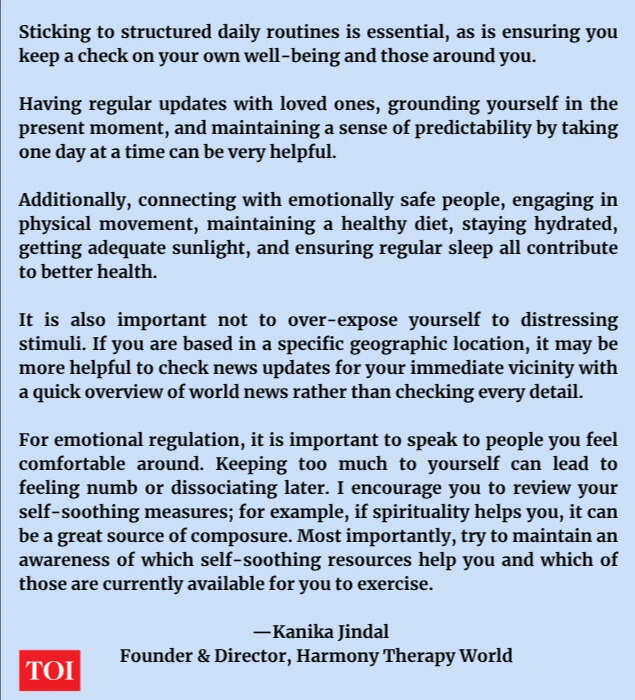
If constant exposure to global crises is straining emotional and cognitive limits, coping becomes less about disengaging entirely and more about managing that exposure in a sustainable way.At a broad level, both psychological insights and everyday responses point toward the same underlying need: creating boundaries.Dr Radhika Goyal explained to TOI, “goal is not to disconnect—but to engage sustainably,” while listing out some strategies for people.
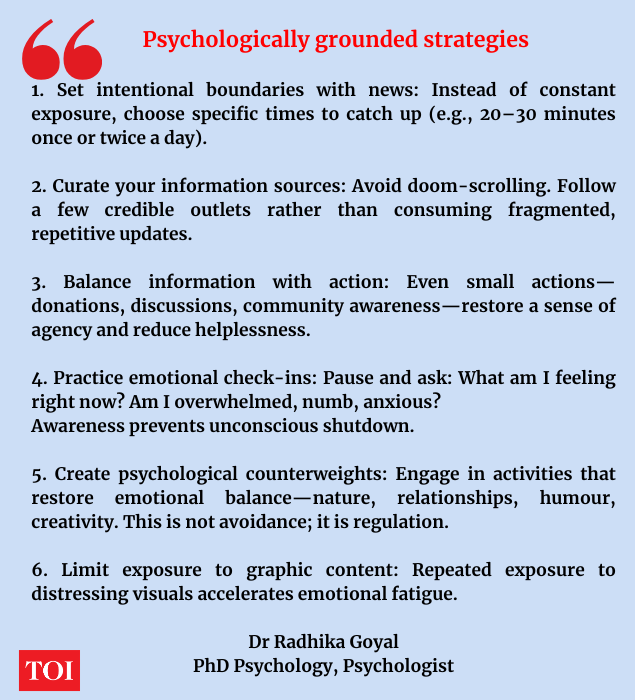
Equally important is the ability to step away without guilt. For many, taking breaks from news is not about indifference, but about preserving emotional capacity. Small shifts—whether it is focusing on routine activities, spending time with family and friends, or engaging in calming practices—help create space for recovery in between periods of engagement, as explained by Kanika Jindal.
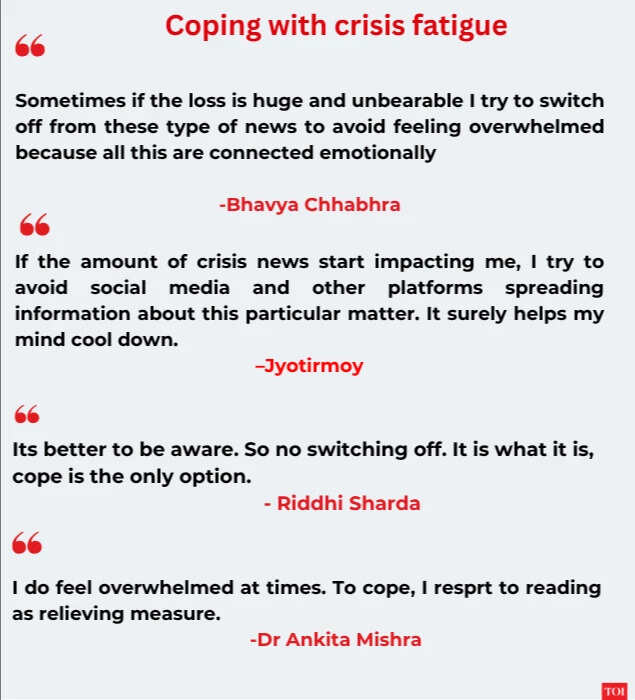
Meanwhile, with people talking to TOI, it was seen that coping with crisis fatigue is less about a single strategy and more about individual calibration between awareness and emotional limits.
While some people consciously disengage, limiting news consumption or stepping away from social media to prevent overstimulation; others choose to stay fully informed, accepting distress as an inevitable part of engagement.
A common thread, however, is the need for regulation: whether through temporary withdrawal, mindful consumption, or alternative activities like reading that provide mental relief.
At its core, coping with crisis fatigue is about balance. It is the recognition that while awareness is important, constant exposure is not always sustainable.
Navigating that balance, between staying informed and staying emotionally intact, has become an essential skill in a world where crises are no longer occasional, but continuous.
A world that asks us to keep adjusting
If crisis fatigue raises difficult questions about empathy and engagement, it also brings the focus back to something more fundamental: how to remain human in a world where distress is not going away.Mental health professionals point out that the challenge today is not a lack of awareness, but the weight of sustained exposure.
As Harmony Therapy World founder Jindal explained, the emotional toll of crises is neither abstract nor distant. She recalled a young Ukrainian woman who, after visiting her war-affected hometown, described feeling “chipped away” by the sight of familiar places reduced to rubble. In another case, a Sudanese-German man evacuated from civil unrest in 2023 continues to deal with post-traumatic stress after surviving an active conflict zone.These are not isolated experiences. They reflect the deeper psychological imprint of crises, especially for a generation that has lived through a pandemic, geopolitical conflicts, and repeated disruptions to daily life. For many, exposure is not just through screens, but through lived or second-hand trauma that can resurface and compound over time.At the same time, experts emphasise the need to rethink how individuals engage with this constant stream of crisis.
Psychologist Dr Radhika Goyal emphasised that not every update demands emotional investment, and that distinguishing between being informed and being immersed is key. She also explained that the burden of global suffering cannot rest on individuals alone, recognising this can ease the pressure to remain constantly engaged.Equally important is reframing disengagement. Stepping back, experts say, is not necessarily apathy but a form of recovery. Sustained awareness requires distance as much as it requires attention. Building what Goyal describes as “psychological literacy”, which means that understanding of concepts like emotional regulation and cognitive overload may be essential in navigating this landscape.Ultimately, crisis fatigue does not signal that people are becoming less empathetic. If anything, it reflects the limits of empathy under continuous strain.In the end, it’s all about caring but not at the cost of yourself!