
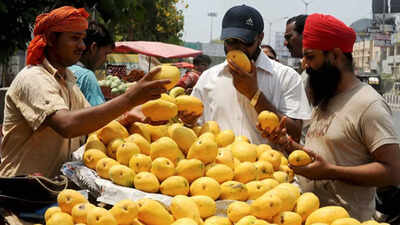
Ever wondered why you can find a Mexican mango in a London supermarket more easily than a Ratnagiri Alphonso? It’s not just about the distance; it’s about a nation that refuses to share its gold.India grows over 1,500 varieties of mangoes and produces over 24 million metric tons of the summer fruit annually. It is the source of nearly half of the world’s supply of mangoes and yet exports only 1% of the fresh fruit. Is it a missed economic opportunity, or just the ultimate flex of domestic demand? While the world craves the “King of Fruits,” India is busy having a 1.4-billion-person private party.This information, while public for years, has recently gone viral all over the internet, leaving global netizens bewildered over the citizens of the country consuming the massive amount of mangoes domestically. “No wonder they all have beautiful skin like milk. Share mango with us please don’t be selfish,” wrote one user on X. “Can you blame them? If I lived in the land of Alphonso and Kesar mangos, my export rate would be exactly 0%. I’m not sending those treasures anywhere,” added another. “We have loads of mango trees in Boca Raton Florida just for instance. We beg people to take them as they fall and rot and attract rodents and other animals.
My sister actually cut her tree down. They are delicious and plentiful but you can only eat so many & no one wanted them,” shared one.
However, Indians on social media platforms were proud to boast of their love for the pulpy fruit. “Can confirm, I eat at least 200 in season,” wrote a user. “110-140 per year is too little. We should start importing,” suggested another. “I alone eat 150-200 mangoes every season” boasted another. “We are not opening Strait of Mangoz” claimed one.
Mangoes and the Indian connection
Mango cultivation in India is believed to have begun thousands of years ago and it is considered to be one of the oldest fruits grown in the country. References to the fruit are found in ancient texts and scriptures like the Vedas and Puranas and over the years, mangoes have transitioned from a mere seasonal fruit to a culturally embedded icon. As soon as the fruit arrives in the markets, it becomes involved in seasonal rituals, family gatherings and religious acts.
From mango shakes for children to mango pickles for the adults and the raw fruit as it is, mangoes are used in diverse forms and dishes across the sub-continent. For Indians, the fruit is an emotion, a memory, that of familiarity, love and the taste of childhood and summer.
The Indian mango market
The Indian mango industry presents one of the most fascinating paradoxes in global agriculture. On one hand, India is a production titan, accounting for approximately 45-50% of global output.
On the other hand, it is a peripheral player in the global fresh-fruit trade.India’s domestic mango market is valued at roughly USD 2.90 billion (2025) and is projected to grow to USD 3.97 billion by 2030. The fruit is produced in numerous states including Uttar Pradesh, Andhra Pradesh, Bihar, Karnataka, Tamil Nadu, Gujarat, Maharashtra, Odisha, West Bengal, Jharkhand, Chhattisgarh, Kerala and more. Nearly half of the country’s mangoes come from two states, Uttar Pradesh and Andhra Pradesh, as per Forbes India.
Moreover, there are diverse varieties that vary in taste such as Langra, Alphonso, Banganapalli, Dasheri, Kesar, and more. With its minimal export outside, India made $60 million in 2024, while Mexico, the largest exporter of mangoes, topped the chart with $575 million in export revenue between 2023 and 2025. This is not a loss for the country, because the 1.4 billion residents create a market for mango so large that the marginal return on its export cannot be compared. Moreover, the logistics of cold-chain shipping a tropical fruit around the world are more complex than selling it down the street. Indian exports face stiff Sanitary and Phytosanitary (SPS) measures. High international freight charges and the requirement for vapour-heat treatment or irradiation (especially for the US and Japan) add high costs, making Indian mangoes a “luxury” item abroad rather than a staple.
“The “less than 1% exported” stat sounds like a failure. It’s actually a demand curve so steep that the rest of the world barely gets a taste,” explained an X user.
India leads the mango pulp market
Interestingly, where India does dominate internationally is in the Mango Pulp market. India is the world’s single largest exporter of mango pulp, accounting for over 55% of global output. The Middle East (UAE, Saudi Arabia) remains the primary anchor for Indian exports, absorbing over 40% of pulp and fresh fruit, followed by the UK and the US.As of now, it seems the mango magic will remain limited to the Indian summer. But of course, there is a chance to travel to the country to get a juicy and fresh bite.