
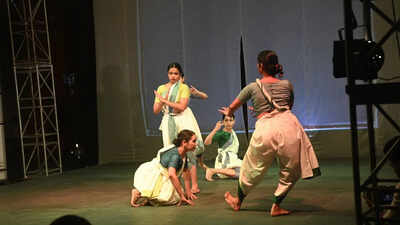
At a time when the city leans into Boishakh with nostalgia, Beral Teral Ityadi offers something more playful, an invitation to step inside Jamini Roy’s world and reimagine it. Conceptualised as part of Jamini Babu-r Jonmodin, celebrating the artist’s birth anniversary and the Bengali New Year-the performance is the first commission under DAG’s Points of Departure programme, directed by dancer-choreographer Vikram Iyengar. But this isn’t a retelling. It’s a response. “We all grow up seeing Jamini Roy’s work,” says Iyengar. “There’s familiarity, but not always understanding. So we wanted to go deeper into his philosophy, his time, and then ask: how do we relate to it today?”
From playful cats to layered questions
The process began with unpacking Roy’s context, his shift from academic styles to a distinctly local, modern visual language shaped by the Swadeshi era.
“We didn’t want to put him on a pedestal,” Iyengar says. “We wanted to engage with his work playfully, even irreverently.” That playfulness comes alive in recurring motifs- fish, birds, and most strikingly, cats. “They’re not realistic, almost like toys,” he says.
“But in that abstraction, you see their essence. So we built a whole ‘cat world’- mischievous, alive.” The performance also turns to Roy’s women, iconic, composed, often frontal. “The moment you turn someone into an icon, you limit what they could be,” Iyengar reflects. “So we asked, what are their hidden lives? Are we looking at them, or are they looking at us?”
A performance that blurs boundaries
Difficult to box into a single form, Beral Teral Ityadi blends dance, design, projection and music. “I prefer to call it a performance,” Iyengar says.
“It’s dance-based, but there’s a lot more happening.” For dancer Sharmila Biswas, the piece felt immersive. “I could see the personalities of cats in the movement. It was a journey, I loved the lighting, the way it evolved.” Others echoed the sentiment. “Fresh and perky, while still rooted in tradition,” said Astrid Wege of Goethe-Institut Kolkata.
Madeleine St John of TRI Art & Culture called it “a beautiful way to bring visual and performing arts together to honour legacy through contemporary formats.” In its final moments, the piece returns to Roy’s bold lines and flat colours- clear, direct, unmistakable. Yet, through movement and imagination, that clarity is gently unsettled. Because this isn’t just about revisiting Jamini Roy- it’s about seeing him anew.

