
- News
- Science News
- Chilling space facts that will stay in your mind long after reading
AA
Text Size
- Small
- Medium
- Large
1/7
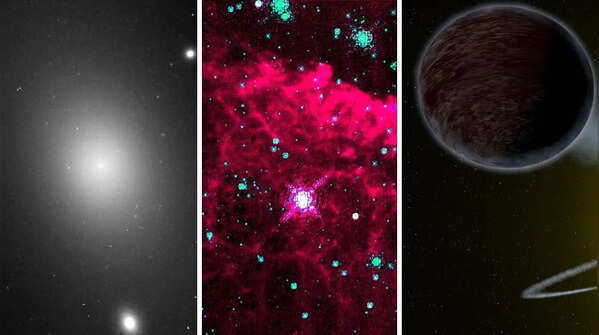
Chilling space facts that will stay in your mind long after reading
Although many people consider the cosmos to be a peaceful, stunning environment, the truth behind its appearance offers an incomprehensible universe with extreme events. For instance, there are the undead stars (or zombie stars) that consume energy from their star neighbours, and there are enormous galaxies that may contain thousands of Milky Ways. Therefore, the universe operates on a scale of existential chaos that defies human intuition. While the night sky looks peaceful, it is a graveyard of ‘Zombie Stars’ and a playground for ‘Galactic Titans’ that challenge the very laws of physics and are impossible to comprehend by human beings.
The most terrible thing is that the more we uncover things about deep space, the more we will find hypergiants that dwarf the Sun and end up drifting in the dark, infinite void of outer space. The facts listed below provide a frightening reality about how vast and incredibly terrifying the universe truly is.
2/7
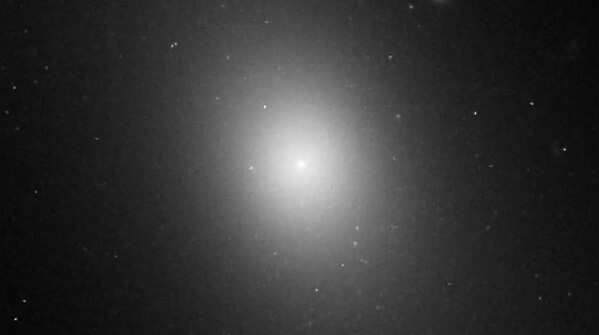
There is a galaxy that is 60 times wider and thousands of times more massive than the Milky Way
The enormous elliptical galaxy IC1101 is located over 1 billion light-years away. The Milky Way measures approximately 100,000 light-years across, whereas the size of IC1101 is around 6 million light-years. There is enough room within the borders of IC1101 to hold thousands of galaxies the same size as the Milky Way, and it has an estimated 10 trillion stars, creating a large, dense, golden mass of old light.
PC: Wikipedia

3/7
There is a dead man on the moon
The lunar surface is also where Eugene Shoemaker (a pioneer of planetary science) was interred. In 1998, NASA sent the Lunar Prospector with a little polycarbonate capsule containing Eugene’s cremated remains to the Moon. When Lunar Prospector finished its successful mission by a planned impact into a permanently shadowed crater at the lunar South Pole, Eugene became the first human to be buried on a celestial body; thus, he will forever gaze down on the Earth from the silent lunar dust.
4/7
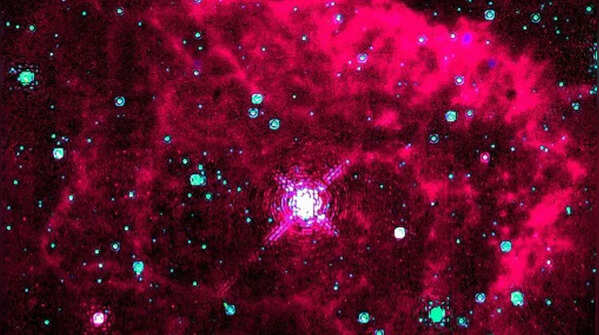
Pistol star is 100 times more massive than the sun
The Galactic Core also has one of the largest stars known; the Pistol Star, which is a blue hypergiant star located at the Galactic centre. It has about 100 times the mass of our Sun, but the real horrifying aspect of the Pistol Star is its luminosity, which is up to 10 million times more luminous than that of our Sun. Because of its incredibly high rate of mass ejection, it has created the visually stunning but very violent Pistol Nebula. If the Pistol Star were placed in our solar system, it would engulf the entire orbital path of the Earth.
PC: NASA Science
5/7
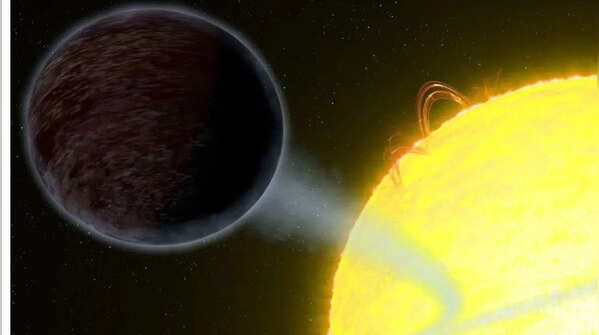
One day, the night sky will turn pitch black
As a result of the accelerating universe’s expanding space due to dark energy, faraway galaxies are moving away from us faster than their light can travel to us. In around 100 billion years, every galaxy outside our local group will have vanished beyond the cosmic horizon. Thus, any future civilisation will look up at a completely dark sky with no knowledge or memory of the existence of other stars and galaxies in their local universe.
PC: NASA Science
6/7
Dead stars can come back to life
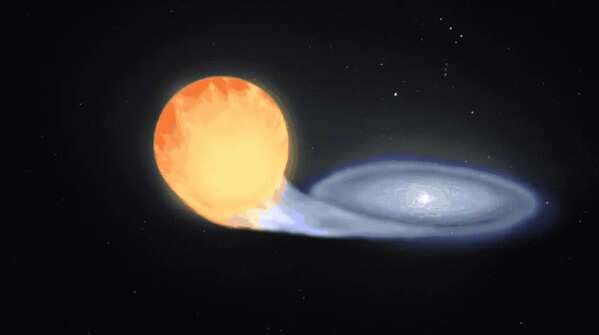
Known as ‘Type Ia Supernovae,’ this occurs when a white dwarf, which is the remnant of a deceased star, reignites as a Type Ia Supernova when it steals the gas from one of its companion stars. This process causes the residual fuel in a dead white dwarf to reignite as a ‘zombie’ star, thus producing an explosive event called a supernova, with brightness exceeding that of galaxies.
PC: NASA Science
7/7
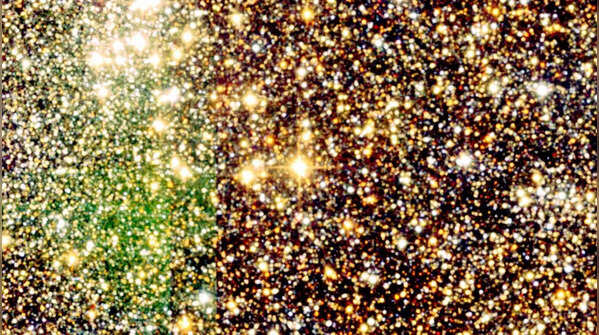
It takes 13 quadrillion Earths to fit into Stephenson 2-18
Stephenson 2-18 is another extremely large star (red hypergiant) and challenges the theoretical limits of stellar sizes and stellar mass. Stephenson 2-18 has a radius of about 2150 times that of our Sun, and is so enormous that you could fit approximately 13,000,000,000,000,000 (13 quadrillion) Earths inside its volume. If Stephenson 2-18 were to replace our Sun, its outer edge would extend to beyond the orbit of Saturn and subsequently consume the entire inner Solar System in a matter of second
PC: Wikipedia
Follow Us On Social Media


