
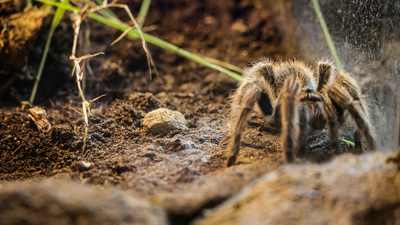
Tarantulas are usually thought to be creatures which just wander through the desert or forest environment. However, tarantulas behave in a much more intelligent manner than is widely assumed.
Tarantulas utilise memory skills, sensory perception, and instinct to thrive in their environments. They are not simply creatures who just wander about randomly; instead, they have particular areas for hunting which they can accurately find and revisit time after time. This is one of the aspects which show just how intelligent these spiders are.
How tarantulas use spatial memory for hunting
Unlike most spiders, the tarantula does not weave a web to catch its victims.
It is an ambush predator whose success is very much based on timing and positioning. According to research into arachnid behaviour, spiders have the ability to cultivate spatial memory, whereby they are able to remember successful hunting sites.One such study conducted by scientists from the journal Animal Cognition showed that some spiders use the environment as guidance, with ground-dwelling spiders exhibiting spatial learning by being able to recognise locations where there is more prey available.
This is a useful adaptation for the tarantula because it prefers to live within burrows and will place itself at certain points around the entrance or paths frequented by insects, ready to pounce when it feels any vibration from its prey.
Why tarantulas don’t wander aimlessly
The common assumption about the tarantula’s tendency to wander about is a misnomer since, despite the dangers of exposure to predators, extreme weather conditions, and the absence of shelter, these animals have devised a survival strategy.According to behavioural ecologists in the research ‘Insights Into Spatial Orientation and Cognition in Tarantulas (Araneae: Theraphosidae) Under Natural Conditions, With Notes on Possible Ontogenetic Niche Shifts’, tarantulas are guided by both their sense of touch and memory. In an article published in the Animal Behaviour Journal concerning the navigational capabilities of spiders, “many wandering spiders exhibit route-based memory, allowing them to return to their shelters following a foraging mission”.It suggests that tarantulas do not just respond to stimuli; instead, they make calculated moves, which revolve around their known shelters and areas where food is plentiful.
The science behind tarantula navigation and intelligence
Even though tarantulas have relatively small brains, they have extremely effective nervous systems. Invertebrate intelligence researchers have proven that very primitive neural organisation enables learning processes and the formation of memory in various animals.One of the main conclusions of the study was that arthropods such as spiders could memorise information related to the environment and use it when necessary.
Therefore, we may conclude that tarantulas are able to think in more complicated ways than was thought earlier.For instance, tarantulas remember places where they could encounter food and avoid dangerous zones where they encountered their enemies. Moreover, after their hunting expeditions, they can find the way back home to their burrows.In other words, the conclusion of this research is that tarantulas are not mindless creatures that move randomly without thinking. On the contrary, these spiders can remember where food is located and plan their further actions accordingly. In this regard, they try to avoid risky situations as much as possible to stay alive and thrive in the wild.