
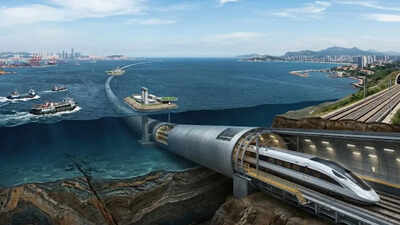
The Bohai Strait Cross-Sea Channel is an ambitious engineering project that will represent a landmark in global civil engineering. This undersea rail tunnel will connect the two major ports of Dalian and Yantai by way of a 120-kilometre-long tunnel constructed beneath the seabed of the Bohai Sea, connecting the Liaodong and Shandong Peninsulas.
Currently, transit is bifurcated for making this trip: an eight-hour ferry ride or a logistically inefficient 1,400-kilometre overland detour through land. The goal of the high-speed rail connection to be built beneath the sea is to reduce this trip to just 40 minutes, as noted in the study in Marefa. Trains will be able to travel at speeds greater than 250 kilometres per hour; therefore, this fixed transit link will facilitate the economic integration of the Bohai Rim and establish its position as a world standard for subsea infrastructure and high-speed logistics.
China proposes 120 kilometer undersea rail Bohai Strait tunnel
When completed, the proposed Bohai Strait tunnel will be the longest subsea rail link in the world by more than double the length of the Channel Tunnel between the UK and France. According to the feasibility reports, the project will have a total length of approximately 123–125 kilometres with an estimated 90 kilometres directly beneath the seabed.The main goal of this project is to logistically transform regional mobility for its users.
Currently, ferries have delays caused by adverse meteorological conditions and have limited capacity. The rail connection will provide an all-weather, high-frequency travel option for users. Trains will operate at high speed and will be able to transport both people as well as vehicles on brand new carriages that will allow for the reduction of the current 8-hour trip down to approximately 40–60 minutes.
Engineering the Bohai Strait across active fault lines
The construction of a large tunnel will need to address significant hydrostatic pressures and complex faulting, as noted in a study at PMC (NCBI).
The Tan-Lu Fault in the Bohai Sea area is one of the most active faults in East Asia. The research on the crust beneath the strait shows that it has considerable lateral variability and extensive stratification; therefore, high-performance Slurry Shield Tunnel Boring Machines (TBMs) will be necessary to operate on an extended basis at great depths.
China’s rail strategy aims to improve access and reduce transport costs
According to the research published in ResearchGate, the Bohai Strait project is a key component of the broader integration approach being taken by the Bohai Rim Economic Zone. With China entering its fifteenth five-year plan (2026-2030), there has been an increased focus on implementing ‘eight vertical and eight horizontal’ high-speed rail systems across China. Economists believe extensive bridge and tunnel projects will reduce Weighted Average Transport Costs (WATC) for the economically less fortunate counties in the northern portion of the Bohai Rim region, thereby enhancing accessibility by linking them directly to the industrial areas of the Bohai Rim.

