
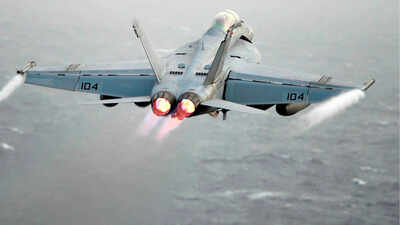
India’s aviation sector is a step closer to manufacture GE F-414 turbofan engines domestically following a technical agreement between HAL and GE Aerospace. This crucial step will power three upcoming fighter jets, including the Tejas Mk-2 and AMCA. The deal promises 80% local production and significant technology transfer, reducing foreign dependency and bolstering India’s self-reliance in advanced aerospace.
The technical agreement between Hindustan Aeronautics Ltd and General Electric (GE) Aerospace has taken the process of manufacturing the F-414 turbofan engine in India a step closer.
The manufacturing of the GE F-414-INS6 is a very critical step in India’s aviation journey as this engine will be at the centre of the three manned fighters the country is working on. The dependable powerplant will power the Tejas Mk-2, the Twin-Engined Deck Based Fighter and for the initial variant of the next-generation Advanced Medium Combat Aircraft (AMCA).With the conclusion of the technical agreement, representatives of both the companies will discuss the commercial aspect of the deal. After the deal is signed, 80% of the powerplant will be produced in the country. GE will also transfer the Intellectual Property of the components India will manufacture, removing India’s dependency on foreign Original Equipment Manufacturers (OEMs)India has been seeking an engine with an output of between 95-100 KN since 2008, as reported by The Hindu back then.
The initial competition was between GE’s F-414 that powers the American F/A-18 Super Hornet and the Eurojet Turbo’s EJ2000. GE was selected and initially the US government gave clearance for 55% Transfer of Technology, much below the 80% ToT, being discussed today.HAL and GE signed an Memorandum of Understanding (MoU), in 2023, to produce the powerful turbofan engine in India. The document was signed during Prime Minister Modi’s visit to the United States.
Many critical aspects of a modern fighter aircraft powerplant such as coating of the hot section of the engine, laser drilling and crystal blades will be included in the tech transfer, as per a report in the Economic Times.As the Indian aviation industry expands and looks to deliver on more complex projects, the sector is taking a very pragmatic approach when it comes to absorbing critical technologies. Partnering with entities that have a proven and deployable system is a practical approach. Theis method also protects the industry from investing money to re-invent the wheel.