
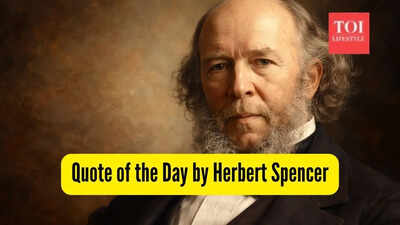
Herbert Spencer was not just a great poet but also a great philosopher and thinker. Even though not many people read him now, he had a big impact on how people thought about evolution, society, and individualism during the Victorian era.
He worked in many areas, including sociology, biology, ethics, and political theory. He was one of the first people to try to come up with a theory that would explain all knowledge.Spencer was born in 1820, in Derby, England, to a family that wasn’t very wealthy. Spencer’s dad was a schoolteacher who believed in individualism and didn’t like authority. These changed the way Spencer thought a lot. Spencer didn’t go to college like a lot of other smart people did.
He learnt most of what he knew on his own by studying on his own. At the beginning of his career, Spencer worked as a civil engineer in England during the time when railroads were growing quickly.
This hands-on work helped him learn to think in a way that’s both analytical and organised. He later became a journalist and writer, writing for magazines like The Economist, where he started to look into social and political issues.
‘Survival of the fittest’ phrase was invented by himOne of his first big books, Social Statics (1851), showed how much he believed in freedom for people and not much government interference. He said that society works best when people are free to do what they want. His most famous work is the multi-volume book The Synthetic Philosophy, which took him many years to write. Spencer used the idea of evolution to try to connect knowledge from different areas.
He said that all systems, like living things and human societies, move from simple to more complex forms.
The phrase “survival of the fittest” was also invented by Spencer. It is now linked to Charles Darwin’s idea of natural selection. Spencer, on the other hand, used this idea in more social and economic situations, saying that competition leads to progress.He believed a lot in individualism. Spencer didn’t like too much government interference because he thought it got in the way of how people naturally interact with each other.
He said that welfare policies and help for the poor could make society weaker by stopping natural selection from happening. Spencer’s philosophy includes the idea of “physical morality,” as shown by his statement that “The preservation of health is a duty.
” He believed that moral responsibility encompasses self-care, as individual health is crucial for societal advancement.People often say that Spencer’s writing is very analytical, systematic, and dense.
He wanted to make whole theories, which made it hard to understand what he wrote sometimes. He used scientific language and abstract ideas to show that he wanted philosophy to be more strict and like the natural sciences. At the same time, his style made him seem very confident and powerful. Spencer wrote as if he thought everyone could use his ideas.
This made his work more intellectual, but it also made it harder for most people to read.Along with Auguste Comte and others, Spencer was one of the first people to study sociology. He helped people see that you could study society scientifically by using ideas from biology and physics. His thoughts changed politics, the economy, and schools. His support for laissez-faire policies changed how people talked about the government’s role and people’s freedom. In the late 1800s, his ideas were very popular with businesspeople and politicians who supported free-market capitalism.
But people also disagree about Spencer’s legacy. People later said that he was wrong to use evolutionary ideas to explain society because they thought they supported unfairness and inequality. People who didn’t like his ideas said they could be used to justify not caring about the needs of the weak and poor.In the 20th century, Spencer’s reputation went down as new ideas in biology and sociology came out. People began to doubt the idea that competition and natural selection were the only things that could explain how society got better.
His ideas are still very important in the history of ideas, though. His attempt to create a unified theory of knowledge was ambitious and had an effect, but it wasn’t completely successful.
He played a big role in making evolutionary ideas more popular outside of biology and in shaping early sociological thought. He died in 1903. Spencer’s ideas about sociology, politics, and the philosophy of science are still very important, even though people don’t agree with them in their original form anymore.
People still talk about how his work connects science, society, and moral responsibility. This guarantees his place in the history of modern thought. People often say that Spencer’s writing is very analytical, systematic, and dense.
He wanted to make whole theories, which made it hard to understand what he wrote sometimes. He used scientific language and abstract ideas to show that he wanted philosophy to be more strict and like the natural sciences.Quote of the Day“The preservation of health is a duty. Few seem conscious that there is such a thing as physical morality”These iconic lines by Herbert Spencer deliver a simple message. It is a duty to take care of one’s health. Few people seem to know that there is such a thing as physical morality. This shows that taking care of one’s health is not just a choice or preference but a moral duty. It implies that our moral behaviour has a lot to do with our physical health, and not taking care of it can be seen as a moral failure.
At its heart, the idea goes against the common view that health is something that can be put off or is not important.
A lot of people put work, comfort, or short-term pleasures ahead of their long-term health and happiness, and they often don’t think about how unhealthy habits affect them. The phrase “preservation of health is a duty” says that keeping good health should be seen as a duty, just like being honest or kind, because it affects not just the person but also society as a whole.The idea of “physical morality” is very important. Fairness, honesty, and compassion are all moral actions that affect other people. But this statement broadens the idea of morality to include how we care for our own bodies. It means that living a moral life includes taking care of your health by eating well, exercising, getting enough sleep, and staying away from bad habits. It is wrong to hurt other people, and it is also wrong to hurt yourself on purpose by not taking care of yourself or making bad choices.
The statement also says that “few seem conscious” of the link between health and morality, which shows that people aren’t aware of it. The idea, in a broader sense, promotes self-respect and discipline. To take care of your body, you need to be consistent, work hard, and pay attention. It shows that you care about yourself and know that your body is important for doing your duties and responsibilities in life. Finally, the statement calls for a change in how we think about health, from seeing it as a personal luxury to seeing it as a moral duty. It calls for more awareness of how our health choices are not just personal ones, but also ethical ones that affect both our own health and the health of others.