
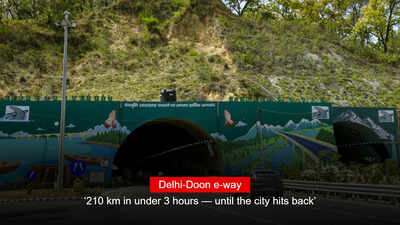
The defining moment came at Mohand, once the route’s most dreaded bottleneck. Earlier, this stretch meant unpredictable jams lasting 35–40 minutes or more.
DEHRADUN: At 1:30 pm on a warm Wednesday afternoon, hours after the Delhi–Dehradun Economic Corridor was inaugurated by PM Modi, I rolled out of Asarodi, Dehradun’s entry/exit checkpoint, to test the much-touted expressway.
Billed as a “game changer,” it promises to cut travel time from five to six hours to about two and a half. I wanted to see if that held true on a regular weekday.Less than three hours later, at 4:15 pm, I was near Akshardham in Delhi, despite brief halts. What once took several hours was done in under three. The 2.5-hour claim felt almost real—at least for large stretches.The defining moment came at Mohand, once the route’s most dreaded bottleneck.
Earlier, this stretch meant unpredictable jams lasting 35–40 minutes or more. This time, I crossed it in 12 minutes, thanks to the 11-km elevated wildlife corridor along the Shivaliks. Smooth, uninterrupted, and built 6–7 metres high to allow animal movement, it includes eight animal passes, two 200-metre elephant underpasses, and a 370-metre tunnel near Daat Kali temple.Saurabh Singh, project director, NHAI, later told me construction of this stretch was challenging, with a large part of the corridor built over a riverbed and work limited by risks of flash floods during monsoons, and wildlife presence at night.
However, accessing the expressway isn’t seamless yet. Near Gagalheri in Saharanpur, vehicles must take a left exit – easy to miss due to incomplete signage. Once on it, though, the 125-km stretch is wide, straight, and surprisingly empty.
Low traffic owes partly to navigation apps not fully integrating the route yet. NHAI has written to Google to fix this.The biggest gap, I felt, is supporting infrastructure. Around 2:45 pm, I stopped at a designated rest area – still under construction.
Across the 120-km stretch, there are no functional petrol pumps, eateries, or proper restrooms. At one under-construction wayside amenity near Baghpat, a contractor told me the facilities could take another 2-3 months to become fully operational. Near Delhi, after the Loni toll plaza, traffic builds up as vehicles from Ghaziabad and nearby places merge onto the highway. The character of the road changes – two-wheelers appear, speeds drop slightly, and the final 20-minute stretch towards Akshardham feels closer to the old reality of Delhi traffic.
I began the return journey at 4:30 pm. The drive back mirrored the onward trip – smooth and largely uninterrupted.
Even with two short breaks of five to six minutes each, I was back at Asarodi by 7:20 pm.But the story doesn’t end at the highway exit. In fact, that’s where the real struggle began. After covering 210 km in under three hours, it took me nearly an hour to travel the final 14 km to my home in Dehradun. Evening traffic within the city was thick, slow-moving, and unforgiving.
The contrast was jarring. The expressway had compressed distance and time in a way that felt transformative. But the gains quickly evaporated as I entered the city’s congested arteries.So, is the Dehradun-Delhi Expressway a game changer?Yes – with caveats.Missing wayside amenities, speed check cameras yet to function, gaps in map integration, and weak enforcement in parts — all need attention. More importantly, the urban choke points at both ends-especially in Dehradun-threaten to blunt the time advantage the expressway creates.For now, the expressway feels like a glimpse of what India’s road travel can be-fast, smooth, and predictable. Just don’t measure the journey doorstep to doorstep. At least, not yet.