
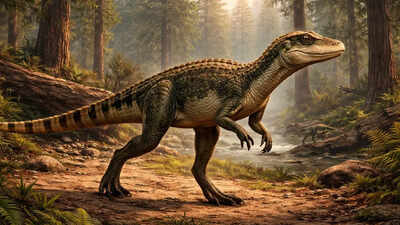
The naming of Sonselasuchus cedrus represents scientific findings that shed light on the diversification of reptiles belonging to the crocodile lineage in the Late Triassic Era, which occurred approximately 215 million years ago.
Fossils of Sonselasuchus cedrus have been found in the Chinle Formation of Arizona and studied in depth by scientists who used specimens of several individuals. According to a study published in the Journal of Vertebrate Palaeontology titled “Osteology and ontogenetic changes in the shuvosaurid archosaur Sonselasuchus cedrus from the Upper Triassic Chinle Formation of Arizona,” the species shows distinct anatomical features, particularly in its limb proportions and skull structure. The features suggest adaptation to land-based living. Changes in movement observed throughout ontogeny, early archosaurs developed different locomotor strategies in prehistoric ecosystems.
Discovery of Sonselasuchus in the Chinle formation
Sonselasuchus cedrus is a fossil animal that has been discovered in the Petrified Forest National Park of Arizona. The fossils of Sonselasuchus cedrus have been unearthed in the formation of Chinle, which contains fossils dating back to the Late Triassic epoch.The excavation project started in 2014 and resulted in the discovery of a significant number of fossils (more than 950) belonging to Sonselasuchus cedrus, comprising a minimum of 36 individuals.
Since the fossils comprised bones of all body regions, both young and mature members of Sonselasuchus cedrus could be studied.
Anatomical features of Sonselasuchus as a crocodile-line reptile
The genus Sonselasuchus is categorised as part of Shuvosauridae, a suborder of the Pseudosuchia order. Some of the features of Sonselasuchus distinguish it from modern crocodiles. For example, it possessed long hind limbs and a light bone structure with large eye orbits.Moreover, Sonselasuchus lacked teeth and may have had a beak-like jaw structure instead.
Although this characteristic appears similar to features found in some dinosaurs, phylogenetics demonstrates that Sonselasuchus is not a dinosaur. The similarity is due to convergent evolution between the lineages.
Locomotion and growth pattern in Sonselasuchus
According to the fossils found by scientists, the locomotion pattern of Sonselasuchus was transformed as it grew into maturity. The young Sonselasuchus was considered to be a quadruped because it moved using all four of its limbs.
However, the adult specimen of Sonselasuchus showed signs of locomotion that could be attributed to bipedalism.This change can be attributed to changes in limb ratio as the creature matured. The hind limbs grew stronger and longer than the forelimbs of Sonselasuchus. This led to an alteration of the centre of mass position for the animal.
Evolutionary significance of sonselasuchus
The research on Sonselasuchus suggests that crocodilian reptiles possessed a larger variety of body shapes and modes of locomotion in the Triassic era compared to their descendants. The creatures belonging to the Shuvosauridae lineage were found in the terrestrial environment and had adaptations for an earth-based way of life.The fact that the creatures from the above-mentioned lineage possessed such characteristics as bipedalism and toothless jaws means that the aforementioned characteristics were acquired in more than one lineage of archosaurs.


