
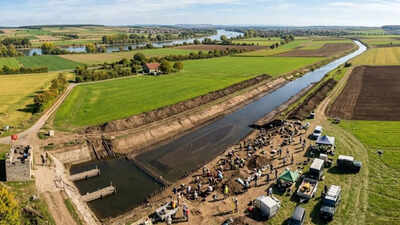
In the German region of Groß-Gerau, archaeologists have discovered a large, engineered canal. Using geophysical remote sensing methods, it has been established that the canal was built in the 4th century during the reign of Emperor Valentinian I.
This artificial waterway (15 meters in width) was used as a means of high-speed military logistics moving goods between the Rhine River and the Fortified Landing Station at Trebur-Astheim.Unlike other Roman ruins, there is evidence to suggest that the canal underwent a final re-excavation for many centuries after the fall of the empire. Such trade routes are thought to have existed into the early Medieval period.
This significant discovery will lead to a reexamination of Roman hydraulic engineering practices, as well as military strategy on the frontier of the empire; specifically, the extent to which the empire was able to manipulate the landscape and utilise its advantages.
Roman superhighway found hidden beneath German farmland
According to the journal Land, an artificial canal that is 15 meters in width and 2.5 meters deep has been discovered, located near Trebur-Astheim.
To assist in fast-moving Roman patrol boats and heavy freight movement between military forts by bypassing the unpredictable, winding curves of the ancient Rhine, this Superhighway was constructed for this purpose.
Rome’s solution to Germanic threats
The purpose of the canal was to link the Rhine with a burgus (a small Roman fortified landing station). The canal was constructed under the orders of Emperor Valentinian I (364-375AD) as part of a larger defensive program to secure the borders against the threat posed by the Germanic tribes.
The building of the canal established a vital link for troop movement and the transportation of resources.
Core samples reveal a masterpiece of Roman civil engineering
Although Roman aqueducts are quite common, there are very few navigable canals constructed to this scale in Northern Europe. Soil analysis and core sampling suggest that the canal was not a repurposed natural stream but rather a specially designed trench with a flat bottom and sloped banks to accommodate the draft of heavy freight vessels (navis oneraria) caused by the wakes of ships.
Radiocarbon dating reveals centuries of post-Roman maintenance
As noted in the research journal Land, organic materials retrieved from sediment in the canal were radiocarbon dated, showing that after the Roman administration ceased to exist, the canal was not abandoned but rather continued to be used and maintained until the 7th to 8th century AD. This canal played an important role as a means of transportation for both the Merovingian and Carolingian dynasties.