
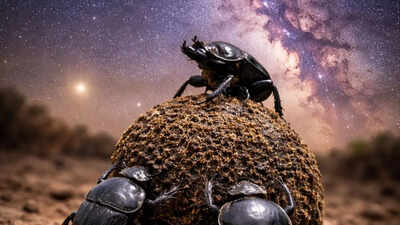
That such a small insect might be able to navigate according to the night sky would be a rather improbable claim, but the fact remains that dung beetles are capable of just this very feat.
It has been proven that the dung beetles are able to navigate according to the pattern of stars of the Milky Way galaxy, thus becoming the first animals known to be capable of such sophisticated means of navigating the world. Such a discovery sheds more light on the way in which animals navigate. The survival of the dung beetle depends on its capacity for accurate movement; therefore, this speciality should not come as a surprise.
How dung beetles use straight-line navigation to avoid competition
The environment that the dung beetles operate in is one of high competition. The moment they come across the droppings from animals, they roll it up in a ball and begin rolling them away from the pile of dung as fast as possible. This behaviour is important if they are to survive. In most instances, many beetles gather around the dung. These beetles prefer stealing dung balls from other beetles instead of making new ones.
It is for this reason that beetles need to follow a straight path when moving. A dung beetle will need to start all over again once it loses the dung ball. Time and energy are wasted in this process. This makes it easier for them to ensure successful reproduction.
How beetles navigate during the day
When it comes to daytime travel, the dung beetles utilize the Sun as an aid in guiding their movements. The beetles make use of polarisation patterns of light, which are formed around the sun in the sky.
Humans cannot see these patterns of light. The beetles have unique receptors in their eyes, through which they are capable of detecting such light. It enables them to maintain an angle that helps them move in a straight line.
How navigation works at night
In darkness, all those means become useless. While the light from the Moon may be an alternative, it cannot be relied upon since it is not always present and does not send out strong signals. Scientists decided to look into the issue by using nocturnal species of the dung beetle, such as Scarabaeus satyrus.
Scientists noticed that, even without moonlight at night, the beetles would continue to orient themselves properly in straight lines.
Therefore, there had to be other ways for the insects to find their bearings. A series of experiments was run in order to explore the issue further. Outside, the bugs kept navigating accurately with full starry skies. When put in a planetarium, they exhibited similar behavior with the help of artificial stars.When they were shown only the bright stripe of the Milky Way, the bugs would remain oriented.
Why seeing the sky is crucial for these insects
To validate their findings, the researchers conducted more experiments by depriving the beetles of sight of the skies. The researchers put tiny caps on the heads of the insects so they would be prevented from sensing any form of celestial light. In such cases, it was observed that the beetles lost their ability to move in straight lines, becoming erratic in their motion. This showed that the visual cues from the sky were essential for navigating.
The experiment also proved that they did not depend solely on earthly clues to navigate.

