
Welcome back to another edition of My Take 5. This week we are covering the situation in the Strait of Hormuz, historic elections in Hungary, polls in Bulgaria, Ukraine’s robot army, and the Baltic states’ principled stance against Russian aggression.
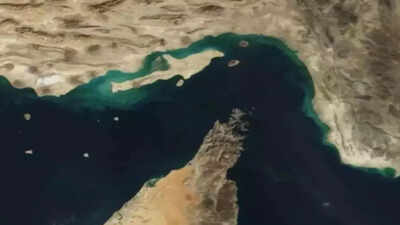
So let’s get to it.Hormuz opens and then shuts again: What a difference a week can make. Just a week ago, US-Iran talks in Pakistan failed to produce a breakthrough for the Iran war. Trump then announced a counter-blockade of Iranian ports to Iran’s blockade of the vital Strait of Hormuz since the beginning of the war. And this past week, since the US blockade went into effect, Iran first announced that the Strait of Hormuz was completely free for civilian and cargo traffic.
It linked this to the now-announced ceasefire between Israel and Lebanon.Trump, however, said that the US blockade of Iranian ports would remain in place till a full peace deal with Iran was worked out. He has also touted another round of talks with Iran, and appeared to be bullish about a deal soon. But as they say, it’s not over till it’s over. And with the US navy turning back Iran-linked ships trying to exit the Gulf of Oman, Tehran reversed course and closed up Hormuz again.
This time Iran’s IRGC fired on two India-flagged ships, compelling New Delhi to lodge a protest and summon the Iranian ambassador.But the thing to point out here is that the US blockade of Iranian ports appears to be working. US cleverly positioned its intercepting naval assets in the Gulf of Oman instead of Hormuz or the Persian Gulf. That kept them away from potential Iranian retaliation because Iran’s warships have all been destroyed, and Tehran only has small boats left.
Those can neither travel as far as to the mouth of Gulf of Oman or Arabian Sea where the interception is happening, nor can they pose any danger to massive US destroyers.Thus, at least 13 ships sailing from Iranian ports – including those carrying Iranian oil – were intercepted and turned back by the US navy. But things have now gone up a notch. After Iran declared the Hormuz closed again, US navy shot at, boarded and seized an Iranian-flagged cargo ship.
Tehran has vowed to retaliate to this and is not yet committing to a second round of talks with the US in Pakistan.Plus, if the US blockade continues, it puts serious economic pressure on Iran’s economy, which has already been battered by the war. Note that throughout the conflict, Iran was able to push out its oil, and the US even gave Iranian oil already at sea a waiver. But that waiver is not being extended and Iranian ports remain blockaded.
This, one can imagine, is putting a serious squeeze on Iran. On the other hand, Iran now loses the moral high ground by interdicting ships from other nations going to and fro through Hormuz to non-Iranian destinations.This then comes down to a game of patience and endurance. Oil prices are likely to keep trending up as long as Hormuz remains closed. That’s neither good for Iran and US, nor for the world. Who can bear the pain more before they crack? Orban out: In a massive election result for Europe, Hungary’s long-time strongman Viktor Orban was finally ousted from power in elections last week. Orban’s Fidesz party was crushed in the parliamentary polls, with Peter Magyar’s Tisza party securing a two-thirds majority. Magyar has promised to completely overhaul theHungarian system, dismantle the regime that Orban had created, including dissolving the state broadcaster, reforming the judiciary, investigating corruption, and creating free, independent institutions, including in media and education.This is a massive blow to conservatives the world over because Orban was the poster boy of the neo-conservative political movement and hosted many conservative conventions, including the American CPAC, with Hungarian taxpayers’ money. Orban’s Hungary had become a laboratory for conservative electoral technologists. Many of the policies and tactics Orban’s regime introduced in Hungary were exported to other countries to strengthen the conservative movement.
Note that Trump endorsed Orban in the Hungarian polls, with JD Vance even making a trip to Budapest just before the election.The other loser is Putin because Orban was practically a Putin surrogate. He kept cosying up to Putin despite European sanctions, and not just to secure Russian oil and gas for Hungary. He kept blocking European sanctions packages against Russia, and support packages for Ukraine. And his foreign minister was caught passing on European documents to Russian foreign minister Lavrov, and even working to remove sanctions on families of Russian oligarchs.
And towards the end, relations between Orban and Ukraine’s President Zelenskyy had really soured.With Orban gone, and Magyar saying no one should tell Ukraine (the victim of the war) to give up territory, or under what conditions it should enter peace negotiations, there is optimism that relations between Kyiv and Budapest are slated to improve. But reversal in Bulgaria: Elections in Bulgaria saw a big win for its pro-Russia former president Rumen Radev.
The latter advocates for closer ties with Moscow and resumption of Russian energy flows into Europe. While it remains to be seen how much Radev toes Kremlin’s line, it would be unwise for Sofia to take a confrontationist position against Brussels – Bulgaria just adopted the Euro in January. Within EU, Bulgaria is seen as a country that’s in much need of reforms.
Thus, it would be better for Sofia to work with Brussels rather than look to Moscow.Ukraine keeps fighting: Despite all the attention to the Iran conflict, Russia’s war against Ukraine continues. In the 24 hours between April 14 and April 15, Russia launched 44 missiles and 659 drones at Ukrainian cities, resulting in several fatalities and casualties. These included four fatalities in Kyiv, three killed in the Dnipro region, and nine fatalities in Odesa. In fact, the war in Iran has accentuated the air defence shortage for Ukraine with President Zelenskyy admitting the connection.
With the Iran conflict, US now has a convenient excuse to delay or withhold transfer of US weapons for Ukraine even under the PURL programme paid for upfront by European Nato members.Add to this the temporary boost in Russian oil revenues – which Moscow uses to fund its aggression against Ukraine – due to the Iran conflict. Therefore, Ukraine has no choice but to keep fighting with whatever it has. In this regard, Ukraine’s innovation on the battlefield has been amazing. And last week came the news thatUkrainian forces had taken over a Russian position exclusively with unmanned systems – a first in any warfare.
In fact, the Russian soldiers in the captured position surrendered to Ukrainian UGVs and UAVs. This is truly amazing and shows Ukraine’s ingenuity and innovation. If Ukraine can use unmanned systems to push back the Russians and protect its own soldiers by keeping them in the rear, that would truly be a gamechanger and reverse the numerical advantage Russia has.Baltic states block Fico’s flight: All three Baltic states, Estonia, Latvia and Lithuania, have again withheld permission for Slovak PM Robert Fico’s flight transit to Russia via their airspace on May 9 for Moscow’s Victory Day parade. All three had done the same last year as well. This is in solidarity with Ukraine against whom Russia continues its full-scale aggression. As Estonia’s foreign minister Margus Tsahkna said, no country would be allowed to use Estonian airspace to boost ties with Russia as long as Moscow continues to wage war against Ukraine.
The Baltic states have solidly stood behind Ukraine since Day 1 of Russia’s full-scaleinvasion. And they continue to adhere to that principle.