
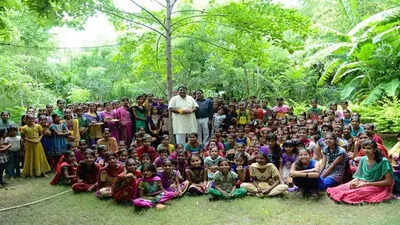
In Piplantri, a small village in Rajasthan’s Rajsamand district, the birth of a girl does not arrive as a quiet family event. It arrives like a community announcement. Neighbours gather, saplings are prepared, and the child is welcomed with a ritual that links her life to the life of the land around her.
What began as one father’s grief has become one of India’s most striking examples of how a village can rewrite its own social script, tree by tree and daughter by daughter. Scroll down to read more…
A father’s grief, turned outward
The story begins with Shyam Sunder Paliwal, the former sarpanch of Piplantri. After the death of his daughter Kiran, he turned private loss into public action. The village’s official platform says he started the tradition in 2007, planting 111 trees for every girl born in the village; earlier reporting showed the practice taking root in the mid-2000s and quickly becoming a defining local custom.
Either way, the idea was simple and radical at once: a daughter would not be met with mourning or anxiety, but with green life, community support and a visible sign that she mattered.
How the ritual works
The ceremony is more than symbolic. According to reporting from The Hindu and the village’s own site, villagers plant 111 trees when a girl is born, and the community ensures those saplings survive as she grows. The trees are not ornamental extras; they are meant to root the child’s arrival in a broader promise of care.
The village also sets aside money for the girl’s future. Earlier reports said Rs 31,000 is collected through a mix of family and community contributions, with the amount placed in a fixed deposit; the official site says that this support is linked to the Kiran Nidhi Yojana and invested under the PM Sukanya Samriddhi Yojana until age 20.
From bare land to a green commons

The environmental impact is impossible to miss. Early reports noted that within the first six years of the initiative, Piplantri had already planted more than a quarter million trees.
By 2018, international coverage indicated that the number had crossed 350,000. The village’s own website now also states that over 350,000 trees have been planted under the 111-tree tradition. In a place once described as drought-hit, the afforestation drive has not only changed the visual landscape but also reshaped the village’s relationship with water, soil and survival.
According to the official site, the large-scale planting has helped improve groundwater levels and soil fertility, showing how a social movement can gradually produce ecological change as well.
Why the idea spread
Piplantri’s deeper significance lies in what it challenged. In the early reporting, Shyam Sunder Paliwal said many families were reluctant to accept girl children, reflecting the larger gender bias that has long shaped parts of rural India. The village responded with a system that combined ritual, accountability and economic support. Families were asked to commit to educating their daughters, not marrying them off before legal age, and caring for the trees planted in their name.
Over time, that practical arrangement helped shift the emotional climate too, making the birth of a girl something to celebrate publicly rather than hide privately.
More than a plantation drive

The model did not stop with trees. Reports on the initiative note that villagers also planted aloe vera around the commons to protect the saplings from termites, and those plants later developed into a small livelihood opportunity through aloe-based products such as juice and gel.
The village’s official site similarly describes the effort as part of a broader ecosystem that supports women’s empowerment, skill development and a local green economy.
The significance lies in the structure behind the idea: the effort is not just a symbolic celebration but a system designed to support girls, families and the land at the same time.
Recognition, but also a reminder
Paliwal’s work eventually drew national recognition. The Ministry of Home Affairs listed Shri Shyam Sundar Paliwal among the Padma Shri awardees in 2021 for social work.
But awards are only the headline version of the story. The real achievement is slower and less glamorous: a village that made dignity routine. Piplantri’s model shows that when a community chooses to attach value to girls at the moment of birth, the effect can ripple far beyond one household.
It can reshape habits, language, economics and even the land itself.
The larger lesson
Piplantri is not a miracle untouched by difficulty. It is a village that made a deliberate decision, then kept making it again and again until the choice became culture. That is what gives the story its force. A daughter’s birth became a reason to plant, to save, to educate and to invest in the future. In a country where girls have too often been treated as a burden to be managed, Piplantri offers a harder, better answer: celebrate them publicly, support them materially and let the community grow around that promise.