
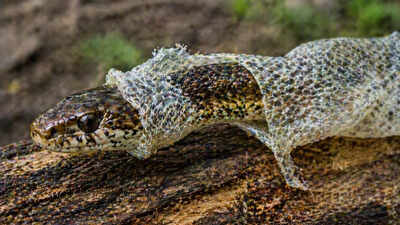
Snakes are famous for the phenomenon of complete skin removal without leaving any fragments behind, a practice that raises interest and questions among people. While in the case of humans, the process of renewal is gradual, snakes go through an entire renewal process, called ecdysis, which takes place on a regular basis.
For snakes, it is vital for development and existence. From biological studies, it is known that shedding of the snake’s outer layer is caused by the inability of this layer to adapt to changes in body size, as well as helps them to get rid of parasites and old scales. The study “Structure, Development, and Evolution of the Reptile Epidermis”, published in the Journal of Developmental Biology, explains that reptile skin is made of layered keratin that requires periodic renewal through shedding.
How skin shedding helps snakes grow and stay healthy
The reason why snakes undergo shedding is that the layer of skin they have does not expand with the expansion of their body size. When a snake gains mass or grows in size, the skin layer underneath its present skin is formed. The existing skin becomes tight, and then it sheds for more development.Skin shedding also acts as a health maintenance process, since it helps get rid of mites, dirt, and damaged skin. This makes the snake regain its natural skin colour, since its colour appears dull before skin shedding.
The process of snake skin shedding
The first step in the process is the formation of new skin under the existing skin. Due to the accumulation of fluids in the region, separation of the two layers takes place. During this period, the skin loses its shine, whereas the eyes turn blue or white as a result of the fluid build-up.During the shedding process, the snake scrapes its skin on rough surfaces such as rocks and tree bark to create an opening in front of its head to shed off the skin.
Generally, the entire skin is usually left intact during this process.
How often do snakes shed their skin
This shedding depends on the age, type of snake, and its environment. The young snakes shed skin quite frequently, mainly because of the fast development rate, and this occurs about every couple of weeks. On the other hand, adult snakes shed their skin infrequently and about a few times per year.Environmental factors also play a critical role in skin shedding. As per the research, “Complexity in the timing of the first postnatal ecdysis in snakes,” published in the Journal of Experimental Biology, shedding periods may differ considerably based on environmental conditions, especially among newborns.
Inappropriate environmental conditions might result in improper shedding.
What shedding reveals about snake biology
Reptile shedding represents another fundamental distinction from the mammal group. In contrast to mammals that constantly shed skin cells, the snake sheds its skin once. That way, it can preserve the barrier function while growing.This is also an illustration of the evolution of snakes into various habitats. It enables them to be flexible, less vulnerable to infections, and adapt to different settings.
Why is this shedding process important
The shedding process plays a vital role in a snake’s life. It helps in its growth, the elimination of harmful organisms, and the proper functioning of its skin. Otherwise, snakes will find it hard to grow and develop their skin.Shedding gives insights into the life of reptiles and their adaptation process. The process proves that any small biological process could be very important in the life of an organism.