
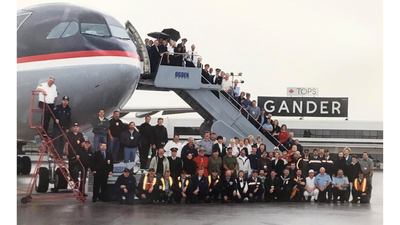
Passengers disembark a diverted flight in Gander as part of Operation Yellow Ribbon after US airspace was closed on 11 September 2001.
When the September 11 attacks unfolded, US airspace was abruptly closed, forcing transatlantic flights to divert. Among the locations that received them was Gander, where 38 aircraft carrying roughly 6,700 passengers and crew landed within hours.
With a population of about 10,000, the town faced an immediate logistical challenge. Over the next four to five days, residents organised shelter, food distribution, transport, and medical support for thousands of stranded travellers. The events in Gander became one of the most documented examples of large-scale civilian response during an aviation emergency.
When 9/11 forced 38 flights to land in a small Canadian town
Following the closure of US airspace on 11 September 2001, Canadian authorities initiated Operation Yellow Ribbon to manage inbound international air traffic.
More than 200 flights were diverted to airports across Canada, including Halifax, Vancouver, and Gander. Aircraft were directed to land at the nearest suitable airport with capacity.Gander International Airport handled 38 diverted flights, including wide-body aircraft such as Boeing 747s and Airbus A330s. Many originated from Europe and were en route to major US cities. The airport’s long runways, originally built for transatlantic refuelling, allowed it to accommodate multiple large aircraft at once.
Planes remained on the tarmac until security clearance was completed and onward travel became possible.The arrival of approximately 6,700 passengers and crew increased the town’s population by more than 60 percent within hours. Municipal authorities coordinated with emergency services, schools, and local organisations to establish temporary accommodation. Public buildings, including schools, churches, and community centres, were converted into shelters equipped with cots, blankets, and sanitation supplies.
Passengers were processed in phases and transported to these sites after security checks.
The scale of local support
Local volunteers organised food distribution systems capable of serving thousands of meals each day. Donations included food, clothing, and essential supplies, while ice rinks were used to store large quantities of perishable items.Pharmacies worked with medical teams to provide prescription medications, including replacements for those left in checked luggage.
Healthcare services addressed both routine and urgent needs. Communication systems were arranged to help passengers contact family members during a period when international communication was limited.Transportation was managed through school buses and municipal vehicles running continuous routes between the airport and shelters. Local radio stations played a key role in coordinating volunteers and sharing updates.
Four days that built lasting connections
Passengers remained in Gander until US airspace reopened on 13 September 2001, with departures staggered over the following days. During their stay, structured systems were in place for meals, clothing distribution, and communication.Travellers from multiple countries created a diverse temporary population. Volunteers helped address language barriers, while religious and dietary needs were accommodated through coordination with local institutions.After leaving, many passengers and residents exchanged contact information. Reunions were later organised, including anniversary gatherings in Gander.
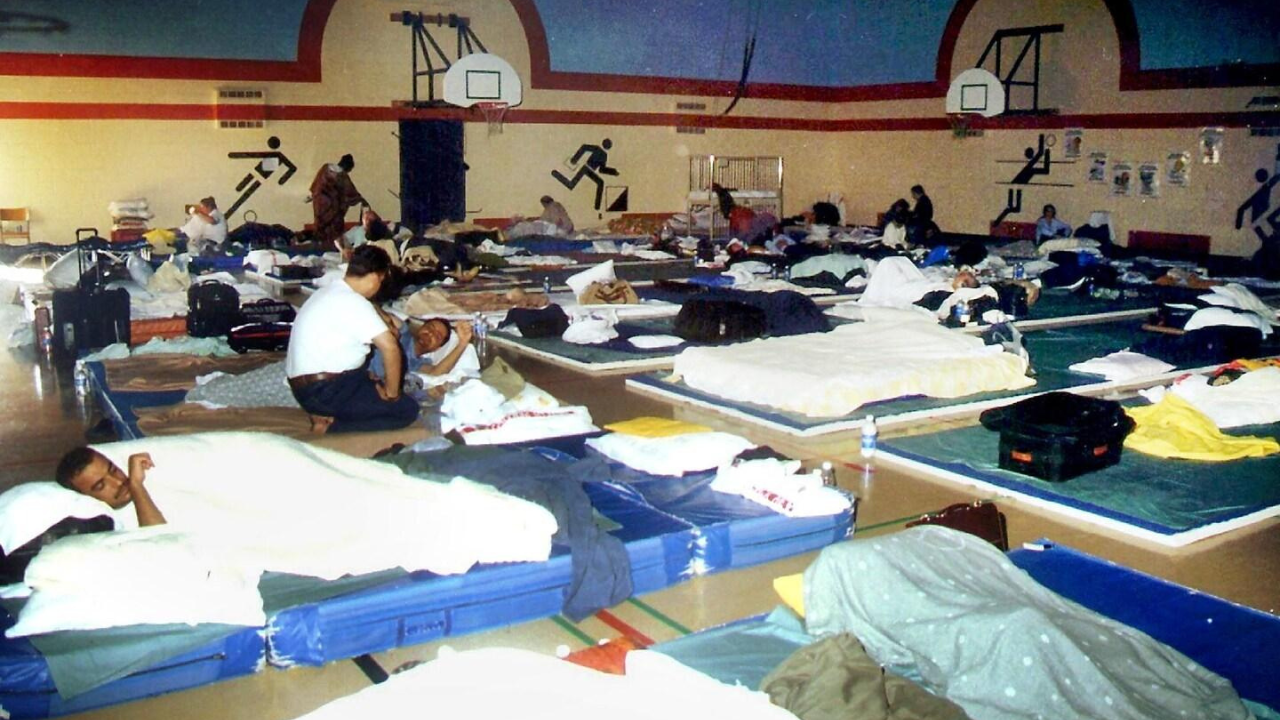
A school gymnasium in Gander converted into a temporary shelter, where stranded passengers were housed on cots and mattresses for several days.
The scholarship fund and long-term impact
A scholarship initiative was created by passengers from one of the diverted flights as a gesture of appreciation. Initial contributions totalled approximately $15,000 and were directed towards supporting local students.Over time, continued donations expanded the fund, which has since distributed more than $1 million in scholarships.
Awards are granted annually based on academic performance and community involvement. The initiative remains one of the most documented long-term outcomes of the events.
From real events to global recognition
The events in Gander were documented through interviews, books, and archival records. They were later adapted into the musical Come From Away, which premiered in 2015.The production ran on Broadway for several years and received multiple award nominations, contributing to global awareness of Gander’s role during Operation Yellow Ribbon.
A documented case of coordinated civilian response
Records from aviation authorities, municipal archives, and eyewitness accounts provide consistent documentation of the events. Data on flight diversions, passenger numbers, and duration of stay are supported by official sources.The Gander case is frequently referenced in studies of emergency management and aviation response, demonstrating how a small municipality managed a large-scale, unplanned event using existing infrastructure and volunteer networks.The events in Gander involved accommodating approximately 6,700 passengers over several days following the closure of US airspace. The response included organised shelter, food distribution, medical support, and transportation logistics. Long-term outcomes include sustained connections and a scholarship fund exceeding $1 million in distributed support.