
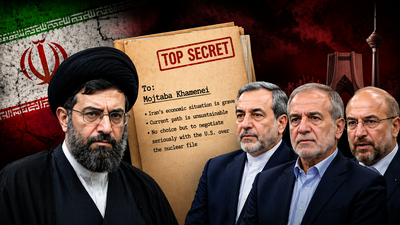
Iran’s carefully coordinated display of unity after US President Donald Trump claimed divisions inside Tehran’s leadership may have been an attempt to contain a far deeper internal crisis, according to accounts circulating in Iranian political circles and reports cited by opposition outlet Iran International.At the center of the controversy is a reportedly confidential letter sent by senior Iranian officials to Supreme Leader Mojtaba Khamenei, warning that Iran’s worsening economic crisis leaves the leadership with little practical choice but to seriously negotiate with the United States over the nuclear issue.The reported letter, which was never meant to become public, is now seen by many observers as evidence of a widening split inside the Iranian establishment over whether Tehran should compromise with Washington or continue confrontation.
Secret letter warned of economic Breakdown
According to people familiar with the matter, the letter argued that Iran’s economic conditions had become severe and unsustainable. It reportedly urged the leadership to reconsider its current course and move toward meaningful negotiations with the US over the nuclear file.The signatories were said to include Parliament Speaker Mohammad Bagher Ghalibaf, President Masoud Pezeshkian, Foreign Minister Abbas Araghchi, Mostafa Pourmohammadi and other senior figures.
Some officials reportedly refused to sign it. One name now being discussed in Tehran political circles is former chief nuclear negotiator Ali Bagheri Kani.The letter was addressed privately to Mojtaba Khamenei and not intended for public release, Parliament, or the wider political class.
Leak sparks political firestorm
Reports circulating in Tehran suggest the document was later shown to hardline figures outside the restricted circle. According to those accounts, Bagheri Kani allegedly emphasized that he had not signed the letter.That leak appears to have triggered a fierce backlash.Jalil Mohebbi, a figure close to Ghalibaf, issued a pointed warning on social media, writing that anyone who disclosed a classified government letter could face prison under Iranian law.He wrote in persian: “If a secret letter is copied to one of the members of a meeting, and that person shows the letter to others (who are not members of the meeting) and says, ‘I did not sign this letter,’ then under Article 2 of the law on punishment for publishing and disclosing confidential and secret government documents, that person can be sentenced to up to ten years in prison. This crime is not pardonable.” (loosely translated)He added: “This offense is unforgivable.” A Telegram channel also referred to an “important confidential letter” written by senior officials and left unsigned by others, asking why some figures were now writing directly to “senior figures of the system.”
Trump claim met with coordinated denials
The leak came just as Trump publicly claimed Iranian officials were “fighting like cats and dogs” over whether to negotiate with Washington.Tehran immediately pushed back. Iranian leaders then issued nearly identical public messages emphasizing unity and loyalty to the new Supreme Leader.Parliament Speaker Ghalibaf wrote: “In Iran there are no hardliners or moderates. We are all Iranian and revolutionary.”He added that with the “iron unity of the nation and the state” and full obedience to the Supreme Leader, Iran would make the “criminal aggressor” regret its actions.President Masoud Pezeshkian posted a nearly identical message: “In Iran, there are no ‘hardliners’ or ‘moderates.’ We are all Iranians and revolutionaries.”Judiciary chief Gholam-Hossein Mohseni Ejei also joined in, saying the term “hardliner” and “moderate” were “absurd and baseless terms from Western political literature.”
Nuclear talks at core of dispute
According to Iranian opposition reporting, Mojtaba Khamenei had reportedly set a red line before the first round of talks, instructing officials not to discuss the nuclear issue directly with the United States.But negotiators reportedly had little room to avoid the issue, since any serious US-Iran talks inevitably center on Iran’s nuclear program.That decision appears to have triggered anger from hardline lawmakers.
Mahmoud Nabavian, deputy chairman of Parliament’s National Security Commission, said the negotiating team made a “strategic mistake” by acting “contrary to the explicit red line of the Leader of the Revolution.”He also said that based on new information he had received, “even if the naval blockade is lifted, any negotiation with America is forbidden.”Hardline MP Amir Hossein Sabeti made a similar accusation.
“I am saying this for the first time, and I stand by what I say,” he said. “If what I say is false, the officials should take action against me.”He added that one of the Leader’s red lines was that “in the negotiations, the nuclear issue must absolutely not be discussed.”
Media warning of “surrender and compromise”
Iran’s Nour News, linked to the Supreme National Security Council, later released a video warning that a “dangerous current” was trying to portray Ghalibaf and Araghchi as figures seeking “surrender and compromise” rather than resistance.That suggested the dispute had moved beyond private meetings and into open factional conflict.
Why the letter matters
Analysts say the episode resembles one of the most important moments in modern Iranian history.In 1988, senior officials warned Ayatollah Ruhollah Khomeini that Iran could no longer sustain the Iran-Iraq War. He then accepted UN Resolution 598 and ended the war, describing the decision as drinking from a poisoned chalice.The new letter reportedly reflects a similar message: ideology may now be colliding with economic reality.
What comes next
Iran’s public messaging now emphasizes total unity. But the sequence of events suggests deep disagreement inside the ruling establishment over one core question: can Iran survive its economic crisis without a nuclear deal, or must it negotiate despite ideological resistance?For now, Tehran says there is no division.But the reported secret letter, coordinated loyalty messages, legal threats over leaks, and hardline accusations suggest the battle is very real, and it is unfolding at the highest levels of power.