
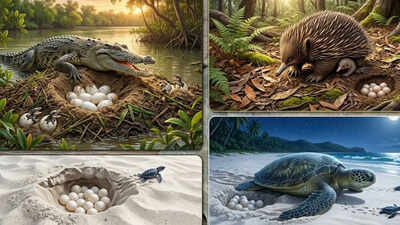
We often think of the egg-laying reproductive strategy in nature as being employed by birds. Indeed, while many people associate egg-laying with birds (chickens, eagles, ostriches), there are literally millions of species throughout nature that utilise this ancient reproductive system.
The monotremes (such as the platypus) produce milk and lay eggs, while most reptiles – including crocodiles – are armoured and lay eggs. Corals utilise a synchronised spawning strategy to produce large quantities of eggs. The strategies employed by these different types of animals are not only evolutionary marvels, but they were developed over millions of years of environmental pressure; they are adaptations to help them survive.
Differences between egg laying and live birth
Embryonic development and nutrition differ between oviparous and viviparous species. In oviparous species, the embryo develops outside of the mother and uses only the food in the yolk to support growth. On the other hand, viviparous species support embryonic development within their bodies. Most mammals give birth to young that are well-developed and receive nutrients from the placenta during gestation, while marsupials give birth to young that are underdeveloped and receive nutrients from the mother while they grow in a pouch.
Monotremes represent an evolutionary exception, as they are the only living mammals that lay eggs. How these various forms of reproduction have been influenced by evolutionary forces illustrates how evolution has produced different ways of ensuring that offspring remain protected until they can survive independently.
Animals that lay eggs
Crocodiles (Reproductive biology and nesting strategies of crocodilians)Crocodilians are oviparous, like all other members of the crocodilian family; therefore, all crocodilian species nest and use eggs and other forms of reproduction (i.e.,
either mound or hole), depending on their ecological location, for the best temperature conditions to incubate their offspring. For many types of crocodilians, the temperature of the nest will influence the sex of the offspring during their development phase.Lizards (Reproductive plasticity and environmental adaptation)Most lizard species are oviparous, which means they lay eggs in a protected habitat to assist them with safely raising their young; however, a few species can display reproductive plasticity and vary the time they hold their eggs in the oviduct to provide for the best possible outcome for their young; this occurs in response to factors such as environmental temperature (i.e.
cold).Monotremes (Egg-laying mammals)Monotremes are the only egg-laying mammals, and they have a unique evolutionary connection to reptiles, both of which lay leathery, fluid-filled eggs; however, placental mammals and Monotremes differ in that placental mammals provide both embryo sustenance and warmth while Monotremes only provide warmth until the baby hatches; once the infant hatches, it is attached to the mother’s abdomen and receives the mother’s milk directly from her skin because Monotremes do not have nipples.Sea turtles (Nesting behaviors and population research)Sea turtles are one of many oviparous reptiles, and they come ashore to nest. When female sea turtles are ready to lay their eggs in the sand, they dig a hole to place their eggs in, then deposit about 80 to 120 eggs, leathery eggs, into the hole. Most of these nests have been subjected to study by researchers, who are trying to determine the influence of changing environmental conditions on declination rates of total hatchlings produced per hatchling and the condition of both the hatchlings and adult populations.Reptiles (Oviparity and the evolution of viviparity) Most reptiles reproduce through laying eggs; eggs are laid in warm, moist habitats such as decomposing plant matter. Approximately 30 per cent viviparity rate applies to squamates (snakes and lizards), as other reptiles like turtles and crocodilians are strictly oviparous – they give birth to live offspring. The use of live offspring is an evolutionary trait that provides the benefit of enhanced reproductive success in cooler climates or aquatic habitats where stable, secure nest sites are hard to maintain.Corals and Marine Invertebrates (Synchronised broadcast spawning)A large number of corals are broadcast spawners, producing an enormous number of eggs and sperm simultaneously, often released on a lunar cycle and only when the temperature is optimal for fertilisation and survival of offspring. The purpose of a synchronised release of reproductive material is to increase the success rates of fertilisation and decrease the risk of predation against offspring.Insects/Arthropods (Diverse mating and developmental strategies)These animals exhibit many forms of reproduction, including depositing eggs on host plants in order to provide food for larvae.
The majority of arthropods utilise special reproductive packets of sperm known as spermatophores or engage in direct copulation. Some arthropods and insects reproduce by parthenogenesis, where the development of offspring occurs without male fertilisation.Fish (Diversity in spawning and parental care strategies)Fish are primarily oviparous; they deposit enormous quantities of eggs that male fish externally fertilise. There is great diversity in spawning strategies; guarders build elaborate nests or mouth-brood; others simply scatter eggs in open water.
Why egg laying still works today
Since egg laying allows an individual animal to have many offspring while investing relatively little energy in the process, it continues to be one of the most successful methods of reproduction. Laying eggs remains effective in many types of environments, from land-dwelling reptiles to aquatic fish; in fact, egg laying enables animals to utilize the external environment for growth and development, allowing them to inhabit many different kinds of niches (whether bury their eggs in sand, deposit eggs in clusters in ponds, or place eggs on specific types of leaves so that the resulting larvae can develop).
Therefore, this reproductive method supports rapid population growth and allows for flexibility in adapting to environmental changes. As a result, egg laying will continue to be an extremely successful, productive reproductive method for species attempting to meet the demands of living in today’s increasingly challenging environment.