
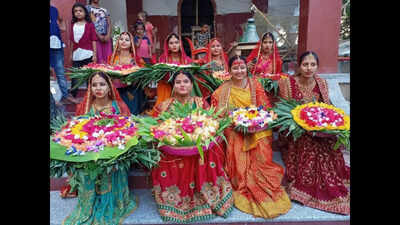
Patna: Long before European couples began their ritualised retreats of the “honeymoon”, the newlyweds of Mithila in Bihar were already immersed in something far richer, more textured, and deeply communal — the celebration of Madhu Shrawani.
Not merely a ritual, but an emotional initiation into married life, it spanned a fortnight, imbued with song, devotion and an intimate understanding of nature’s rhythms.This festival is a lyrical confluence of folk music, art, and worship, celebrating the “sweetness” — madhu — of the first monsoon month, Shrawan. It once served a powerful social purpose: to help new brides, often entering patriarchal households, find their footing, build confidence, and weave social connections in unfamiliar surroundings.
It was as much about emotional anchoring as it was about ritual observance.The roots of Mithila’s cultural tapestry stretch back over 3,000 years to the late Vedic period (1100-500 BCE), intertwined with the legacy of King Janak and the mythic resonance of the Ramayana. Over centuries, this region has nurtured a civilisation rich in literature, art, and ceremonial depth. Yet today, that inheritance appears to be fraying.
Modernisation, urbanisation, and widespread migration have begun to dim the glow of these traditions. Cultural custodians — the sentinels of memory — now watch with unease as local festivals are eclipsed by more cosmopolitan celebrations. Rituals once embedded in the very soil of Mithila are receding, not with a dramatic rupture, but with a slow, almost imperceptible fading driven by indifference.Scholars, too, express a sense of loss. As families migrate in search of livelihood, children grow up detached from their ancestral rhythms, strangers to the festivals that once defined their identity.
The consequence is not merely the loss of celebration, but the erosion of belonging.Patna University Maithili department head Jeevach Ram said younger generations, shaped by exposure to diverse cultures and consumed by modern routines, are gradually losing touch with Mithila’s intricate rituals. The traditional modes of celebration — community gatherings, folk songs carried across generations, and the use of natural materials — are weakening.L N Mithila University Maithili department teacher Ashok Kumar Mehta echoed this concern. He said rapid urbanisation of villages has stripped many agriculturally rooted festivals of their charm. For modern youths, the allure lies elsewhere, often in spaces far removed from their cultural origins. This drift, he warned, poses a serious threat to Mithila’s distinct identity. If the trend persists, these festivals may soon survive only as archival descriptions rather than lived experiences.ANCIENT FESTIVALS OF MITHILAJur Shital: Known as Mithila’s New Year, this festival marks the first harvest day of summer. Households prepare meals the night before, leaving them under the moonlight to cool on rooftops. At dawn, even before sunrise, elders sprinkle cool water on the younger members, followed by ritual bathing and the consumption of the pre-cooked food.“It is believed that this festival is celebrated to protect the people from the forthcoming intense heat waves and also from diseases like small pox and measles,” said Shiv Kumar Mishra, a retired official of Bihar Research Society.
Around the same time, Baisakhi is also observed in other parts of the country.Sapta Vipta Puja: A ritual of endurance, this is a monthlong or sometimes two-month-long fast observed by women, beginning on the first Sunday — or the new moon or full moon — after Holi. It involves wearing a sacred thread and listening to the tale of King Nal and Queen Damyanti, invoking prosperity and the blessing of children. It is devotion stretched across time, binding faith with patience.Chaurchan: Observed on the fourth day of Shukla Paksha of Bhadrapada, this festival venerates the Moon and draws upon the legend of Lord Krishna and the Syamantak gem. It is believed that worshipping the Moon on this day helps dispel stigma and false accusations. Women undertake a day-long fast, offering curds and fruits, seeking relief from Chandra Dosha and protection from social dishonour.Kojagra: Celebrated on the luminous night of Sharad Purnima, Kojagra carries a special significance for newly married couples.
It marks the end of the monsoon and is dedicated to Goddess Lakshmi and Chandra. Families remain awake through the night, awaiting the goddess’s blessings. The bride’s family sends ‘Bhar’ — gifts comprising sweets, makhana, curd, and paan. The night is animated by games such as Pachchisi, played with cowrie shells, ensuring wakefulness.
The groom is honoured, and prayers are offered for a harmonious life ahead.Hukka Paati: Observed on Diwali night, this ritual follows the Lakshmi Puja.
The head of the household lights a specially prepared structure, often made of dry sticks, using a ghee-soaked lamp from the Puja. It symbolises the burning away of darkness and the welcoming of prosperity into the home — a visual and spiritual invocation of light.Sama Chakeva: A festival of affection and familial bonds, Sama Chakeva celebrates the relationship between brothers and sisters. Beginning the day after Chhath and lasting about ten days until Kartik Purnima, it sees young girls crafting clay idols of Sama, Chakeva, and other figures. Evenings come alive with songs narrating their story, echoing themes of love and loyalty. The festival concludes with the immersion of these idols in rivers and ponds — a poignant farewell to both the ritual and the values it embodies.