
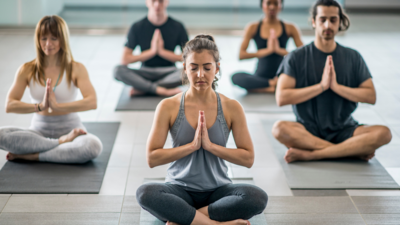
In the modern world, while we have successfully reached the pinnacle of success and innovation, at the same time, it has also brought forth twin challenges of anxiety and overthinking.
These are silent epidemics that are slowly engulfing our mental peace. The solution to this lies in meditation. While we have been practising it for ages, in modern times, meditation, dhyana, and yoga have gained popularity. Our physical health is closely linked to mental well-being, and meditation is a powerful tool for induce mental peace.
The Mind as a Living Organism
Just as our body might catch a viral infection that requires a doctor and medicine, our mind can also become sick with sadness, unhappiness, and fear.
When the mind is unwell, it manifests as overthinking—a state where thoughts race without a destination. The “medicine” for this condition is not always found in a pharmacy; rather, it is found in the intake of “good thoughts” and the practice of spiritual hygiene.
The Trap of Conditional Happiness
A primary driver of anxiety is the adamant mind and rigidity of thoughts. Many people link happiness to certain conditions, like: “I will only be successful if this happens,” or “I can only be happy if I get that.
This rigidity of thought leaves you overwhelmed, and if you are unable to achieve it, it results in disappointment. When we become obsessed with specific outcomes, we ignore the opportunities of the present.
The Dual Pillars: Abhyas and Vairagya
To reclaim mental health, one must lean on the two pillars mentioned in the Bhagavad Gita: Abhyas (consistent practice) and Vairagya (detachment). Since eons, Rishi Munis and Spiritual Gurus have trusted in the power of meditation to heal mental and physical health.
health.1. Abhyas (Practice): Controlling the mind is difficult, but not impossible. It requires training the subconscious. Just as we learn a language through repetition, we must learn peace through daily meditation.2. Vairagya (Detachment): This is the “medicine” for overthinking. It involves letting go of the need to control the future. By focusing on Karma (effort) in the present rather than on the future result, anxiety naturally dissipates.
Rewiring the Subconscious through Meditation
Our minds are often conditioned by a “wall” of negative habits built during childhood—critiques from society, complaints from parents, or self-doubt. Meditation allows us to dismantle this wall, brick by brick.Practical techniques like the “Body Scan” are vital. By relaxing the body from head to toe, we release the physical tension where anxiety hides—in the jaw, the shoulders, and the chest. Deep, rhythmic breathing serves as a bridge, calming the nervous system and silencing the internal chatter.
Cultivating the Inner Environment
While tranquil spaces, such as mountain retreats, can support meditation, the most crucial environment is within. It is important to make a Sankalp (a firm resolve) to stay positive. Success does not always favor the highly educated or wealthy; instead, it often comes to those with the determination to remain positive and continuously work on themselves, regardless of circumstances.Meditation is a journey from the “Shav” (a lifeless, stressed state) to the “Shiv” (enlightened consciousness). By embracing “good thoughts” as medicine and detachment as a lifestyle, we can overcome the habit of overthinking. Mental health is not an end goal but a daily practice of returning to the present moment, finding peace not in what we might get tomorrow, but in the effort, we put in today. In the silence of meditation, the noise of overthinking fades, leaving a mind clear, resilient, and truly free.(Dr Archika Didi, Phd in Meditation, Vice Chairperson, Vishwa Jagriti Mission)