
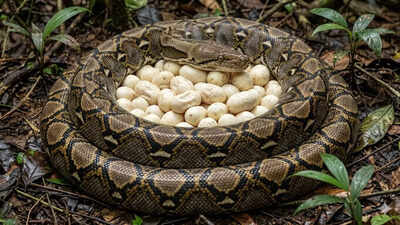
Generally, there is a belief that reptiles completely depend on their surroundings for their existence, especially for reproduction. Some species, however, show more behaviour patterns than assumed.
Big pythons have a unique reproductive behaviour that is characterised by a combination of many eggs produced and taking care of them. Unlike other species that abandon their eggs, big pythons keep them and control the temperature around them during incubation.Some specific reptile species, for example, reticulated pythons, are able to lay a number of eggs if conditions permit. Their special feature, which distinguishes them from the rest, is that they are able not only to lay many eggs but also to create warm conditions for developing embryos.
How do pythons lay up to 80 eggs and protect them after laying
The pythons reproduce through egg-laying, a method referred to as oviparous reproduction. One female snake can lay a considerable number of eggs, with numbers ranging between 20 and 80 eggs, depending on the individual’s size and environmental conditions.In the research “Captive breeding of the reticulated python (Python reticulatus) in Andaman and Nicobar Islands, India,” it is shown that the clutch sizes can differ significantly; however, the species has the potential to lay a considerable number of eggs. Once the eggs are laid, the female python forms a coil around them.
Not only does it protect the eggs from any harm, but it maintains stable conditions as well. As opposed to other reptiles, she remains within the nest, which already differentiates the pythons’ behaviour.
How pythons generate heat to incubate their eggs
One of the interesting aspects of pythons’ reproductive process is that they can actually heat their eggs. While most reptiles need an outside source to warm their eggs up, female pythons can generate warmth from their bodies by making repeated muscle contractions, which are called “shivers.”This process creates sufficient warmth to increase the temperature of the surrounding area. This provides a stable environment for the development of the embryo. Another way of providing a favourable environment for the offspring is changing positions from sunbathing to coiling back.
Maternal care in pythons and why it is unusual in reptiles
Care from parents is usually not considered an attribute of the reptile class. However, in the case of pythons, it becomes obvious that this species is an exception.
The mother does not abandon her eggs during the whole incubating period, which might last several weeks. In such cases, she is rarely seen away from the clutch and hardly eats at all.This way, by surrounding her eggs, the mother provides a safe environment for them to survive and ensures the offspring’s survival rate.
Why does this egg-laying and incubation behaviour help survival
Having multiple eggs ensures the survival of at least some of the offspring. In addition to this, pythons incubate their eggs, ensuring an even higher rate of successful hatching.This shows the effectiveness of this strategy. Moreover, it proves that certain reptiles take part in the development process, rather than being passive in their approach towards reproduction.

