
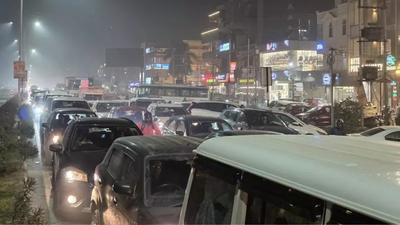
RUDRAPUR: Across Udham Singh Nagar, a daily reality has become as predictable as sunrise: vehicles barely crawl, horns blare incessantly, and routine life grinds to a halt in relentless gridlock.
According to district police sources, 258 people were killed in road accidents between Jan and Nov 2025—nearly seven times the number of murders—while 391 others suffered serious injuries, underscoring a deepening road safety crisis.The district’s main arteries, including stretches of the former National Highways 87 and 74, pockmarked with craters and riddled with improvised “cuts,” have become as hazardous as they are essential.
“Google Maps shows 10 minutes, but I leave home 45 minutes earlier,” said a schoolteacher from Awas Vikas Colony, whose daily commute near Agrasen Chowk often comes to a standstill. “If there’s a jam, students wait.
If there’s a crash, we all wait. No one knows if we will reach anywhere on time,” he added. In Rudrapur, the district headquarters, tens of thousands of commuters set out each morning into suffocating queues stretching kilometres.
National highways, internal market roads and service lanes have buckled under unchecked growth, turning every commute into a gamble of time and safety.Traders in the city’s core market say congestion is strangling business. “Our shops open to honking, not customers. By evening, the smoke and noise are so bad that you can feel the city suffocating,” said Sanjay Juneja, president of the city traders’ union.In Kashipur, repairs to a damaged service road near the old Roadways bus stand have triggered day-long tailbacks.
With only a narrow lane open, buses and other vehicles compete for space, clogging adjoining roads. “We were not informed about the closure. It’s chaos out here all day long,” said depot assistant manager Rajendra Kumar Arya. The repairs, though intended as a long-term fix, have deepened immediate hardship.Khatima faces a similar situation. Despite bypasses built to ease congestion, bottlenecks persist near bus stands, markets and major intersections, with expansion slowed by encroachments and bureaucratic delays.Pedestrians, students and motorists point to weak enforcement as a major factor. “Wrong-side driving, triple-riding and e-rickshaws blocking crossings—everyone knows it’s illegal, but nobody fears being fined,” said Rajat Kumar, a college student.The problem extends beyond these towns. In smaller settlements like Bazpur, Sitarganj and Kichha, residents say haphazard development, shrinking road widths, illegal colonies and unregulated parking have turned routine travel into a daily ordeal.Amid growing anger, local MLA Shiv Arora offered assurances. “I want to assure the people of Rudrapur that both the city bypass and the proposed ring road will become a reality within the next four months,” he said. He added that once completed, these corridors will divert heavy vehicles away from the city, significantly easing congestion and improving safety.SSP Manikant Mishra said enforcement has been stepped up. “We have intensified traffic enforcement across Rudrapur, Kashipur and Khatima with dedicated teams during peak hours.
Strict action is being taken against wrong-side driving, overloading and illegal parking. Our focus is sustained monitoring, public awareness and safer roads for every commuter.”However, residents remain wary, saying such assurances have rarely translated into results on the ground. Social worker Sushil Gava said, “Whether these promises translate into tangible relief for weary commuters remains to be seen. Until then, the industrial capital of Kumaon and its satellite towns remain, in our eyes, cities held hostage by traffic—a daily assault on dignity, time and livelihood.”