
(Image Credits: Pinterest)
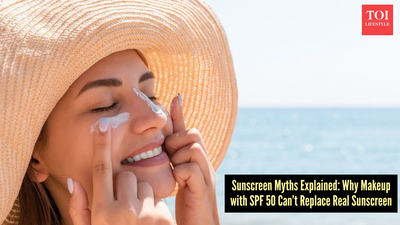
We all love a product that pulls double duty. A moisturizer that primes, a tint that hydrates, or the holy grail of beauty marketing: a foundation that promises high-level sun protection.
Seeing “SPF 50” stamped on your favorite bottle of makeup feels like a safety net.
(Image Credits: Pinterest)
It suggests you can skip the extra step of a dedicated sunscreen and still walk out the door fully protected. However, dermatologists and cosmetic chemists have some bad news. While that added SPF is a nice bonus, relying on it as your sole source of protection is a dangerous gamble. Here is why your makeup bag might be leaving you exposed to sun damage.
Importance of sunscreen during monsoon
The Math Just Does Not Add Up
The biggest issue with makeup-based sun protection boils down to simple mathematics. To get the SPF protection number promised on the label, whether it is a sunscreen or a foundation, you have to apply the product at a density of two milligrams per square centimeter of skin. In practical terms, that is roughly a quarter to half a teaspoon for your face alone. Picture a nickel-sized dollop of heavy foundation. Now imagine applying that entire amount to your face. For most people, that much product would look incredibly cakey and feel heavy.
Studies show that the average consumer applies only about 25 to 50 percent of the recommended amount of makeup. Unfortunately, sun protection does not work on a linear scale. Applying half the amount does not give you half the protection. If you apply a thin layer of SPF 50 foundation, you might actually be getting protection closer to SPF 5 or SPF 10.
That is barely enough to prevent a burn, let alone long-term damage.
The Swiss Cheese Effect
Sunscreen works best when it forms a uniform, continuous film over the skin.
When we apply makeup, we buff, blend, and sheer it out to make it look natural. We often skip the hairline, the ears, the eyelids, and the jawline to avoid staining our hair or clothes. This creates what experts call the “Swiss cheese” effect. You might have coverage in some spots, but there are microscopic gaps and holes in others where UV radiation can penetrate directly. A dedicated sunscreen is usually applied more liberally and evenly, ensuring those high-risk areas are covered before any pigment touches your face.
The Reapplication Reality
We know that sun protection ingredients degrade after about two hours of UV exposure. The golden rule of skincare is reapplication. But let us be realistic about how that works with makeup. Are you going to wash your face and reapply a full layer of foundation every two hours while sitting at your desk or running errands?Probably not. While powder sunscreens exist for touch-ups, they face the same volume problem as liquid foundation.
To get the labeled protection, you would have to apply so much powder that your skin would look chalky.
(Image Credits: Pinterest)
Makeup First, Protection Second
At the end of the day, a foundation is formulated to provide color, texture, and finish. Sun protection is often a secondary add-on. Mixing UV filters into a pigment-heavy formula can sometimes compromise how well those filters spread across the skin compared to a pharmaceutical-grade sunscreen designed specifically for protection. Furthermore, while many foundations stop UVB rays which cause burning, they may not always offer broad-spectrum protection against UVA rays, which are responsible for aging and deep cellular damage.
The Right Routine
Does this mean you should toss your SPF makeup? Absolutely not. Think of the SPF in your foundation as the icing on the cake, but remember that the cake itself must be a dedicated sunscreen. The best routine is simple. Start with a clean canvas by washing and moisturizing, then apply a substantial layer of broad spectrum sunscreen. Stick to SPF 30 or higher for real safety. The key is to wait a few minutes for it to set into a shield. Once it dries down, apply your makeup as you normally would. You get to keep the flawless look, but you also ensure your skin stays safe.