
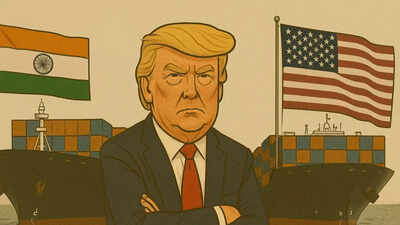
The US Supreme Court’s ruling striking down president Donald Trump’s tariffs will mean that 55% of India’s exports to the US will not face the 18% reciprocal tariffs. The US Supreme Court on Friday deemed Trump’s reciprocal tariffs as ‘illegal’, a move that is a big blow to the American President’s trade war.
The ruling invalidates country-specific “reciprocal tariffs” and fentanyl-linked duties imposed on imports from major trading partners. Trump had recently removed the 50% tariffs that he had imposed on India, bringing it down to 18%. An India-US joint statement on the same was issued earlier this month and an Indian delegation is travelling to the US in the coming days to finalise the interim trade deal.
SC ruling on Trump tariffs : What does it mean for India?
According to Global Trade Research Initiative (GTRI) founder Ajay Srivastava, the ruling by the topmost US court should prompt India to re-examine its trade deal with the United States.“Removal of reciprocal tariffs will free about 55% of India’s exports to the US from the 18% duty, leaving them subject only to standard MFN tariffs,” says a GTRI analysis. According to the think tank, on the remaining exports; (i) Section 232 tariffs will continue — 50% on steel and aluminium and 25% on certain auto components(ii) products accounting for roughly 40% of export value, including smartphones, petroleum products and medicines, will remain exempt from US tariffs“The decision effectively renders recent trade deals initiated or concluded by the United States with the UK, Japan, the EU, Malaysia, Indonesia, Vietnam and India one-sided and useless.
Partner countries may now find reasons to dump these deals,” says GTRI.
What the US Supreme Court said
The court ruled that President Donald Trump had overstepped his authority by levying tariffs under the International Emergency Economic Powers Act (IEEPA), a 1977 statute that has been designed to address national emergencies. The decision reinforces Congress’s central role in shaping trade policy, significantly limiting the president’s discretion to use tariffs as a strategic tool and redefining how future administrations may rely on emergency economic powers.Chief Justice John Roberts said that IEEPA does not grant the president the power to impose tariffs unilaterally and noted that the administration failed to identify any law that authorized such action.The judgment strikes down the country-specific “reciprocal” tariffs as well as fentanyl-related duties applied to imports from key trading partners. Although Trump may seek to reinstate tariffs under Section 301 or Section 232, those provisions require fresh investigations and formal justification, which would slow implementation and likely trigger additional legal disputes. Moreover, these statutes cannot be deployed as a blanket enforcement mechanism.