
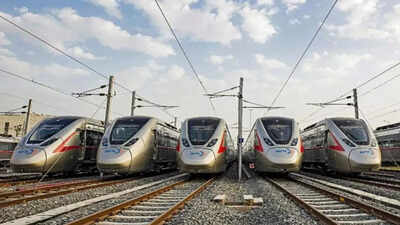
The complete opening of the 82-km Namo Bharat rapid rail corridor between Delhi and Meerut, along with the Meerut Metro, is set to give a further push to real estate activity across the route, analysts and developers said.According to industry estimates, property prices within a two-kilometre radius of stations along the corridor have already climbed between 30 per cent and 67 per cent over the past two years. With the entire stretch becoming operational, prices are expected to firm up further.Prime Minister Narendra Modi inaugurated the corridor on February 22. The high-speed rail link will cut travel time between Delhi and Meerut to about one hour, significantly improving daily commuting and regional mobility.
Travel time cut to one hour
The project is being implemented by the National Capital Region Transport Corporation (NCRTC). A 55-km section with 11 stations is already operational.Shalabh Goel, managing director of NCRTC, was quoted by ET as saying that the project was designed to promote decentralised growth in the National Capital Region (NCR). “When the Namo Bharat project was conceptualised, one of the aims was to enable polycentric development in NCR,” he said.
“We are also harnessing the potential of TOD (Transit Oriented Development) in the region to foster communities.”The improved connectivity is expected to support reverse migration, encourage new business activity and open up fresh residential and commercial hubs along the alignment.
Property prices surge along route
Demand has increased sharply in cities and towns along the corridor, including Meerut, Ghaziabad, Muradnagar and Modinagar.In Meerut, land prices have risen from Rs 8,000–12,000 per sq yard to Rs 12,000–20,000 per sq yard in recent years. Developers say the trend reflects infrastructure-led demand.SK Sayal, MD and CEO of Bharti Real Estate, said that public transport projects have historically reshaped urban economies. “Public transport has historically brought people and places together and changed the economic and social fabric of concerned areas,” he said.He added that the upcoming corridor will include a station near Worldmark Aerocity, creating a multi-modal hub linking Meerut, Ghaziabad, Noida, Delhi and Gurugram.
Developers line up new projects
Real estate firms are already positioning themselves to benefit from the improved connectivity. Developers such as Paras Buildtech and Alpha Corp are launching projects along the corridor, including MeerutOne in Modipuram.Santosh Agarwal, executive director at Alpha Corp, said, “By reducing travel time from Sarai Kale Khan to Meerut to just an hour, the Namo Bharat trains will make the city far more accessible and aspirational.
Improved connectivity and frequent services will spur economic activity, create demand for quality housing, and unlock opportunities for commercial growth.”Pritam Mishra, senior vice president (Sales) at Paras Buildtech, said the twin launch of the Namo Bharat corridor and the 23-km Meerut Metro — which has 13 stations and shares infrastructure with the RRTS — would transform the local property market.“For Meerut’s real estate landscape, these two projects will be game-changers, elevating peripheral zones into high-demand urban nodes,” he said.
“In the last two years, property prices in areas along the Namo Bharat route have appreciated by 35–40%, reflecting a structural shift driven by infrastructure-led demand.”
Focus on transit-oriented development
Developers are also aligning projects with Uttar Pradesh’s Transit Oriented Development (TOD) policy, which encourages mixed-use developments around transit stations.International cities such as Hong Kong, Singapore and Tokyo have successfully used TOD models to finance public transport while improving urban planning.In India, the National Metro Rail Policy of 2017 promotes TOD and value capture financing (VCF) models to help generate revenue and create transit-friendly communities.International agencies including the Asian Development Bank and the World Bank are supporting NCRTC in implementing such initiatives.NCRTC plans to monetise land parcels around stations, generate non-fare box revenue and develop commercial, residential and service hubs near Namo Bharat stops, a move that could further reshape the property landscape along the Delhi–Meerut corridor.