
- Authored by: Deeksha Teri
- Updated Feb 12, 2026, 20:52 IST
With international enrolment under pressure at home and a possible threat of bankruptcy, British universities look to India for growth and revenue stability

Lower costs and no visa hurdles draw British institutions to India as overseas enrolment slows
India is rapidly becoming a popular destination for UK universities looking to expand beyond their home market. As UK universities are struggling to attract international students back home, many British varsities are now planning to open campuses in India, due to its vast student base and growing demand for globally recognised degrees. Another major advantage for UK universities is the supportive policy framework introduced by the University Grants Commission (UGC) in 2023. With lower costs for students, huge student market, a large and highly skilled talent pool, and Indian regulations now permitting foreign campuses, India offers British universities an opportunity to scale up operations sustainably, positioning India as an attractive education hub compared to the UK’s restrictive visa environment and rising expenses.
Be it Gujarat’s GIFT City or Delhi-NCR’s Gurugram, international universities seem to be setting up campuses in India, which is being looked at as the world’s fastest-growing student markets. The Minister of State for Education Sukanta Majumdar, recently shared in Rajya Sabha that the number of Indian students going abroad has been declining in the past three years. This is complimented by the increase in the number of foreign universities setting up campuses in India under the banner of ‘Study in India’.
University of Southampton has commenced its academic calendar at its first Indian campus; it is nestled in a modest office complex on the outskirts of Delhi (Gurugram), a British institution located nearly 7,000 kilometres away in southern England. “The new part of the model … is that now universities can start thinking about going to the students,” Professor Andrew Atherton, vice president of international and engagement at the university, told Reuters. “So it’s a two-way flow. Some students will come to universities, but the universities increasingly will go to students. And that, to me, opens up much more choice.”
Following Southampton’s move, the University of Surrey is planning a campus in GIFT City, Gujarat, while the University of York is set to open one later this year. While University of Southampton has become the first UK university to establish a physical presence in India, this points towards a shift in trend of British institutions expanding overseas.
Why UK Universities Are Coming to India
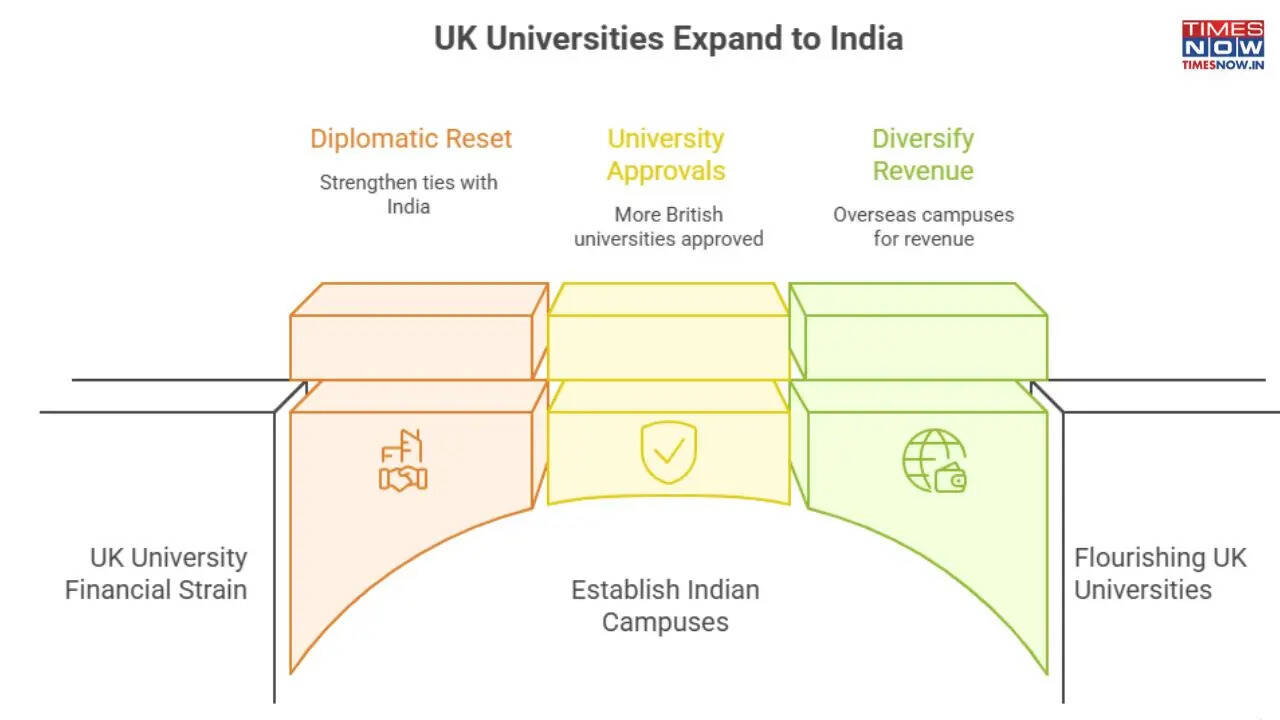
In 2025, the UK Prime Minister, Keir Starmer, visited India in October 2025 with the aim of strengthening ties between India and the United Kingdom. During this trip, India and the United Kingdom also agreed to deepen educational cooperation as part of a broader diplomatic reset in 2025, which included a free trade agreement and reciprocal visits by the two Prime Ministers.
While Southampton celebrated opening its Gurugram campus around the same time, Starmer also announced approvals had been issued for more British universities including Liverpool, York, Aberdeen, Bristol, Coventry, Queen’s Belfast, Lancaster, and Surrey to establish campuses across India, including GIFT City and Bengaluru. So much so, out of the 19 universities setting up campuses in India, at least nine are from the UK.

More British universities are expected to setup campuses in India in the near future
This shift in trend comes at a time, and is probably motivated by the fact, when the UK universities have been facing increasing pressure at home as the UK government has been tightening visa regulations for international students. As part of measures to reduce immigration, the Starmer government introduced a £925 annual levy per international student. This has increased pressure on UK universities regarding recruitment of international students.
The Education sector is one of the biggest exports for the British economy, generating £32 billion annually ($44 billion). However, the long-standing model of depending on international students travelling to the UK is under strain. A few years ago the University of York, Vice-Chancellor Charlie Jeffery had stated in an opinion piece published online that “it is only because of the international student fee income that we can afford to teach home students”.
UK universities are expanding their base in India for revenue stability
Reports by PwC and the Office for Students state that England’s universities face the danger of budget deficits. The most recent report by Office for Students (OfS) also states that nearly 45 per cent of higher education institutions in England are projected to run deficits in 2025–26. With this in mind, experts believe that overseas campuses (such as the ones being established in India) may help UK institutions diversify revenue, even if they may face financial challenges in the initial years due to high investment costs.
Universities can benefit in the long run as Indian campuses of these British universities can offer the best of both worlds to Indian students, while ensuring that universities flourish in India. While the UGC regulations require degrees to match the standard of courses in Britain, the tuition fee and cost of living is lower for Indian students. Courses that have fees of over 25,000 pounds for an international student in Britain cost in the region of 10,000-12,000 pounds for Indian students at the new campuses. This can help attract Indian students to these UK universities and help these British varsities make up for revenue lost due to declining international enrolment.
Get Latest News Live on Times Now along with Breaking News and Top Headlines from Education and around the world.