
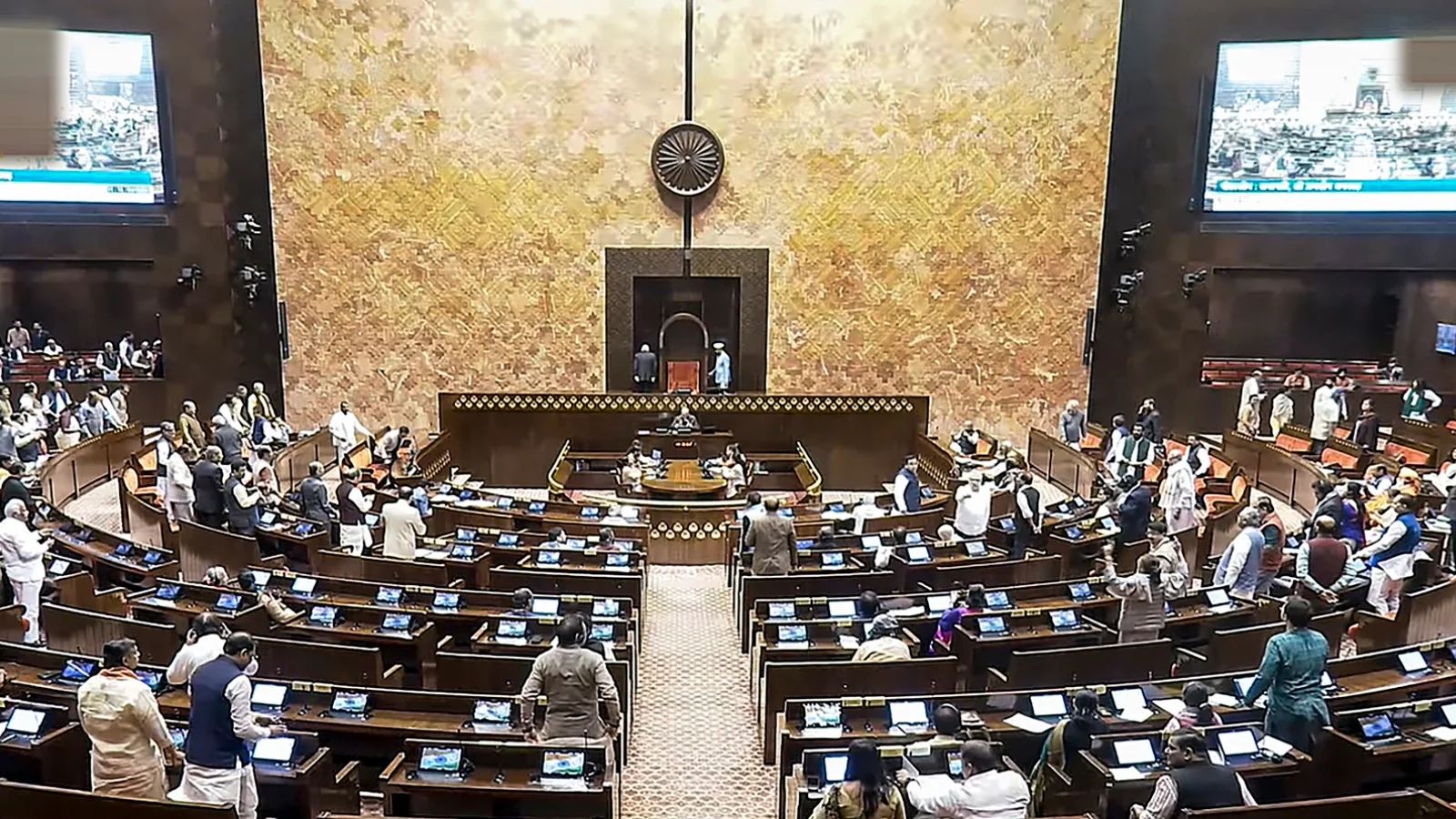
 In the Rajya Sabha, the NDA is well above the majority mark. (File Photo)
The latest elections to the Rajya Sabha have further strengthened the NDA, increasing its tally from 135 to 141 in the 245-member House. While the number of the BJP’s elected members has gone up from 98 to 101, five of the 12 nominated members have joined the party, pushing the number of BJP MPs in the Upper House to 106.
The present strength of NDA-plus is as follows: BJP 106, AIADMK 5, JD(U) and NCP 4 each, TDP, Shiv Sena, and United People’s Party (Liberal) 2 each, and 1 each in RLD, JD(S), AGP, RPI (Athawale), and Rashtriya Lok Morcha (Upendra Kushwaha’s party), independent Rajya Sabha MP Kartikeya Sharma, and one each from the MNF, NPP and PMK. Then there are the 7 members the government has nominated, but those who have not declared their party affiliation. This adds up to 141.
Opposition parties
In case of parties that can take a line against the BJP, the Congress’s tally has gone up from 27 to 29 MPs, the TMC has 13, the AAP 10, the DMK 8, the BJD 6, the Samajwadi Party 4, the National Conference, BRS, CPI (M), and RJD 3 each, 2 each in JMM, IUML, and CPI; and 1 each in Shiv Sena (UBT), NCP (SP), MDMK, Kerala Congress (M), BSP, and DMDK.
Going forward, the NDA is further likely to consolidate its tally in the Upper House following the next round of biennial elections. As many as 33 of the 71 seats scheduled to be vacated in the Upper House — 37 seats have been filled, with 26 members elected unopposed — will come up for polls later this year. In the present round of elections held across 10 states, just Haryana, Odisha, and Bihar saw contests that led to the NDA winning more seats than expected because of cross-voting in Odisha and FOUR Opposition members not turning up to vote in Bihar.
Twenty-three more seats will see vacancies in two phases between May 21 and June 25, and 11 till November 25. Of the 23 seats scheduled to be vacated in the first phase, 12 are currently held by the BJP, four by the Congress, and three by the YSRCP.
The vacancies will arise in seats currently occupied by prominent NDA leaders such as JD(S) founder and former Prime Minister H.D. Deve Gowda, who represents Karnataka, as well as the BJP’s own Minister of State for Railways and Food Processing Industries, Ravneet Singh Bittu, who represents Rajasthan, in the first phase.
From the Opposition, the seats of Congress president Mallikarjun Kharge, sent to the Upper House from Karnataka, and senior Congress leader and former Chief Minister Digvijaya Singh from Madhya Pradesh, will also fall vacant. The sole Rajya Sabha seat from Mizoram is due to fall vacant in mid-July.
What this means
The increasing strength of the NDA means that ordinary Bills will pass through both Houses without any problem. While the tally of the BJP in the Lok Sabha fell from 303 to 240 in the last general election, the NDA as a whole is well above the majority mark, and allies have not created any problems for the ruling party till now. In the Rajya Sabha, too, the NDA is well above the majority mark.
However, constitutional amendments still remain a problem for the government, as these require special majorities in both the Houses: the number of votes for a constitutional amendment Bill should be at least one-half of the total strength of that House, and not less than two-thirds of those present and voting.
If one takes the full strength of the Lok Sabha, the two-thirds majority mark is 362, and that in the Rajya Sabha is 164. So, unless there are many abstentions on the voting day, bringing down the number required, constitutional amendments are still a challenge for the ruling alliance. For instance, the one-nation-one-election plan will require constitutional amendments, and the numbers are still not very favourable on paper for that. Significantly, the constitution cannot be amended via a joint sitting of both the Houses, and the Bill has to be passed by both Houses separately.