

Norway’s Ambassador to India, May-Elin Stener, recently took her first ride on the Delhi Metro, and her experience has quickly caught the attention of both commuters and observers of India’s urban infrastructure.Sharing her thoughts on X, the ambassador (@NorwayAmbIndia) wrote, “Tried the Delhi Metro for the first time this weekend! Fast, clean & super-efficient. A fantastic way to get around in Delhi. Should have done this sooner! Will definitely use it again.” Her spontaneous comment is a testimony to what all daily commuters of the Delhi Metro are aware of—the Delhi Metro is one of the most reliable and efficient means of travel in Delhi.
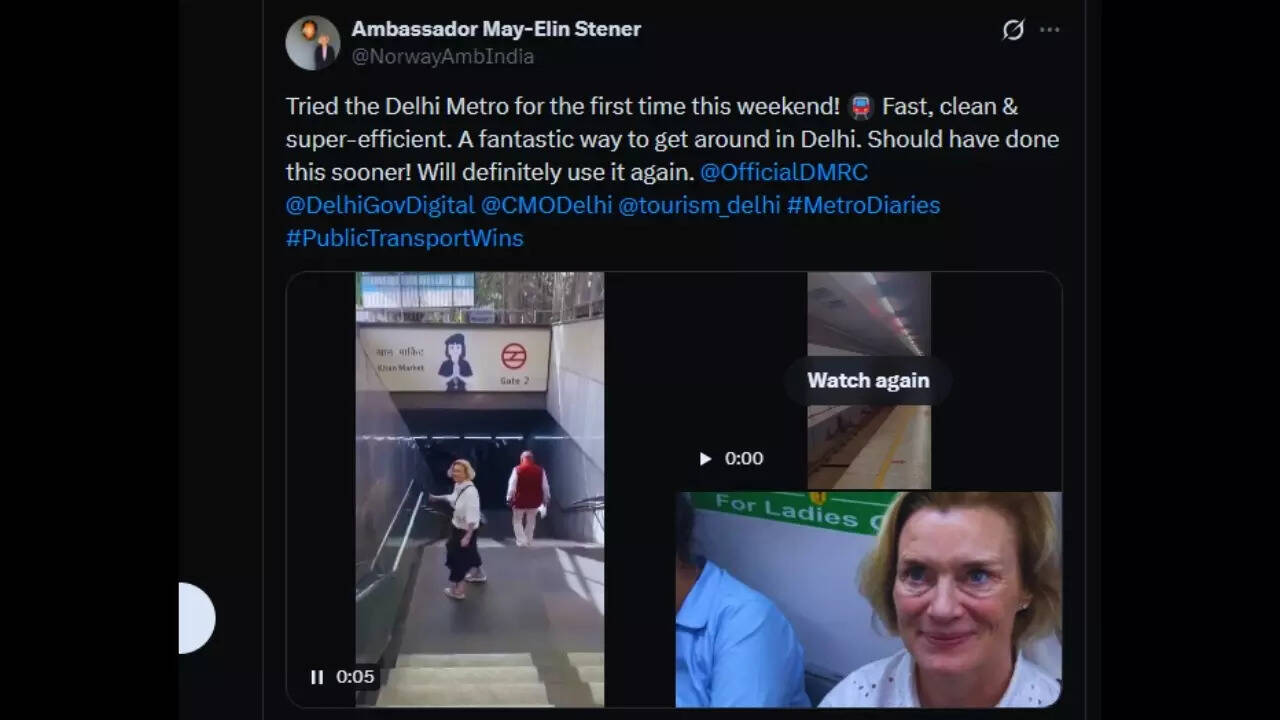
Norway’s Ambassador to India, May-Elin Stener on X
Her visit is not just a personal experience of travel through the Delhi Metro; rather, it is a testimony to the increased interest in India’s public transport systems across the globe. Over time, the Delhi Metro has become a benchmark for other public transport systems in the country, with proper emphasis laid on factors such as effective time management, cost-effectiveness, and environmental awareness. With a huge network of routes covering most of the National Capital Region, the Delhi Metro has revolutionized public transport in Delhi.
The ambassador has also placed emphasis on factors like cleanliness and efficiency, which are often considered the most important factors in the comparison of metro systems around the world. The Delhi Metro has always been successful in maintaining a high standard in the aspect of hygiene, as strict rules and regulations are followed in this regard. The metro stations are clean and well-maintained, and the signs are clear and commuters are disciplined, making the experience a pleasant one.
Another important aspect is the reputation of the Delhi Metro in terms of being punctual. The trains are run according to a well-regulated time-table, ensuring the commuters minimal waiting time even during peak hours. For a city that is already plagued by traffic jams, this is a welcome alternative for those who prefer to travel by road. Safety features such as surveillance and women’s seats also contribute to commuters’ faith in this mode of travel.Her ride also speaks to another story: that India’s infrastructure is finally coming into its own at the global level. As cities around the world seek to address issues concerning mobility, India’s Delhi Metro stands in as a template for how public transportation at this scale can be both efficient and accessible.For Delhi residents, this may just be another part of their daily lives. But for Ambassador Stener, who is using this service for the first time, it is also a reflection of how this city is in constant evolution: contemporary, connected, and always in motion.