
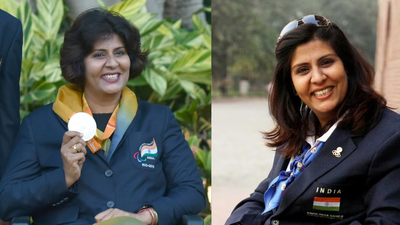
Deepa Malik’s story sits at the intersection of setback and reinvention. Long before she became a familiar name in Indian sport, a spinal tumour surgery in 1999 changed the course of her life and pushed her into a wheelchair.
Years later, she turned that private upheaval into public history at Rio 2016, where she won silver in the women’s shot put F53 and became the first Indian woman to win a Paralympic medal. Scroll down to read more….A life rewrittenWhat makes Malik’s journey compelling is not simply that she returned to sport after paralysis, but that she rebuilt herself in full view of a country still learning how to speak about disability with respect.
Her early sporting life did not come from a straight or easy path. It came after medical crisis, rehabilitation, and years of adapting to a body that no longer responded the way it once had. Yet she refused to let the wheelchair become the last word on her identity.
Instead, she kept moving toward competition, toward performance, and toward the stubborn idea that her life would still be defined by ambition. The road back was longer than the medal
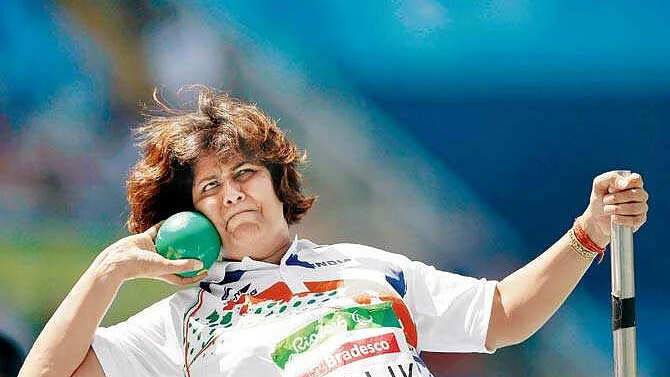
Malik’s rise was not built on a single event or one lucky breakthrough.
The record shows a steady climb through national and international para-sport, with her name appearing across para athletics and, earlier, other sporting disciplines. That breadth matters because it shows a different kind of athleticism: one shaped not only by talent, but by patience, repetition and the discipline of returning to the field again and again.
The result was not merely participation.
It was endurance at the highest level. Rio changed the conversationThe defining moment came in 2016, when Malik’s silver in shot put F53 gave India its first female Paralympic medallist. Official Paralympic coverage described the achievement as history-making, and it was exactly that: a medal that widened the frame for what Indian sport could look like, and who could be celebrated within it. In a landscape where women para-athletes were often kept at the margins, Malik stepped onto the podium and forced the centre to move.
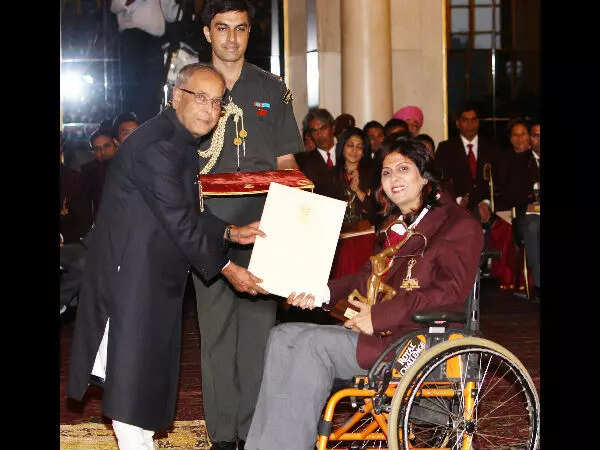
Rio mattered for another reason too. The medal was not presented as an ending. It became a beginning, a public proof that a life altered by disability could still produce elite sport, national pride and global recognition. Malik’s achievement landed with such force because it combined performance with narrative power: a woman who had already survived major surgery and long rehabilitation had reached one of the most visible stages in world sport.Recognition followed, but so did responsibilityAfter Rio, the honours came in layers. The Government of India awarded Malik the Padma Shri in 2017, and the Ministry of Youth Affairs and Sports list shows she had earlier received the Arjuna Award as an athlete in 2012. In 2019, the government named her among the recipients of the Rajiv Gandhi Khel Ratna, India’s highest sporting honour at the time. Those awards did more than decorate a resume; they marked her transition from breakthrough athlete to national symbol.That symbol has also had a practical edge. Malik moved into sports administration and advocacy, and official Paralympic reporting says she was elected President of the Paralympic Committee of India in 2020, serving until 2024. In 2022, the Press Information Bureau described her as India’s first woman Paralympic medallist and said she had become the national ambassador for the TB Mukt Bharat campaign. Her public life, in other words, extended well beyond the stadium.The quiet lesson behind the medalMalik’s journey offers a lesson that reaches far beyond sport. Her life shows that resilience is rarely dramatic in the beginning. It often begins quietly, in rehabilitation rooms, in small daily exercises, and in the decision to continue when progress feels slow. Rather than waiting for circumstances to change, she rebuilt her goals around the reality she was given. That shift, from loss to possibility, is what allowed her to transform adversity into achievement.Deepa Malik’s legacy is not built on inspiration alone, though that is often the easiest way to package it. Her real achievement lies in changing the grammar of possibility. She showed that disability does not cancel excellence, that a wheelchair does not diminish competitive fire, and that a woman who has lived through profound physical loss can still become a force in sport, public service and civic imagination.
In that sense, the line associated with her journey rings true: pain was not the end of her story. It became the material she used to build the next chapter.


