
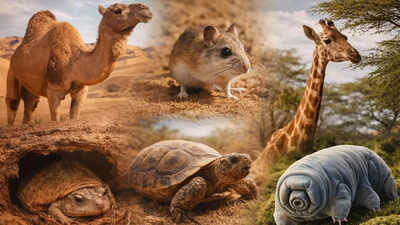
Water is the essence of life; yet in the natural world, there are many examples of the opposite being true. There are many creatures that need access to water on a regular basis, but there are also many that have adapted to survive in some of the driest places on Earth.
These creatures have adapted to survive in the desert, in the ground, and in many other dry places by finding ways to obtain the water that they need. Some of these creatures can go without water for days, months, and even years without ever needing a drink of water.
Why can animals survive for long without water
Animals that live in dry habitats have developed special adaptations that help them cope with the scarcity of water in such regions. Unlike humans, these animals do not always need to drink water directly to stay hydrated; they still require water but obtain it through food, metabolic processes, or stored reserves.
Animals that live in the desert save water from being lost through sweating and produce concentrated faeces. Some animals get water from their food, such as seeds, plants, and meat. Some animals may even adjust their behaviour by sleeping during the day and staying awake at night to avoid dehydration.Animals that live in dry habitats may even decrease their metabolism to such an extent that they sleep and do not need to consume water for years.
Camels and their desert survival strategy
According to research carried out in a study titled “Dromedary camel and its adaptation mechanisms to desert environment: A review,” it is a general assumption that camels are the ultimate symbol of survival in a desert environment. They have the ability to survive without water for 10 days or longer, depending on other environmental factors.The research states that the secret to a camel’s survival in a desert environment lies in its ability to utilise water, not store it, and that a camel can withstand dehydrating conditions and drink a substantial amount of water if available, owing to its ability to conserve sweat and excrete highly concentrated urine.It is also noted in this research that the fat in a camel’s hump is convertible to energy and also provides a certain amount of metabolic water.
The kangaroo rat that never drinks
According to a study published in the National Medicine Library, it has been found that kangaroo rats are capable of living their entire lives without ever drinking a single drop of water.The study states that these rats get all the necessary moisture from dry seeds. Their kidneys are also highly efficient in this regard.
They are capable of producing extremely concentrated urine. In addition to this, their respiratory system also plays a vital role in minimising moisture loss.
Desert amphibians that wait for years
As published in the Journal of Arid Environments, not only do certain animals conserve water, but they also avoid using it at all, and the method by which they do that is called “aestivation.”Water-holding frogs dig holes in the ground and go to sleep during dry seasons. Their metabolism decreases, and they survive without water for quite a while.
They then come out when there is rainfall.The same survival mechanisms are also found in other amphibians and lungfish.
Tortoises and long-term water storage
According to a publication in Ecological Indicators, tortoises store water internally to help them survive in a desert environment.The tortoises store a considerable amount of water in their bladder, which they use over time. This helps them to survive for months without taking in water.Their low metabolic rate also helps them conserve water, and they are very adapted to living in a desert environment.
Giraffes and plant-based hydration
As cited in Environmental Advances, “giraffes obtain most of their required water from their diet.”They mainly eat leaves rich in water content, especially from acacia trees, which are enough for their survival. Thus, there is no need for giraffes to frequently drink water and can even survive for long without taking water from any source.
The microscopic survivor that defies limits
One of the most remarkable examples is found in the microscopic world. Tardigrades, also called “water bears,” are able to survive dehydration under extreme conditions due to their ability to enter a state called cryptobiosis.In this state, they lose almost all their water content and stop their metabolism. They can stay in this condition for years, even decades, until water is again present.Once rehydrated, they return to life as if nothing happened, making them one of the toughest organisms known.


