
A homecoming, report card and a new challenger
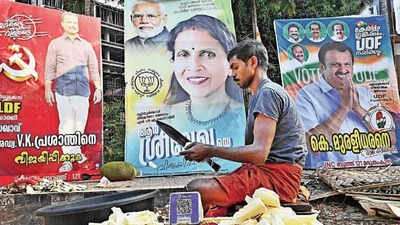
In the leafy, fast-expanding urban stretches of Vattiyoorkavu, the 2026 Assembly election is shaping up to be more than a routine political contest. It is a story of return, resilience, and rising ambition—three distinct narratives converging on a single electoral stage.For K Muraleedharan, this election carries the weight of personal reckoning. A two-term MLA from this very constituency, he returns after a bruising electoral run—defeats in Nemom and then Thrissur—seeking to reclaim familiar ground. Within Congress, he has long been the man dispatched into difficult battles, tasked with blunting BJP’s advance. This time, the battle is his own. He calls it a homecoming. His critics call it a last chance.
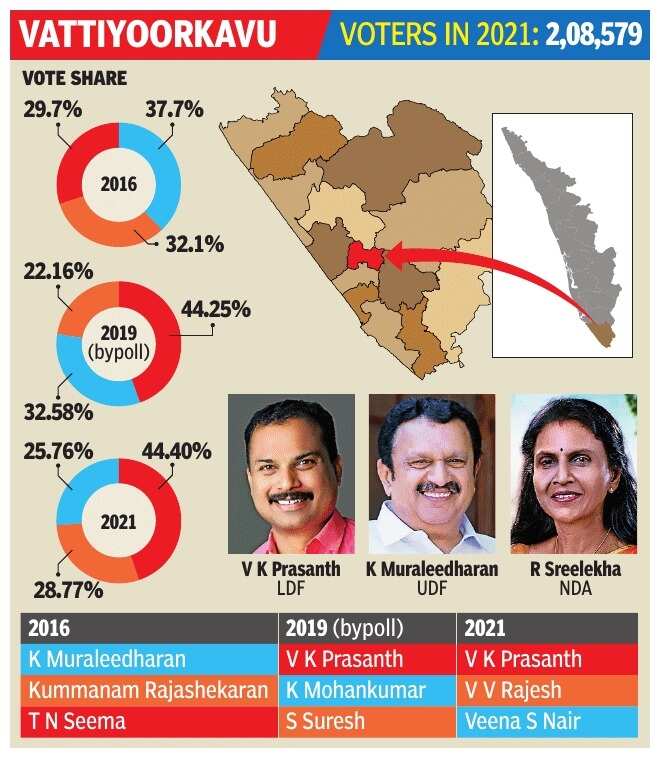
Standing in his path is the incumbent, V K Prasanth, whose rise reflects the changing face of Vattiyoorkavu itself. First elected in a bypoll triggered by Muraleedharan’s elevation to the Lok Sabha from Vadakara, Prasanth has since built an image rooted in accessibility and delivery. Roads widened, infrastructure expanded, welfare schemes rolled out—his campaign leans on a development record backed by claims of over Rs 1,000 crore spent in the constituency.
For voters, he represents continuity. For opponents, he is the man to beat.But this is no straight duel. The entry of R Sreelekha as NDA candidate has injected a fresh dynamic. Kerala’s first woman DGP, Sreelekha brings administrative credibility and a non-traditional political appeal. Her candidacy signals BJP’s growing confidence in urban Kerala— confidence built on steady, if gradual, electoral gains.The numbers bear this out. In the 2024 Lok Sabha election, NDA candidate Rajeev Chandrasekhar led in the Vattiyoorkavu segment with 53,025 votes, ahead of UDF’s Shashi Tharoor at 44,863 and LDF’s Pannian Raveendran at 28,336.
A result that would have seemed improbable a decade ago. At the local level too, BJP has tightened its grip— winning 10 of the 18 corporation wards within the constituency, against six for LDF and just three for UDF.
Having finished second in both the 2016 and 2021 assembly elections, what was once a bipolar contest is now unmistakably triangular.
Yet Vattiyoorkavu resists easy categorisation. It is an urban seat where apartment complexes rise alongside traditional homes, and where voters are as moved by civic concerns as by political loyalty.
The constituency is Hindu-majority (77%), with Christians (13–14%) and Muslims (7–8%) forming significant minorities. Caste and community matter, but operate quietly here—shaping choices at the margins rather than dominating the conversation.On the ground, the central question is whether development or the desire for change will carry the day.“The long-pending development of Vattiyoorkavu junction is finally materialising,” says Sunny R.
Nair from Kodunganoor. “Land acquisition and compensation disbursement were the main stumbling blocks for years. Both have been resolved, and the last five years also saw real improvements in roads and basic infrastructure.”But not everyone is looking to reward the incumbent. “If there is a UDF govt, Vattiyoorkavu will certainly have a minister—and that means direct benefits for the constituency,” says Daniel Thomas of Nettayam.
“People are aware of this. The vote will be for change.”The result is a constituency in flux. Past victories offer little guarantee. Muraleedharan’s legacy, Prasanth’s performance record, and Sreelekha’s emergence each appeal to different sections of the electorate. For the Congress, the fight is about reclaiming lost ground. For Left, it is about defending governance. For BJP, it is about breaking through in urban Kerala.As campaign trails wind through Vattiyoorkavu’s busy streets and quiet neighbourhoods, one thing is clear: This is no longer a safe seat for any party. It is a contest shaped as much by its past as by the possibilities ahead—one that may well signal the future direction of urban politics in Kerala.