

A surprising number of people are drifting in a health limbo known as malaise, an understated middle ground between feeling good and unwell. Common experiences like ongoing exhaustion, slight unease, or cognitive fog can point to important bodily changes. Health professionals recommend acknowledging these quiet signals, asserting that minor tweaks in lifestyle could help avert serious medical problems later on.
There are days when everything looks normal on paper, yet something feels quietly off. Work takes more effort. Sleep does not refresh. The body moves, but without ease. This is not illness in the usual sense, but it is not wellness either.Modern medicine has a word for this grey zone. It is called malaise. A subtle, often ignored state that sits between health and disease. And more people are living in this space than they realise.
What exactly is this ‘in-between’ state?
Dr Ankush P M explains it in simple terms, “There are days when nothing is clearly wrong, yet everything feels slightly off. You wake up tired even after a full night’s sleep. Work feels harder than usual. Your body is not in pain, but it is not at ease either.
It is easy to brush this aside as a mild stress or a passing phase. But doctors say that this vague discomfort often has a name and a meaning to it. This feeling of discomfort is often described as the ‘in-between health state.
’ It sits somewhere between being completely fine and being clearly unwell.”Doctors define this state as ‘malaise’—a general sense of feeling unwell that is difficult to describe. It is not sharp like pain or measurable like fever.
Instead, it feels like something is not right, even if you cannot explain what exactly. And this state is not random. It is often one of the earliest signals that the body is dealing with something beneath the surface.Dr Ankush added, “Long-standing malaise, especially when associated with joint pains, muscle pains and fever, may be due to underlying autoimmune disease.”This state is not dramatic. There is no fever to measure or pain to locate.
But the body is still communicating. It is often the earliest signal that something underneath is shifting.
Why do people feel this way?
The body rarely moves from healthy to sick overnight. It transitions slowly, often quietly. Several factors can push a person into this middle zone:
Chronic stress that never fully settles- Poor sleep quality, even if hours seem adequate
- Nutritional gaps, especially in iron, vitamin D, or B12
- Early metabolic changes, such as insulin resistance
- Low-grade inflammation, which may not show in basic tests

Constant feeling of ‘not being well’ shows up as fatigue, low energy, or subtle discomfort.
Research supports this slow drift. A report by the Indian Council of Medical Research highlights how lifestyle diseases develop over years, often beginning with vague symptoms people ignore.Similarly, the World Health Organization has documented how chronic stress and lifestyle imbalance contribute to non-specific symptoms before disease appears.
The subtle signs people overlook
This phase is easy to dismiss because each symptom feels ordinary. But patterns matter more than individual signs.Common signals include:
- Persistent tiredness without a clear cause
- Mild digestive discomfort that comes and goes
- Dry mouth or slight dehydration feeling
- Low mood or reduced motivation
- Brain fog or lack of focus
None of these stop daily life. But together, they create a quiet discomfort that lingers. The risk lies in normalising them.
How this state affects everyday life
Living in this in-between state often feels like moving through resistance. Tasks take longer. Decisions feel heavier. Even rest does not fully restore energy.Over time, this can lead to:
- Reduced productivity
- Irritability and emotional
fatigue - Lower immunity
- Increased risk of chronic conditions
When health dips even slightly, everything else begins to feel the weight.
Why ignoring it can cost more later
One of the biggest problems with malaise is that it does not demand attention. It allows postponement.But this phase often precedes:
- Viral infections
- Hormonal imbalances
- Burnout
- Early stages of diabetes or thyroid disorders
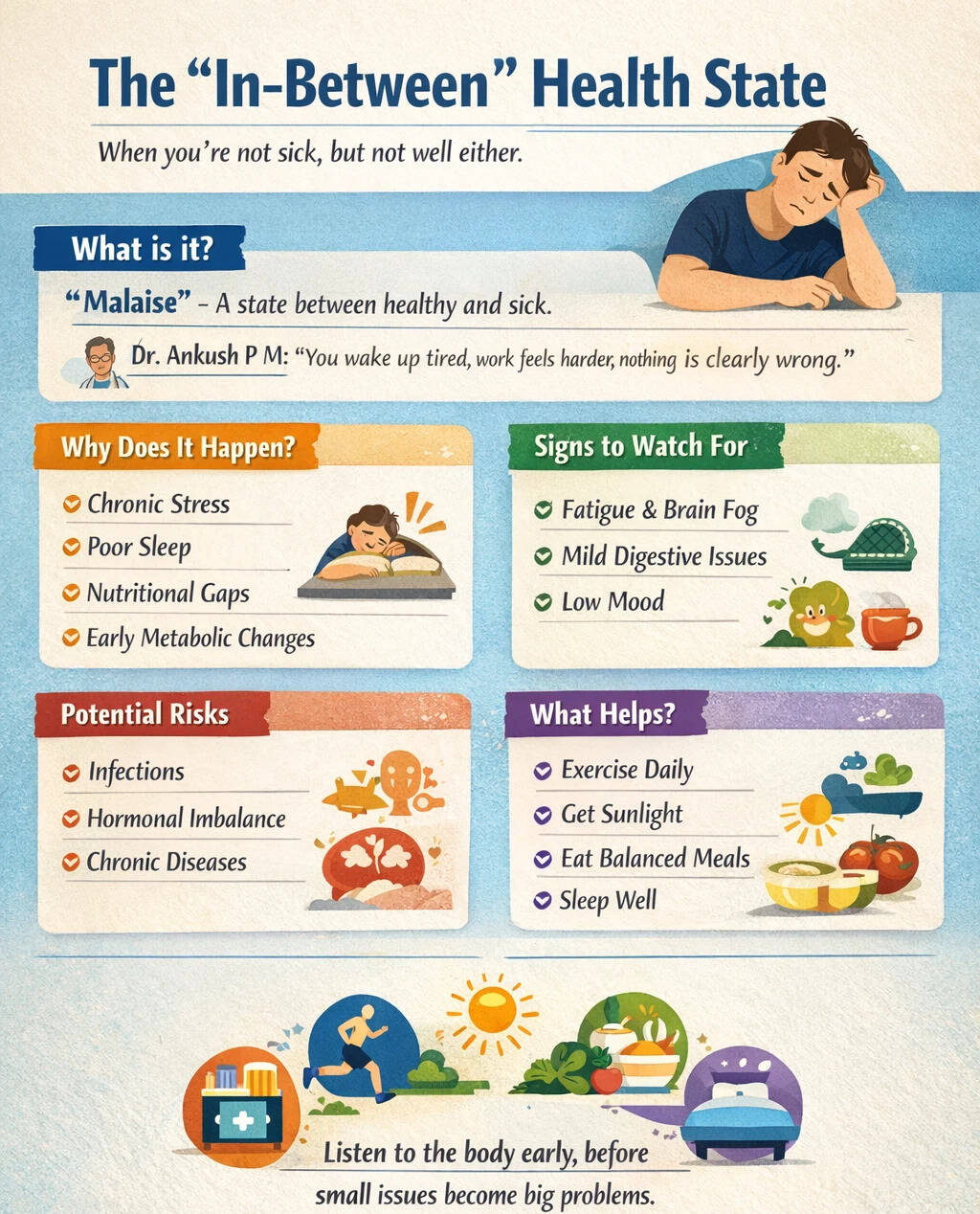
While easy to ignore, it often signals deeper imbalances. Paying attention early and making small lifestyle changes can prevent bigger health issues later.
What can actually help?
The solution is not drastic. It is consistent and observant.Start by noticing patterns:
- When does fatigue show up?
- Does it follow poor sleep or heavy meals?
- Does stress make it worse?
Small corrections often bring large shifts:
- Regular movement, even 30 minutes a day
- Exposure to morning sunlight
- Balanced meals with enough protein and micronutrients
- Fixed sleep and wake timings
Tracking how the body feels over time can also help doctors connect the dots faster.
The key is simple: respond when the body whispers, not when it starts shouting.Medical experts consultedThis article includes expert inputs shared with TOI Health by:Dr Ankush P M, MD Internal Medicine and DM Clinical Immunology and Rheumatology.Inputs were used to explain the often-overlooked “in-between” health state, where a person is not exactly sick, but not truly feeling well either, and why it deserves attention.