
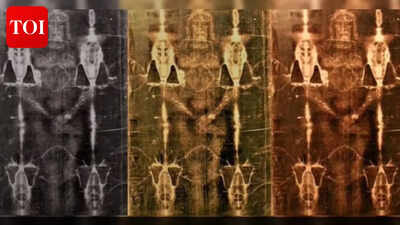
For followers of Christianity, items associated with Jesus Christ are held in the highest reverence. One such relic is the Shroud of Turin, a 4.4-meter-long linen cloth believed by many to be the burial shroud of Jesus.
While its authenticity has been debated for centuries, a modern DNA analysis has added a surprising new chapter to its history: a significant genetic link to India.
DNA analysis of Shroud of Turin
The Shroud of Turin has always been shrouded in mystery. However, a recent DNA analysis has made the intriguing history of the cloth even more exciting. A vast array of plant, animal and human material was found to be contaminating the shroud which measures 4.4 metres long and 1.1 metres wide. In 2015, Gianni Barcaccia at the University of Padova, Italy and his colleagues analysed material collected from the relic in 1978 and first suggested that it may have originated in India. Now, the expert led a new study reanalysing the material from 1978. He and his team found the shroud to have preserved a huge diversity of medieval and modern DNA. The sources of the genetic material include:
- Domestic cats and dogs
- Farm animals such as chickens, cattle, goats, sheep, pigs and horses
- Wild animals like deer and rabbits
- Fishes including grey mullet, Atlantic cod, ray-finned fishes
- Insects such as flies, aphids, and arachnids
The shroud also had DNA of some plant species including carrots, wheat species, peppers, tomatoes, potatoes, some brought to Europe after explorers began travelling to Asia and the Americas.
The Indian connection
The most startling discovery involved the human DNA present on the fabric. Along with plants and animals, the shroud had also come in contact with humans over the years. The team found human DNA from numerous individuals who have handled the shroud, including the team from 1978. “The Shroud came into contact with multiple individuals, thereby challenging the possibility of identifying the original DNA of the Shroud,” they wrote.Interestingly, nearly 40% of the human DNA found on the shroud is from Indian lineages. This could have resulted from historical interactions or from Romans importing linen from regions near the Indus valley, as per Barcaccia and his team. “The DNA traces found on the Shroud of Turin suggest the potentially extensive exposure of the cloth in the Mediterranean region and the possibility that the yarn was produced in India,” the team wrote.
The history of the Shroud of Turin
The Shroud of Turin is one of the world’s most famous and controversial Christian artefacts. It was first located in France in 1354 and for nearly half a millennium, it has remained at the Cathedral of Saint John the Baptist in Turin, Italy, since the 16th century.Many believe that the shroud is the linen burial cloth which was used to wrap the body of Christ prior to his burial after crucifixion, almost 2000 years ago. It bears the faint image of a crucified and scourged man as visible from the front and the back. While it may have existed for years, the shroud became a popular relic in 1898, when it was photographed by Italian lawyer and photographer Secondo Pia. In these widely circulated photographs, the figure, which is believed by many to represent the crucified Jesus, appeared much more clearly than it does to the naked eye. The cloth depicts the entire body of an approximately middle-aged man with a moustache, beard and long hair.
On one half of the cloth, the front side of the body is visible, while, on the other half, the back side is depicted. The two sides are oriented in opposite directions, with the face and the back of the head approximately in the centre of the cloth. Of particular interest to worshippers of the cloth and researchers of the context are the reddish stains on the image, which give the appearance of bloodstains and wounds. More importantly, they substantiate the texts of the Gospels about the crucifixion of Christ.
There are also swollen cheekbones and bruises with abrasions on the shoulders of the image, consistent with the Gospels. In 1988, researchers used radiocarbon and accelerator mass spectrometry dating to determine that the shroud was made sometime between 1260 and 1390, excluding the possibility that the person perceived as being imprinted on the cloth could have been Jesus. However, this dating of the shroud to the later medieval period remains contested by some Christian scholars.
Biblical alignment of the Shroud of Turin
Historically, there has been some evidence to corroborate the existence and authenticity of the shroud. Scholars have referred to the Pray Codex, an illuminated Hungarian manuscript. In the upper section of the miniature manuscript, the body of Jesus is shown in the scene of anointing after crucifixion. The Codex is reliably dated to around 1192–1195, making it roughly two centuries older than the age of the shroud.
As per scholars, there are some similarities between the images of the two objects, including details such as the hidden thumbs behind the palms. In 1203, Robert de Clari, a French Crusader, recorded that the church My Lady St. Mary of Blachernae in Constantinople displayed, every Friday, a cloth believed to be Christ’s burial shroud, with his figure clearly visible on it. Moreover, some hypotheses accept the Resurrection of Christ.
They suggest that the image on the Shroud was formed under supernatural and rather rare conditions. It is the inalienable right of each individual to believe or not believe in the miracle of the Resurrection. However, if one accepts the authenticity of the Shroud and believes in the Resurrection, it is a rather oxymoronic attempt to explain a supernatural miracle through science.
In the New Testament, the burial shroud is mentioned in three Gospels.
In the corresponding passage of the Gospel of John (19:40), it is described that Jesus’ body was wrapped with strips of linen, without reference to the use of a single linen cloth, as in, the shroud. In the passages of the Resurrection, the Gospels of Matthew and Mark make no mention of any cloth or strip, while, in the Gospels of Luke (24:12) and John (20:5 & 20:6), it is written that the disciples who visited the empty tomb found linen strips, with no shroud mentioned; in John’s Gospel, the sudarium is mentioned (20:7).
Therefore, after the Resurrection, none of the four Gospels mentions the burial Shroud of Jesus, as per a 2025 research published in Textiles. It is also striking that the book of the Acts of the Apostles, which describes events following Jesus’ Resurrection from a Christian perspective, makes no mention of any cloth associated with Christ, either a shroud or linen strips. Whether truly adorned by Jesus Christ or not, followers and worshippers maintain that the Shroud of Turin is worthy of respect and veneration. It is still held in a religiously high regard and was even prayed before by the late Pope Francis during its most recent exposition in 2015.