
India’s reliance on imported gas, particularly LPG and LNG, is highlighted due to geopolitical tensions affecting the Strait of Hormuz. Disruptions impact millions using LPG for kitchens and industries relying on LNG for power and fertilizer production, underscoring energy security concerns.
The fear of an LPG supply shortage has suddenly made India’s dependence on imported gas a daily reality for millions. With tensions in West Asia and repeated disruptions at the Strait of Hormuz – a narrow waterway that carries more than 20% of global energy flows – gas is back in focus.Gas now sits at the core of India’s energy security debate because it powers everything from homes and cars to fertiliser plants and power stations.To make sense of the crisis, it is necessary to understand the difference between LPG, LNG, PNG, and CNG. Though they all fall under the “gas” umbrella, they are processed and used in very different ways, and that difference influences how much India is exposed to global shocks.
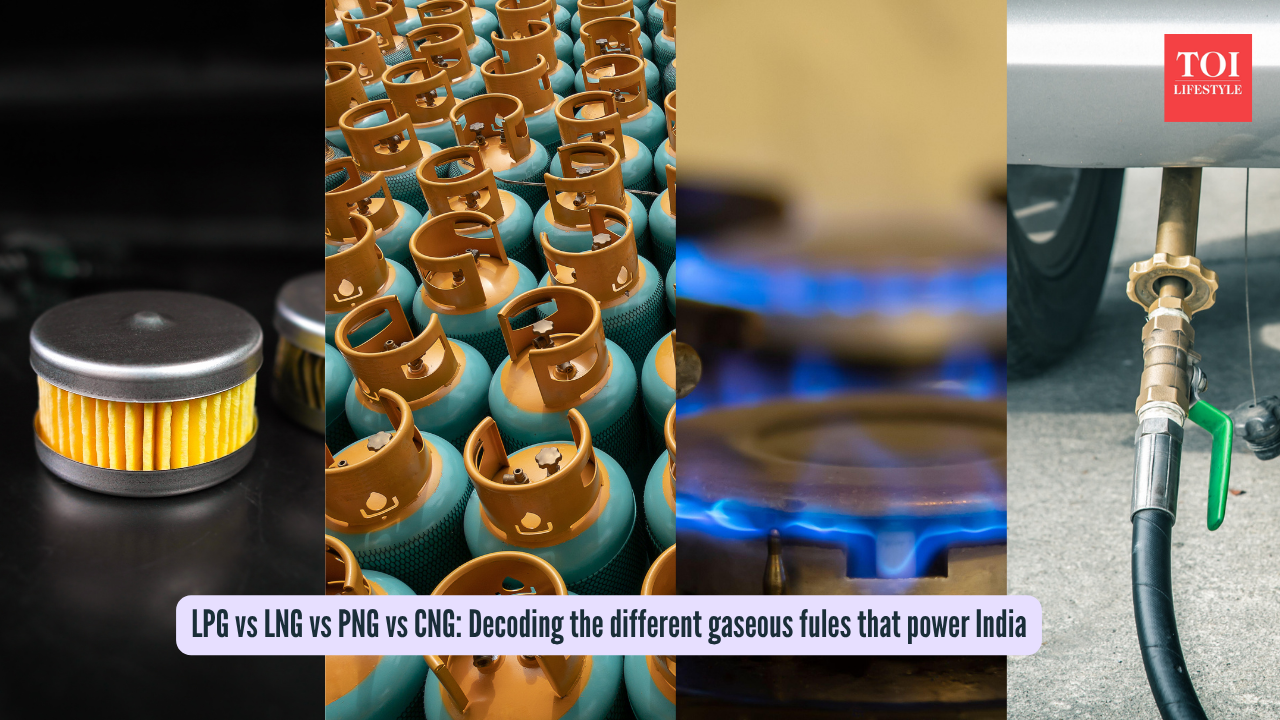
LPG vs LNG vs PNG vs CNG: Decoding the different gaseous fules that power India
liquefied Petroleum Gas(LPG): The gas that fuels our kitchens
LPG, or liquefied petroleum gas, is the gas that comes in cylinders and powers your stove. It is mainly composed of propane and butane, stored as a liquid under pressure, which makes it easy to move around. India produces some LPG domestically but still imports around 60% of its total requirement, much of it from the Middle East, making it highly sensitive to conflict and shipping delays at the Strait of Hormuz.The government has used schemes like the Pradhan Mantri Ujjwala Yojana to expand access for low‑income households.
Compressed Natural Gas (CNG): Cleaner choice of fuel for buses and cars
CNG, or compressed natural gas, is mostly methane squeezed into high‑pressure tanks for use in vehicles. Running at roughly 200–250 kg/cm², it allows cars and buses to carry a lot of fuel in a small space. It burns more cleanly than petrol or diesel, cutting urban pollution and greenhouse‑gas emissions.CNG is supplied through city‑gas networks and filling stations, and in recent years it has become a key part of India’s push to clean up transport.
However, when LNG imports get disrupted, refilling stations can face pressure because most of the gas ultimately comes from imported LNG or domestic fields.
Piped Natural Gas (PNG): The quiet backbone of urban homes
PNG, or piped natural gas, is also natural gas made mostly of methane, but instead of being provided in cylinders, it reaches homes and factories through a network of pipelines. Because PNG is supplied through pipes, the networks usually have reserve stocks and are given priority, which makes them more stable than LPG when supply is disrupted.PNG burns very cleanly and runs continuously, so the government is promoting it as a safer and more convenient alternative to cylinder‑based LPG. However, if LNG and pipeline gas supplies fall short, even households using PNG may eventually feel the impact.
Liquefied Natural Gas: Gas travels across oceans
LNG, or liquefied natural gas, is natural gas (mostly methane) cooled to about –160°C so it turns into a liquid and fits into big tankers. After arrival at Indian ports, it is “regasified” and then sent via pipelines to power plants, fertilizer units, city‑gas networks, and industries.Qatar supplies about half of India’s LNG, and most of those shipments pass through the Strait of Hormuz, exposing India to any conflict‑related disruption.