
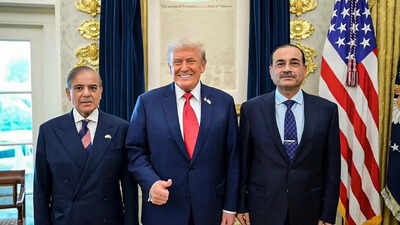
Pakistan is once again caught between allies and adversaries. Islamabad finds itself pulled between powerful partners and dangerous neighbourhood realities, between competing risks.
As war between Iran and the Gulf states continues to spiral, Islamabad’s response has been strikingly cautious. Officials insist there is “no question” of rushing to Saudi Arabia’s defence, even as they reaffirm a long standing strategic pact with Riyadh.Time and again, it has aligned with stronger powers in conflicts that promised influence, aid or strategic leverage, only to face instability and blowback at home.
Defence minister Khawaja Asif recently reminded lawmakers that Pakistan’s past involvements in foreign wars were never fought for its own purposes. “These were not our wars; they were superpower wars,” he said, adding bluntly that Pakistan had been “used… and then thrown away like toilet paper”.
His words echo a longer narrative of strategic overreach.In the 1980s Afghan war and again after 9/11, Islamabad aligned with great powers to secure foreign aid and diplomatic favour.
But the domestic costs were steep. Paramilitary groups and jihadist networks nurtured for proxy wars later destabilised Pakistan itself. Asif now calls those choices “mistakes” that fueled terrorism and economic strain. He lamented that Pakistan has failed to learn from history, continually “turn[ing] to Washington, sometimes to Moscow, and sometimes to Britain” for quick gains.
Indeed, Pakistan’s pattern of seeking “short-term interests” from external patrons has repeatedly traded long-term stability for short-lived relevance abroad.Today, as another regional confrontation wreaks havoc across the Middle East, Pakistan stands at a familiar crossroads, weighing the pull of alliance against the cost of entanglement and asking whether it can finally break a cycle that has defined its strategic history.
Lessons from history: Proxy wars and blowback
Pakistan’s founding strategy in Afghanistan and beyond was shaped by the idea of “strategic depth” using proxies and friendly governments to hedge against regional threats, particularly from India.
During the 1980s Soviet-Afghan conflict, Pakistan invited the US and Saudi support to train mujahideen fighters against the USSR. Its military dictatorship at the time framed this as a holy cause, but leaders were driven by seeking legitimacy and aid.
The result was a proliferating network of Islamist militias that later launched attacks across South Asia. After 9/11, then-President Pervez Musharraf again aligned with Washington in the “War on Terror,” providing bases and intelligence.
Billions in aid flowed in, but Pakistan’s internal stability deteriorated. Militants that had found safe haven inside Pakistan from the Haqqani network to Lashkar-e-Taiba to the newly formed Tehreek-e-Taliban Pakistan (TTP) turned their guns inward. The devastating toll of terrorism in the 2000s and 2010s is widely seen now as blowback from these foreign entanglements.
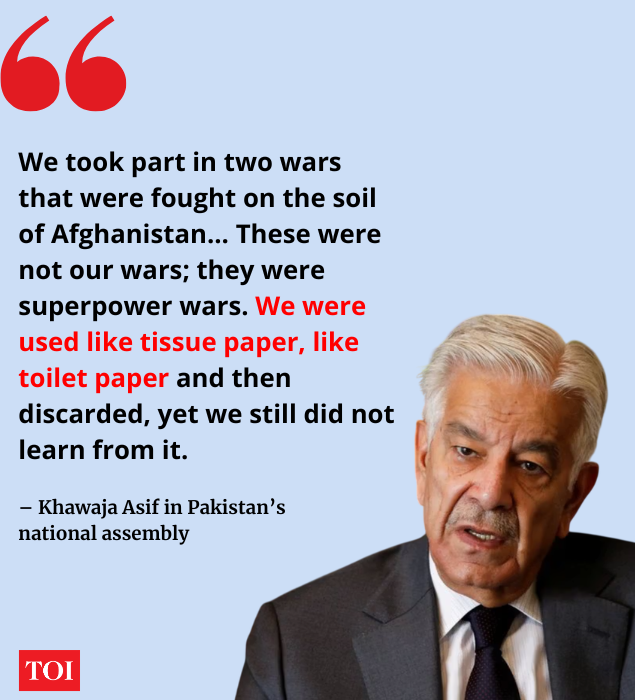
By the time Khawaja Asif spoke in parliament, many Pakistani officials acknowledged the bitter lesson: Pakistan’s leaders “entered those conflicts in the name of Islam and religion” but were serving “global powers” and were discarded when convenient.
The deflating reality, as Asif put it, is that past alignments were mainly useful to others, not Pakistan. He even recalled how the US treated the country as a once-useful pawn, a “pawn that was replaced” after its utility ended.
That sense of betrayal underlies current wariness. Pakistan’s generals and diplomats now stress that future commitments abroad must be carefully vetted for national interest, not just immediate payoff.
The Saudi-Pakistan defence pact: Alliance or ambush?
Pakistan’s Prime Minister Shehbaz Sharif and Saudi Crown Prince Mohammed bin Salman signing a mutual defence agreement in Riyadh, September 2025. In September 2025, Islamabad codified its security alliance with Riyadh by signing a Strategic Mutual Defence Agreement. State media from both countries announced that “any aggression against either country shall be considered an aggression against both”. The pact was presented as the “culmination of years of discussions” and a formalisation of decades-long cooperation.
Observers noted that by framing it like a NATO-style commitment, Saudi Arabia, facing a shaken faith in US guarantees, was in effect expanding its security umbrella. Pakistani officials insist the treaty was not aimed at any specific adversary. But its timing, after an extraordinary Arab League session on Gulf security, underscored the shift: Gulf states, including Saudi Arabia, openly questioned US reliability and looked to partners like Pakistan for reassurance.
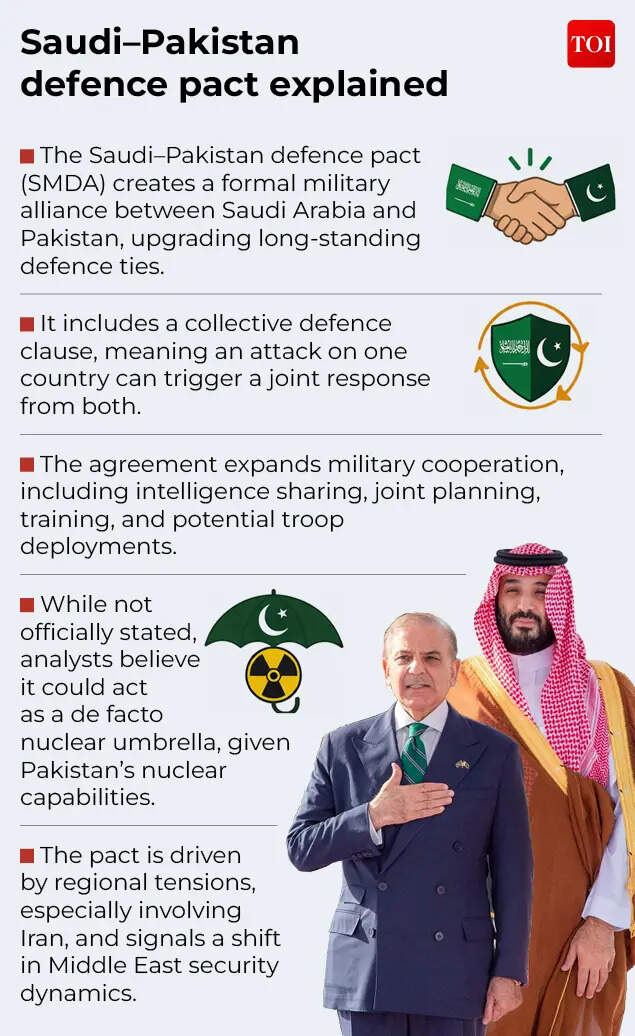
Defence minister Asif was quick to tout Pakistan’s role in the new alliance. In media interviews he declared, “No one should doubt what we have and what the capabilities will be that are available to them under this pact,” words widely understood as an implicit promise of Pakistan’s nuclear protection to Saudi Arabia. Within days, he backtracked, clarifying that nuclear weapons were “not on the radar” of the agreement.
This ambiguity, potent rhetoric followed by cautious retreat – highlighted the risks of the deal. Even without explicitly sharing atomic arms, the agreement deepened Riyadh’s reliance on Islamabad. Analysts in Washington and Islamabad noted the changed calculus in the Gulf: the pact signaled a significant pivot away from US defense guarantees.Interestingly, the pact has already raised eyebrows in Pakistan, with officials warning it is “becoming a problem” as regional tensions rise.
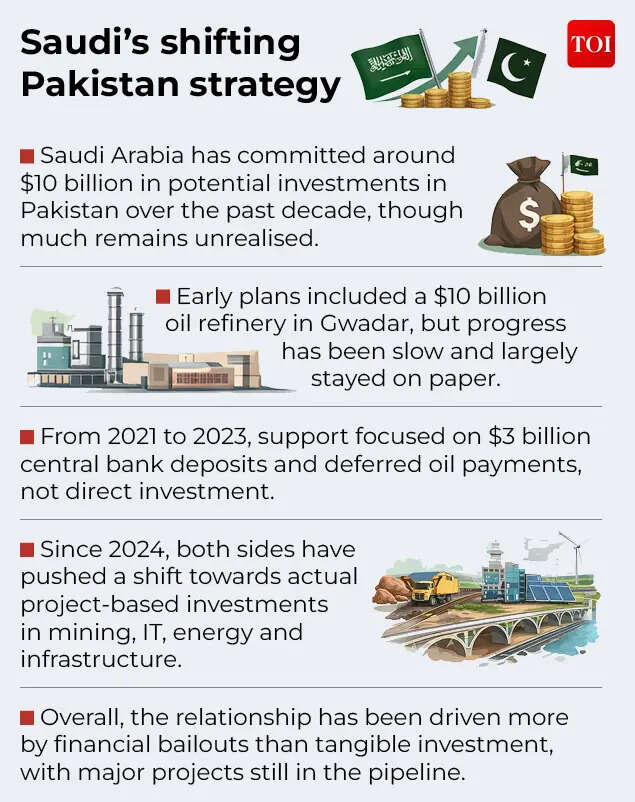
According to a Financial Times report, a source familiar with senior military thinking said the Saudi defence deal was meant to deliver “cash for deterrence”, but “we’ve not gotten any new Saudi investments, and deterrence failed”.Officials fear the agreement could drag Islamabad into a wider conflict following Iranian strikes on Saudi territory. Analysts echoed these concerns, with Kamran Bokhari saying the challenge is not just geopolitical but driven by strong anti-US and anti-Israel sentiment at home, which has created public sympathy for Iran and constrained Pakistan’s options.
Between Riyadh and Tehran: Pakistan’s balancing act
Even as it deepens ties with Saudi Arabia, Pakistan has emphasized restraint and balance. Its officials have tried to reassure Tehran even while reassuring Riyadh. In recent weeks, Islamabad’s public statements have conveyed solidarity with Saudi Arabia’s security concerns alongside appeals to Iran for calm. A Dawn analysis noted how a carefully-worded Pakistani communique on Saudi soil’s bombing “signal[led] solidarity with Riyadh” but immediately urged Iran, the “brotherly country,” to avoid miscalculation.
In a routine diplomatic shuttling, Deputy Prime Minister Ishaq Dar reportedly established “shuttle communication” between Tehran and Riyadh to defuse tensions. He reminded Iranian officials that Pakistan had a defence pact with Saudi Arabia, but he also secured Iranian assurances that Pakistan’s territory would not be used as a launchpad against Iran.
This language reflects Pakistan’s dual-track diplomatic instinct.
On the one hand, Pakistani spokesmen publicly acknowledge the gravity of attacks on Saudi Arabia and insist on support within the pact framework. On the other hand, they add calls for restraint. The 13 March Dawn commentary notes Islamabad “cannot ignore its security partnership with Saudi Arabia nor can it afford a rupture with Iran,” so it carefully crafts statements “on multiple levels” to manage both relationships.
Thus, Pakistani officials will stress that the defence agreement binds Islamabad to Saudi security, yet fall short of an open military commitment. As Dawn concludes, Islamabad’s posture is one of “solidarity without committing to escalation.”This cautious stance has historical precedent. In fact, Pakistan’s official line toward Middle Eastern conflicts long has been non-interventionist. When the US-Iran standoff flared in early 2020, Foreign Minister Shah Mehmood Qureshi bluntly stated that “Pakistan’s soil will not be used, nor will [it] become part of this regional conflict”.
He emphasized that Pakistan did “not endorse any unilateral action” in the Gulf.
Today, as war clouds gather, Islamabad is striking a similar note. One senior Pakistani source insisted publicly that the country “will not be rushed” into combat—even under the Saudi pact. Instead, Pakistan’s leadership is “engaging deeply” with regional actors to defuse tensions. In part this reflects hard calculations: Pakistan shares a 900+ km border with Iran and significant trade and communal ties.
Its domestic stability is fragile, with a large Shia minority (15–20% of the population) that is sympathetic to Iran. Pakistani policymakers are well aware that if war spills over or polarizes public opinion, the blowback could be severe.
A broker under strain
Yet, as in the past, Pakistan’s external opportunity is unfolding alongside a deepening internal fragility that risks constraining any diplomatic gains. Islamabad’s attempt to mediate between the United States and Iran may elevate its international standing, but it also places the country in a position of heightened exposure.
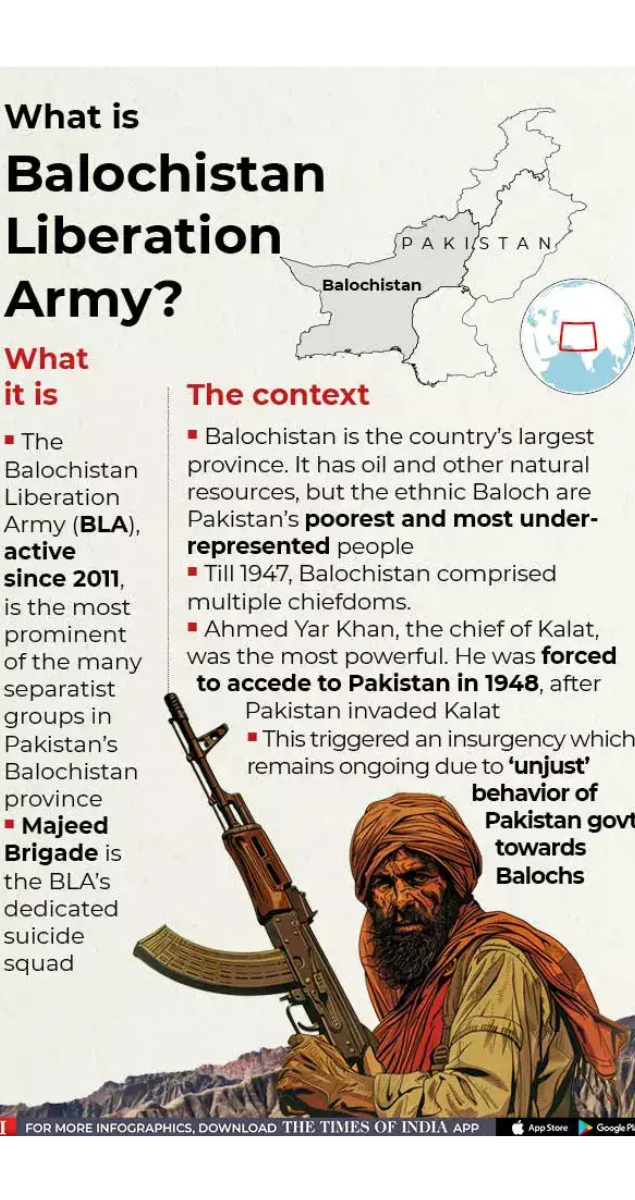
Acting as an intermediary in an active conflict inevitably invites scrutiny and pressure from all sides, particularly if mediation efforts falter or are perceived as biased.This vulnerability is most acute in Balochistan, where long-standing instability is intersecting with new geopolitical pressures. Security assessments suggest that militant networks are already adapting to the shifting regional landscape, with the Iran conflict creating both operational space and ideological momentum.
Groups such as the Baloch Liberation Army and the Tehreek-e-Taliban Pakistan are not only intensifying attacks but also recalibrating their strategies towards the Iran-Pakistan border, anticipating a redistribution of state attention and resources.Crucially, this is not simply a question of increased violence, but of convergence. Separatist insurgencies, jihadist organisations and sectarian networks are increasingly overlapping in geography and, at times, coordination.
The Iran war adds a further accelerant. As Tehran becomes more deeply engaged in conflict, the risk of proxy dynamics spilling into Pakistan rises, whether through material support, ideological mobilisation or retaliatory targeting.
This creates a scenario in which local grievances in Balochistan are amplified by external rivalries, making containment significantly harder.There is also a structural dimension to this fragility. Pakistan’s security apparatus is already stretched across multiple fronts, from the Afghan border to internal counterterrorism operations.
Any sustained escalation linked to the Iran conflict risks forcing difficult trade-offs in resource allocation. In such a context, even limited instability can have disproportionate effects, particularly in peripheral regions that have historically felt politically and economically marginalised.
The Afghan front: Escalating conflict at home
While Pakistan juggles ties in the Gulf, conflict is erupting on its western border. In late February 2026, Islamabad unleashed a dramatic escalation with Afghanistan.
Pakistani jets, for the first time in decades, bombed Taliban-controlled cities – including Kabul and Kandahar – in a broad retaliation against Taliban positions. Foreign Minister Asif immediately characterized the situation as “open war”. The trigger was a suicide bombing in Islamabad claimed by the Pakistani Taliban (TTP), an Afghan-based insurgent group.
Pakistan accuses the Taliban government of sheltering these militants inside Afghanistan, a charge Kabul denies.The fighting between erstwhile allies has been fierce. Pakistani strikes targeted Taliban military installations, prompting hundreds of return strikes on Pakistani border posts and towns. Although each side claims disproportionate losses, independent reports emphasize that the clashes mark the bloodiest confrontation since the Taliban took Kabul in 2021. Pakistani media reported dozens of Taliban fighters killed, while Taliban sources claimed significant Pakistani casualties – figures that are impossible to verify.
The upshot is clear: Pakistan is now devoting precious resources to a neighbour who was once a supposed ally. In the past, Islamabad enjoyed “strategic depth” in Afghanistan; today, those gains have turned to liabilities. The TTP, nurtured during past proxy wars, remains active, and Pakistan’s counter-insurgency operations have spilled over the border.This new Afghan front compounds Pakistan’s strategic strain.
As one Atlantic Council analyst notes, an intensifying Iran conflict could further embolden insurgents – from Baloch separatists in the southwest to the TTP in the northwest – placing Pakistan in “a worsening conflict on its northwestern border” while still facing tension with India in the east. More importantly, the Afghan front is not a separate crisis but a direct consequence of the very strategic choices that once promised Pakistan security and influence.
The militant networks Islamabad cultivated for leverage in Afghanistan have not disappeared; they have fragmented, adapted and, in many cases, turned inward. What Pakistan now confronts along its western border is not simply instability, but the accumulated residue of its own past policies.This is what makes the current moment uniquely constraining. As tensions rise in the Gulf, Pakistan is no longer dealing with external pressures alone.
It is managing the simultaneous unravelling of earlier strategies at home and in its immediate neighbourhood.Stability vs. Relevance: An unending questionPakistan’s dilemma today is often framed as a choice between competing pressures. In reality, it is the product of a strategy that has steadily narrowed its own room for manoeuvre. Decades of reliance on external patrons and proxy actors have delivered moments of influence, but at the cost of deepening internal fragility and strategic dependence.What remains is not so much a balancing act as a structural trap. Commit too much, and Pakistan risks entanglement in conflicts it cannot control. Hold back, and it risks irrelevance with partners it cannot afford to lose. This is no longer flexibility; it is constraint.The coming months will test whether new lessons have been learned – or whether Pakistan’s leaders will find themselves, as in the past, “used and thrown away” in a larger game they were never really a part of.
Stay updated with our Live Blog for minute-by-minute coverage of the Israel Iran War including breaking news, missile attacks, and Middle East crisis Latest Updates

