
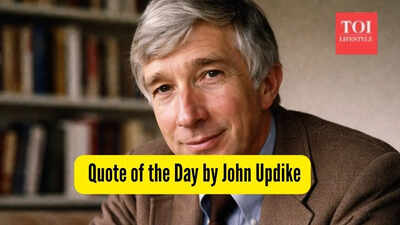
John Updike was one of the most important American writers of the 20th century. He was known for his clear writing, deep understanding of psychology, and detailed descriptions of middle-class life in the US.
Born on March 18, 1932, in Reading, Pennsylvania, and raised in the nearby town of Shillington, Updike grew up in a simple but smart home. Linda Grace Updike, his mother, was an aspiring writer who strongly supported his writing goals. Wesley Updike, his father, was a high school teacher. From a young age, Updike showed that he was very talented. He went to Harvard which helped improve his writing. After getting his degree in 1954, he spent a year at the Ruskin School of Drawing and Fine Art in Oxford, England.
This was a sign of his lifelong interest in visual art, which would later show up in his writing style, which was very descriptive.Updike started working for The New Yorker in 1955, and this job would become very important to his writing career. He was first hired as a staff writer, but later he became a regular contributor, writing short stories, poems, and essays. His work with The New Yorker gave him a platform and a steady stream of readers, which helped him find his own voice.
His early stories often dealt with marriage, religion, sexuality, and life in the suburbs—subjects that would stay important to him throughout his career.
In 1960, Updike’s big break came when Rabbit, Run was published. Harry “Rabbit” Angstrom, a former high school basketball star who is having trouble with the rules of adult life, is introduced in this book. The character was the main focus of the Rabbit series, which includes the books Rabbit Redux, Rabbit Is Rich, and Rabbit at Rest.
These books tell the story of one man’s life over several decades of social and cultural change in the United States. Many people think the series is one of the best things to happen to modern American fiction. Rabbit Is Rich and Rabbit at Rest both won the Pulitzer Prize for Fiction, making Updike one of the few writers to win the award twice.In addition to the Rabbit books, Updike wrote more than 20 other novels, many short story collections, poetry, literary criticism, and essays.
The Witches of Eastwick is one of his most famous books. It is a novel that combines real life with fantasy to look at issues of women’s power and desire. The book was later made into a successful movie, which added to Updike’s cultural impact. Another important book, Couples, caused a lot of debate because it honestly showed how suburban couples had sex.
This was a sign of the changing morals of the 1960s. One thing that sets Updike’s writing apart is how much he pays attention to small details.
He had a special talent for capturing the textures of everyday life with almost photographic accuracy. This included the look of a room, the rhythm of a conversation, and the inner thoughts of his characters. People often say that his writing is lyrical and elegant, but it is also based on the boring realities of everyday life. He was especially interested in topics like religion, death, cheating, and the passage of time.
His characters often struggle with spiritual uncertainty, which is similar to Updike’s own complicated relationship with faith.Along with writing fiction, Updike was also a well-known literary critic. His essays and reviews, many of which were published in The New Yorker and later collected in books like Picked-Up Pieces and Hugging the Shore, show how smart and involved he was with literature. He thought that literary tradition was very important, and he often wrote about writers from different times and places.
His criticism is known for being both smart and kind, as he doesn’t make harsh judgements but instead thinks about them carefully.
Even though Updike did a lot of great things, he still had critics. Some readers and scholars have said that his writing is too focused on the lives of white, middle-class people who live in the suburbs, and that it often ignores bigger social and political issues. Some people have said that his portrayal of women is sexist and that his female characters are sometimes seen through a male-centered lens.
But even these criticisms recognise his technical brilliance and his important role in American literature.The work of Updike has had an impact on more than just his own. He helped change what it meant to write about everyday life by showing that the lives of people who seem unremarkable can be described in a way that is deep, beautiful, and meaningful. His work is a detailed history of American society after World War II, showing how culture, values, and identity changed over the years.
For a lot of people, his writing is both a mirror and a record of a certain time in American history.
Updike won many awards and honours during his career, such as the National Book Award, the Pulitzer Prize, and the National Book Critics Circle Award. He was also a member of the American Academy of Arts and Letters, which shows that he was one of the most important writers of his time.John Updike died on January 27, 2009, at the age of 76, from lung cancer.
His death brought an end to a long and successful career in writing that lasted more than 50 years. His work is still widely read and studied, even after he died, and it has an impact on new generations of writers and readers.Quote of the Day“Suspect each moment, for it is a thief, tiptoeing away with more than it brings” is one of the most famous lines of John Updike from A Month of Sundays. He says that every moment that goes by takes something away from us, even if we don’t notice it right away. We often think that time gives us experiences and memories, but Updike reminds us that it also takes things away from us all the time, like our youth, opportunities, and chances that will never come back. He calls each moment a “thief,” which gives time a hidden, almost dangerous quality. This shows that it moves silently and without warning.
The quote reminds us to be more mindful of how we spend our time and not take it for granted. Overall, it shows a thoughtful and slightly sad view of life, telling us to appreciate the present because once a moment is gone, it is gone forever.

