
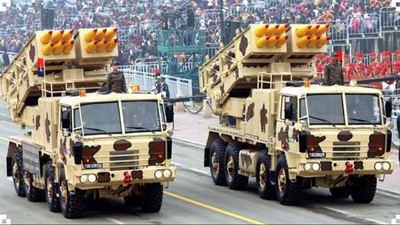
NEW DELHI: With increased security threat along the western and northern frontiers, especially after last year’s conflict with Pakistan, the Indian Army has added another Pinaka regiment and is preparing to induct one more by the end of the year, it is learnt.With the operationalisation of one more regiment, the Indian Army now has seven Pinaka rocket launcher regiments deployed along its borders with Pakistan and China. “The eighth regiment has received more than half its equipment. It should become operational before the end of 2026,” a source in the defence establishment said.Two more regiments are likely to be operationalised next year, which will take the total number of Pinaka regiments in deployment to 10.
The Army has a long-term goal of 22 regiments, equipping them with newer, longer-range guided versions, which would replace older systems.The urgency to raise more regiments was felt especially after the Indian Army’s Galwan Valley clash with Chinese troops in June 2020. In Aug 2020, the Army signed contracts with Bharat Earth Movers Ltd (BEML), Tata Power Company (TPCL) and Larsen & Toubro (L&T) for supply of six Pinaka regiments at an approximate cost of Rs 2,580 crore.
Developed by DRDO, Pinaka is India’s premier indigenous multi-barrel rocket launcher. While early versions had a range of 40 km, newer variants such as Guided Pinaka and Long-Range Guided Rocket (LRGR) have extended ranges of up to 120 km, making the system a critical asset for deep-strike operations. Pinaka is battle-proven and had demonstrated its effectiveness during the 1999 Kargil war, neutralising Pakistani positions on mountain tops.Armenia is the first country to have purchased and received the Pinaka multi-barrel rocket launcher system from India; France, Saudi Arabia, Vietnam and Indonesia have also shown interest in procuring the multi-barrel rocket launcher system.A Pinaka regiment typically comprises three batteries. Each battery operates six Pinaka launchers, giving a regiment 18 launchers in combat configuration. Two additional launchers are generally maintained for training and wartime replacement. A single battery of six launchers can fire 72 rockets in about 44 seconds. Named after the divine bow of Lord Shiva, it is designed for rapid, high-volume fire to saturate large areas and neutralise enemy troop concentrations, logistics hubs and infrastructure within minutes.
The system is mounted on a high-mobility Tatra or Tata truck, featuring “shoot and scoot” capability that allows it quickly relocate after firing and avoid counter-battery fire.