
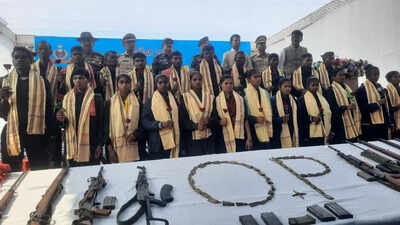
A few surrendered Maoists
When Pramod Kumar Satpathy, an assistant commandant of the Odisha police’s Special Operations Group (SOG) — a specialized anti-Naxal force — was conferred the Ashok Chakra posthumously on Oct 14, 2018, the honour carried both immense pride and immeasurable sorrow for his family.
Satpathy and 13 other security personnel had laid down their lives on Feb 16, 2008, during a fierce encounter with Maoists in the dense Gosama jungle near the Ganjam–Kandhamal border, a day after an attack by the Naxals on Nayagarh district police armoury. Years later, on March 31, when Odisha police officially declared the state free of Maoist insurgency, the announcement was hailed as a historic milestone. Yet, grief and resentment simmered quietly among families who had lost loved ones to Maoist violence.
For them, the victory was bittersweet.What Families Have To SayFor many bereaved families, the announcement of a Naxal-free Odisha reopened wounds rather than healing them. They watched with mixed emotions as surrendered Maoist leaders — accused of orchestrating killings, ambushes and abductions — were welcomed with garlands, bouquets and financial rewards that sometimes reached as high as Rs 1 crore. To the families of slain police martyrs and civilians, this spectacle felt like salt being rubbed into their wounds.
“We thank the govt for wiping out left-wing extremism, but it pains us to see Maoists being garlanded and rewarded. They should have been given stringent punishment,” Satpathy’s wife, Amita Satpathy, said.In a quiet displacement colony of Narayanpatna block in Koraput district, the family of slain village guard Jagabandhu Tadingi lives with memories that refuse to fade. On the night of Dec 31, 2009, while people elsewhere were celebrating New Year’s Eve, a group of Maoists stormed into his home, accusing him of being a police informer.
“They came around 8 pm when all of us — my parents, three brothers and three sisters — were in our hut in the fields.
They mercilessly killed my father,” recalls his eldest son, Bapi Tadingi.The family had received Rs 5 lakh as govt compensation, but they say it was insufficient to rebuild their lives or restore a sense of security. While Bapi acknowledged the improved security situation and the state’s claim of being Maoist-free, there is a sense of injustice in his mind.
“Those who were once involved in violence are now being rewarded and rehabilitated, but families like ours are still struggling. I have requested many times for a home guard job,” he said.
Similar anguish was voiced by Sunaram Tudu, elder brother of martyred SOG commando Sudhir Tudu, who, along with colleague Debasis Sethy, was killed by Naxals in Kalahandi district on Sept 9, 2020. “It is shocking that anti-national elements are being shown leniency and given financial rewards after waging war against the state and killing innocent civilians and security personnel.
They should have been arrested or gunned down,” Tudu said.Another family member questioned the fairness of the policy. “If criminals are arrested and jailed for murder, extortion and abduction, why are Maoists — who committed the same crimes — being treated in such a lenient manner,” Parsu Majhi, kin of civilian Lalabari Majhi, who was killed by Maoists in Kalahandi district on suspicion of being a police informer on Nov 24, 2022, said. The family members of some other victims pointed out that top Maoist leaders such as Sabyasachi Panda and Dunna Kesava Rao, alias Azad, had been arrested and remained behind bars, while others were granted amnesty and rehabilitation. “Why is the law different for different cadres?” a victim’s relative asked.Govt’s StandOfficials defended the surrender-and-rehabilitation policy as a pragmatic necessity. A senior home department officer said, “We chose peace over endless bloodshed.
By welcoming them back, we ensured they laid down arms. It is not about forgetting the past, but securing the future.”ADG (anti-Naxal operations) Sanjeeb Panda credited the Maoist-free Odisha tag to the sacrifices of security personnel, civilians and all others, including SOG, district voluntary force, special intelligence wing and central forces involved in the decades-long battle. “We stand with the families of 239 security personnel and 359 civilians who lost their lives in Naxal attacks in Odisha,” Panda said.—————————————-‘Feel sad when I reflect on the past… many lives were lost’Niranjan Rout alias Nikhil, a top Naxal leader who was a member of CPI (Maoist)’s state committee and, along with his wife carried a bounty of Rs 1.10 crore, surrendered on Feb 7 this year. Debabrata Mohapatra speaks to the 44-year-old as he looks back on the path he chose as a youngster and what prompted him to lay down arms. Excerpts:Was it the fear of encounters, the govt’s lucrative rehabilitation policy, or a change in ideology that convinced you to surrender? When I was 21 years old, I was deeply influenced by Maoist ideology and their call for armed revolution.
At that time, it seemed like the only way to fight for the rights of the poor, the oppressed and the marginalized sections of society who had been neglected for generations. However, gradually I realized that armed struggle was no longer a necessary or an effective path and that change can only be achieved through democratic means.
I want to emphasize that my decision was not driven by fear of death or encounters, nor by the lure of govt rewards.
I supported govt’s Naxal-free movement.Looking back, how do you view the violence committed by Maoists against security forces and innocent civilians? Do you feel a sense of remorse or justification? I feel a deep sense of sadness when I reflect on the violence of those years. The loss of lives was immense – security personnel, civilians and our own comrades – all paid the price. At that time, within the movement, our actions seemed justified because we believed we were fighting for a larger cause.
Personally, I survived nearly 15–20 encounters with security forces, often escaping death by a whisker.Did senior Naxal cadres intimidate and exploit innocent tribals into joining their illegal movement? We never forced anyone to join us. Our intention was to be the voice of the villagers who had been oppressed, neglected and ignored by mainstream governance. We tried to sensitize them about our vision and the reasons behind our struggle.
Those who joined us did so voluntarily.Maoists are accused of extorting money, subjecting women cadres to sexual assault and killing civilians on suspicion of being police informers. What do you have to say to that? Like in any large organization, there are always some individuals who engage in wrongdoing. Unfortunately, the misconduct of a handful of people tarnished the image of the entire movement. The allegations of systematic extortion and harassment of women cadres are, in my view, exaggerated and unfounded.
As for civilians, they were never our intended targets. Our struggle was against the system, not against innocent people.
Did factionalism in leadership lead to the failure of your movement? Differences in opinion among cadres became visible, especially around 2020. Some of us felt that the armed struggle had outlived its purpose. But the top leadership insisted on continuing the armed movement. This ideological divide weakened our unity. Inability of the leadership to adapt to changing realities and make the right decisions ultimately led to the movement’scollapse.

