
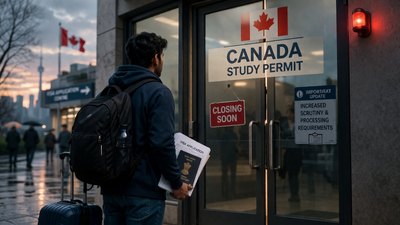
A Canadian audit shows Indian nationals dominated SDS approvals despite flagged risks and a slow response (Image AI generated)
A Canadian government audit has exposed a troubling contradiction at the heart of the country’s international student regime: Even as internal concerns mounted over fraud, weak oversight and “non-genuine students”, an India-dominated fast-track visa route, Student Direct Stream (SDS), continued to receive unusually high approvals.
The report on International Student Programme Reforms shows that Indian nationals overwhelmingly drove approvals under the SDS, even as Canada’s own system had flagged integrity risks and was slow to respond. Now, with that easy-entry phase over and scrutiny tightening, the real cost may not be borne by those who exploited the gaps, but by genuine Indian students entering a system made more suspicious and harder to navigate.
India at the heart of Canada’s visa contradiction
Canada’s international student system did not just expand, it ballooned. The Office of the Auditor General of Canada notes that study permit applications rose 121 per cent between 2019 and 2023, from about 4.26 lakh to 9.43 lakh. Even before the clampdown, the Canadian government’s own 2023 internal review had flagged the pressure points: Integrity risks, student vulnerability and a troubling lack of diversity in the international student population.
India sits at the centre of this story.The audit points squarely at Immigration, Refugees and Citizenship Canada (IRCC), saying the department was slow to respond to integrity concerns in the SDS.Almost all approved applications in that stream, the audit says, came from India. 96 per cent of SDS approvals in 2022 were for Indian nationals; the figure stayed at 96 per cent in 2023 and was still 87 per cent in 2024. Yet applications in this route were subjected to what the audit calls a “light touch” eligibility review, even though India had been assigned a high-risk profile by the department’s own risk assessment units.
The Auditor General says the department had identified integrity risks in SDS in 2022 and, by August 2023, had flagged that the stream was being targeted by “non-genuine students”. Still, scrutiny did not meaningfully tighten. Instead, approval rates for Indian nationals processed through SDS climbed from 61 per cent in 2022 to 98 per cent in 2024. This was not a case of ignorance as the alarms had already gone off. The system, however, just did not seem in much of a hurry to take action.
Why SDS became an India-heavy corridor
Canada designed SDS as an expedited route for legal residents of 14 countries who could meet heavier upfront conditions: Full first-year tuition paid, a Guaranteed Investment Certificate, qualifying language scores, and other supporting documents. In theory, that was the bargain: More paperwork upfront, faster processing later. This eligibility design fit a segment of Indian applicants quite neatly who could front-load proof of finances and paperwork in exchange for faster processing.Moreover, India was already Canada’s biggest international student source market even outside the SDS stream. IRCC’s own briefing notes say India accounted for 45 per cent of Canada’s international students in 2022. Another official note says the number of Indian study permit holders rose from 218,522 in 2019 to 427,083 in 2023. For a market already sending very large numbers of students to Canada, a speedier, document-heavy route was bound to attract heavy use.
Speed is not, in itself, a flaw. The trouble starts when a system moves quickly and leans too heavily on one stream, putting security at stake.
Canada’s warning signs did not trigger tougher scrutiny: Here is why
The audit shows that IRCC had already identified integrity concerns in the SDS. By August 2023, it had also flagged that the route was being used by “non-genuine students”. Yet tougher scrutiny did not follow with any real urgency. The reason seems to lie in a contradiction Canada never quite resolved.
It wanted to rein in excess, but not at the cost of shutting down a major intake stream. It wanted integrity, yes, but also volume, economic gain, labour-market supply, and a migration pathway that still looked attractive.
So, the hesitation was there despite the red flags. The hesitation becomes harder to defend in the next set of findings. The Office of the Auditor General of Canada says three reports had identified 800 approved study permits issued between 2018 and 2023 in cases where applicants had either used fraudulent documentation or misrepresented information to gain entry into Canada.
Of these, 541 permits, or 68 per cent, had been approved under the Student Direct Stream.
The examples are not minor aberrations. In 710 cases, applicants claimed to have studied at overseas institutions that risk assessment units later found to be either non-existent or effectively in the business of selling qualifications for immigration purposes.The audit notes that the department’s own policies allowed it to act even after a permit had been issued.
It could place alerts on files, examine whether the fraud had been organised by third parties, or even move to strip an individual of immigration status in Canada. Yet, the department did not consider acting in any of the 800 cases. Not one. No alert was placed on these individuals’ immigration files either. So when future applications came up, processing officers were not even being prompted to weigh that history properly.
The consequence was that by the end of the audit period, 92 per cent of these study permit holders had either already been approved, or were still awaiting decisions, on other kinds of immigration permits, including applications for permanent residence.
Genuine Indian students may end up paying the price
When a state lets a profitable route grow too fast, looks away while the numbers are flattering, and only rediscovers caution after the misuse becomes too visible to ignore, the eventual tightening has a way of falling rather indiscriminately.
Not always on those who bent the system. Often on those who arrive later, paperwork in order, intentions intact, and a little too late for the easy years. That, in all likelihood, is where many genuine Indian students now stand.There is an irony here, and not a subtle one. Canada did not market itself merely as a place to study. It marketed a sequence. Classroom first, then work, and if things aligned, perhaps something more permanent.
That promise mattered. It helped bring students in, especially from India, in very large numbers. Then the numbers began to swell, the integrity concerns thickened, the fraud findings accumulated, and the same system that had seemed comfortably open suddenly developed nerves.
By September 2025, India’s share of visas issued to new international students had dropped to 8.1 per cent, down from 51.6 per cent in 2023 and 33.6 per cent in 2024.
Call it diversification if you like. It also looks suspiciously like recoil.And recoil, as bureaucracies know only too well, is rarely delicate. Those who gamed weak checks are one story. Those who now inherit the colder climate are another. The two should not be lazily folded into one category, though that is often what late-stage correction ends up doing in practice. More documents. More scepticism. Longer pauses.
A visa officer reading the file with a little less generosity than before.
The audit does not forecast all this in so many words, and it would be silly to pretend otherwise. But the direction is not hard to miss. Canada leaned too heavily on one stream, moved too late when the risks became harder to wave away, and is now pulling back after having let the thing run rather too far. Honest Indian students may find that they are walking into the clean-up.

