
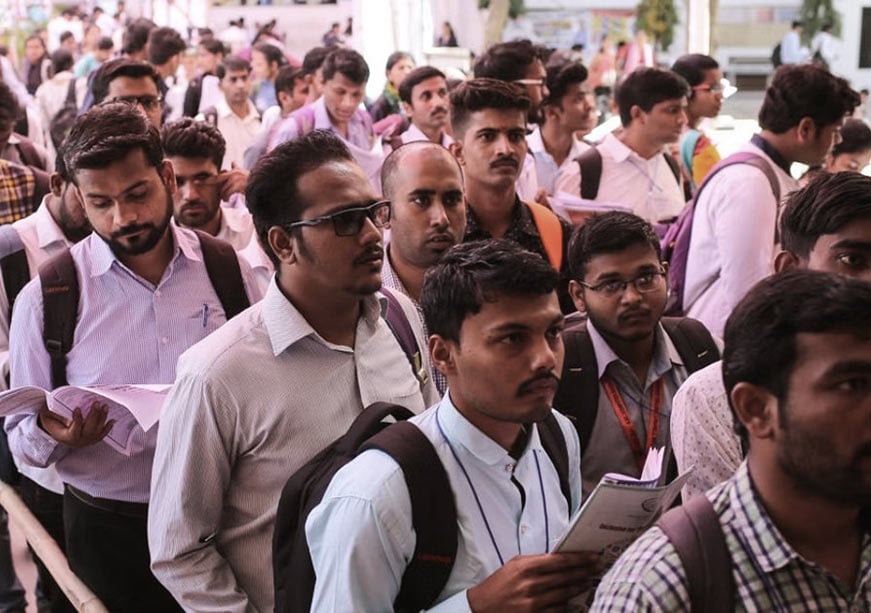
Cash transfers by state governments have become deeply entrenched in India’s political economy as an instrument of social protection and poverty alleviation. Although most of these programmes have been directed towards women and farmers, given their influence on electoral outcomes, there is an emerging category of cash transfer beneficiaries: unemployed youth. Nearly ten state governments offer cash transfers to their unemployed youth — including Bihar, West Bengal, Assam, Uttar Pradesh, Rajasthan, Haryana, Chhattisgarh, Karnataka, Kerala and Tamil Nadu. About six of the eleven programmes currently in effect were launched between 2022 and 2024, according to an analysis by Project DEEP, an organisation working on cash-based policies. Cash transfers, both globally and in India, have taken hold as a popular policy tool in the aftermath of the economic disruption caused by COVID-19.
These cash transfers are explicitly targeted at the educated unemployed youth, a cohort facing growing employment precarity as labour markets struggle to absorb new entrants with formal qualifications. For instance, Karnataka’s Yuva Nidhi scheme offers a monthly unemployment allowance of Rs. 3,000 for degree holders and Rs. 1,500 for diploma holders for a period of two years. Similarly, the Saksham Yuva scheme in Haryana offers monthly allowances of Rs. 1,200 to those who have completed schooling, Rs. 2,000 to graduates, and Rs. 3,500 to post-graduates. In Bihar, the Mukhyamantri Nischay Swayam Sahayata Bhatta Yojna — which was earlier applicable only to those who had completed schooling — was expanded to include graduates just before the election last year, in a bid to reach young voters, with youth unemployment emerging as a key poll issue. Bihar, which has one of the largest youth populations by proportion among Indian states, has struggled with job creation, leading to distress-driven migration of its workforce.
In India, where a persistent mismatch between education, skills, and labour market requirements remains a key challenge, combining cash support with skilling interventions is particularly imperative.
Though the majority of these programmes are unconditional, some are linked to skill development or on-the-job training, often referred to as a “Cash +” approach, combining cash with vocational training or skills development to boost employment prospects. In India, where a persistent mismatch between education, skills, and labour market requirements remains a key challenge, combining cash support with skilling interventions is particularly imperative. The Rajasthan government’s Mukhyamantri Yuva Sambal Yojana, for instance, includes mandatory skill development and internships for beneficiaries. The programme run by the Bihar government requires mandatory training in language, communication skills, basic computer knowledge, and behavioural skills, and is implemented by the Bihar Skill Development Mission. Haryana, in addition to monthly transfers, provides an honorarium to beneficiaries for temporary assignments in government departments, boards, or corporations, with a maximum limit of 100 hours per month, providing youth with practical work exposure.
The scale of the skills-jobs mismatch in the country was highlighted in the Economic Survey 2024-25, which showed that only 8.25 percent of graduates are employed in roles aligned with their qualifications, while nearly 50 percent are working in “elementary” or “semi-skilled” jobs that do not require their level of education. The Survey underlined the need for reforms in education and skill development policies to align them more closely with labour market requirements.
Educated Youth Unemployment: Global and Indian Contexts
While these state-level programmes attempt to cushion educated youth against labour market shortages, they are situated within broader demographic, labour market, and economic trends. India is entering a critical demographic window, with the largest youth population globally. Pegged at 27 percent of the total population in 2021, according to a report by the International Labour Organization, the youth population is expected to decline to 23 percent by 2036. Each year, India adds around 7–8 million persons to the labour force, and generating employment for young entrants is essential to realise the demographic dividend.
In India, the phenomenon of educated youth unemployment has grown in scale and severity, as the pace of job creation has failed to keep up with the expansion in higher education.
In India, the phenomenon of educated youth unemployment has grown in scale and severity, as the pace of job creation has failed to keep up with the expansion in higher education. Unemployment in India is highest among the most educated youth, particularly those with secondary education and above, according to the Periodic Labour Force Survey. The unemployment rate among graduates is estimated at 13 percent, while it is close to nil for those with no education. Indian youth consistently demonstrate a preference for education and white-collar jobs over vocational employment.
India also has a high share of youth not in education, employment, or training (NEET), at close to 25 percent in 2024, against the global average of 20 percent. High NEET rates among youth are a common challenge across countries in the Global South — at around 20 percent in Brazil and nearly 34 percent in South Africa. Across these countries, structural constraints such as limited job creation, uneven quality of education and vocational training, and persistent gender disparities have contributed to young people disengaging from the labour market.
India’s high NEET rate is largely driven by young women, who are far more likely than young men to be outside education and the labour market, with rates nearly five times higher (48.4 percent versus 9.8 percent). The gender gap in labour force participation stems from a combination of factors, primarily restrictive social norms alongside a lack of suitable jobs, with long-term implications for equitable and sustainable economic growth.
The gender gap in labour force participation stems from a combination of factors, primarily restrictive social norms alongside a lack of suitable jobs, with long-term implications for equitable and sustainable economic growth.
Evaluating the Impact
Most advanced economies have unemployment benefit programmes that provide income support during periods of job loss, helping households meet basic consumption needs and prevent distress asset sales. Research shows that these programmes can help stabilise the economy during recessions; however, if benefits are overly generous, they can lengthen unemployment spells and increase the overall unemployment rate. With the rise of jobless growth, recurring economic shocks, and the accelerating impact of AI and automation, unemployment benefits are likely to become a critical component of social protection systems in many countries.
Countries in the Global South have begun experimenting with their own approaches to address youth unemployment. Examples include Chile’s Youth Employment Subsidy, which provides wage support to workers from the most vulnerable households, and South Africa’s Social Relief of Distress Grant, which offers a temporary monthly benefit for unemployed citizens and has been shown to improve the probability of job search by 25 percent. These programmes operate within contexts common to the Global South, marked by high informality and limited unemployment insurance coverage.
While these programmes provide short-term relief, they cannot substitute for sustained investment in social and physical infrastructure and in policies that generate productive and decent jobs for India’s youth.
In India, only a few evaluations have assessed the impact of current unemployment benefit schemes on labour market outcomes or skilling. According to information shared by the Karnataka government, participation in Yuva Nidhi Plus, a skill-based training programme linked to the Yuva Nidhi scheme, has seen very poor uptake, reflecting limited interest in skilling programmes among beneficiaries. An audit report on Rajasthan’s Mukhyamantri Yuva Sambal Yojana flagged that 41 percent of beneficiaries were between the ages of 21 and 25, an age group considered too young for unemployment allowance. These findings raise concerns about programme design and targeting.
As with cash transfers targeted at women, more programmes aimed at educated unemployed youth will likely be rolled out by state governments in the coming years. The Economic Survey 2024-25 has pointed out the increase in cash transfers from governments to households, cautioning that although such programmes provide short-term benefits, their scale, persistence, and design could weaken state finances and crowd out growth-enhancing public investment. Finally, while these programmes provide short-term relief, they cannot substitute for sustained investment in social and physical infrastructure and in policies that generate productive and decent jobs for India’s youth.
Sunaina Kumar is Director and Senior Fellow, Centre for New Economic Diplomacy, Observer Research Foundation.
The views expressed above belong to the author(s). ORF research and analyses now available on Telegram! Click here to access our curated content — blogs, longforms and interviews.



