
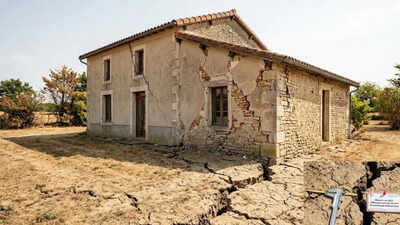
There is a phenomenon called ‘Shrinking and Expanding’ when a clay-rich soil shrinks (or dries out) and expands (or swells) due to the moisture available, and it has become one of the leading geologic risks in France (known technically as Retrait-Gonflement des Argiles).
As per the NHESS Journal, with climate change producing higher temperatures globally, evaporation and transpiration are creating a lot more dry and shrunken soils; therefore, there is a large amount of volume loss in the structure of clay minerals. In response to large amounts of rainfall after periods of drought, clay minerals can quickly regain water and create large amounts of swelling, creating differential settlement of the foundation of structures and putting them at structural risk.
As per BRGM (French Geological Survey), over 11.2 million individual dwellings are in medium to high-risk zones; this ‘quiet crisis’ is a physical manifestation of climate change, with increasing numbers and intensity of extreme weather events (e.g.
, drought) turning stable foundation structures into very unstable liabilities affecting 54 per cent of France’s single-detached housing stock.
Is climate change really breaking French homes? The mechanical reality
Clay-rich soils undergo the ‘shrink-swell’ phenomenon, which represents an ongoing response to hydric stress or any moisture loss/flux at the soil’s upper boundary.
The NHESS Journal provides evidence that climate change is the main culprit, and this includes the increased frequency and intensity of what scientists term ‘geotechnical droughts’. Clay soils, through their physical properties, shrink when they lose water from the heat during a hot spell or heat wave; conversely, they swell when exposed to excess moisture, as during heavy rainfall events. Thus, the cyclic movement of the clay soil will cause the soil to exert force on the structure and create system failures as they exceed the structural limitations of the foundation.
10.4 million dwellings in the danger zone
According to the European Environment Agency (EEA), it is estimated that roughly 10.4 million individual homes in France are located in either ‘medium’ or ‘high’ risk to shrink-swell soils. This depicts approximately 50 per cent of the housing stock (detached) within the country. In order to better understand the cumulative risk of structure collapse and its potential occurrence, all regional vulnerability mapping has been compiled utilising a higher resolution and is concentrated at the commune level, isolated and identifiable by their current soil composition.
The economic crisis: Over 21.5 billion euros in cumulative losses
According to the Caisse Centrale de Réassurance (CCR), a state-controlled organisation, the financial implications of soil subsidence have increased recently. The cumulative total of costs between 1989 and early 2026 is estimated to be approximately 21.5 billion euros. By 2050, it is predicted that these same costs will have doubled as much of France is expected to transition from ‘occasional drought’ to ‘structural hydric deficit’.
Beyond 2065: The permanent state of soil deficit
According to the collaborative research of Météo-France and the BRGM (French Geological Survey), soil moisture levels are expected to be considerably decreased through the IPCC Climate Change Scenarios (RCP 4.5 & 8.5). The ‘return period’ for periods of extreme, soil-shrinking droughts will shorten by 2065. Therefore, a previous ‘once every 5 to 10 years’ event could happen every few years.