
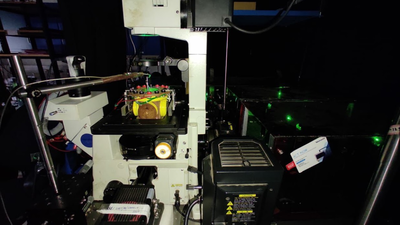
Fluorescence imaging with microscope combined with a Helmholtz coil | Credit: IISc
BENGALURU: In a step towards probing the inner workings of living cells with precision, researchers from IISc have developed a technique to actively steer quantum sensors through the dense, viscous interiors of biological systems.
The work addresses a long-standing limitation in cellular sensing: tiny probes often drift aimlessly, relying on chance encounters with the molecules they are meant to detect.Cells are not empty spaces. Their interiors are crowded and gel-like, making it difficult for nanoscale sensors to move freely. This restricts measurements of key parameters such as temperature, viscosity (internal resistance to flow), and chemical activity.
The IISc team flipped the problem. Instead of waiting for molecules to reach the sensor, they built a system that carries the sensor to where measurements are needed. At the centre of the approach is a nanodiamond embedded with a nitrogen vacancy (NV) defect. This defect allows the sensor to respond to changes in its surroundings through shifts in its quantum spin state, which can be read out using fluorescence. Such sensors are known for their sensitivity, but positioning them inside cells has been a challenge.
Earlier methods relied on optical tweezers, which use tightly focused laser beams to trap and move particles. While effective, the intense light can damage delicate biological material. The IISc team avoided this by attaching the nanodiamond to a tiny, helical microbot made partly of iron. When exposed to a rotating magnetic field, the microbot spins and moves forward like a corkscrew, carrying the sensor along.
This magnetic control allows precise movement in three dimensions without exposing cells to harmful light. Illumination is only required at the moment of measurement, reducing heating and phototoxic effects.Another hurdle at such small scales is Brownian motion — the constant, random jostling caused by surrounding molecules. This can cause the sensor to orient unpredictably, introducing noise and reducing measurement reliability.
By controlling the microbot’s alignment with an external magnetic field, the researchers were able to hold the sensor steady and suppress this noise. “We are able to counter Brownian motion with magnetic manipulation,” Ambarish Ghosh, professor, Center for Nanoscience and Engineering (CeNSE), said, adding that this makes the platform more promising than optical or other techniques.Designing the system required careful engineering. Magnetic elements can interfere with the sensor’s readings, so the team positioned the nanodiamond about a micron away from the microbot’s iron head, where magnetic disturbances are minimal.The researchers say the platform could be used to track reactive oxygen species within cells, which play a role in ageing and diseases such as cancer. More broadly, it offers a way to carry out minimally invasive, real-time measurements in environments that were previously difficult to access.The study, published in Advanced Functional Materials, points to a future where mobile quantum sensors can navigate complex biological landscapes, offering new insights into cellular processes as they unfold.