
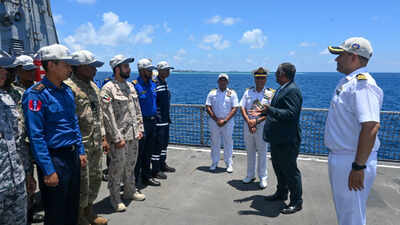
INS Sunayna at Male for her first port call as part of IOS SAGAR26, marking a key step in India and Maldives maritime cooperation.
The closure of the Strait of Hormuz has highlighted the strategic importance of maritime chokepoints. The Strait of Hormuz, through which 20% of the world’s oil and gas pass, provides the Persian Gulf countries access to the world via the Indian Ocean.
This ocean is one of the most critical bodies of water for global trade, as it is a maritime bridge between the east and the west. Apart from the Strait of Hormuz, the ocean can be accessed by many choke points such as the Bab El Mandeb, which leads to the Suez Canal, while the Malacca Strait, the Sunda Strait and the Lambok Strait. In the entire Indian Ocean Region (IOR), India plays a very important role. The country juts out into its eponymous ocean like an arrowhead and on a map looks like a crown that adorns this massive waterbody.
As the most dominant economy in the region and as a budding super power, India is playing an important role in ensuring to safeguard the maritime trade routes that criss-cross this vast ocean. “India is a pivotal state in the Indian Ocean Region. 50% 0f the global economy passes through the Indian Ocean Region. Ensuring the security of the maritime region means ensuring trade security, food security and energy security,” said Commodore Anil Jai Singh (retd), who has commanded three submarines and a ship.
The importance of Indian Ocean
The strategic importance of the Indian Ocean has long been known. Admiral Alfred Thayer Mahan, considered the most important strategist of the 19th century, said “Whoever controls the Indian Ocean will dominate Asia. This ocean is the key to the seven seas in the 21st century. The destiny of the world will be decided in these waters”.A large proportion of global energy, commodities and manufactured goods sail through the Indian Ocean.
The ocean directly connects Africa, South Asia and South Asia directly. With the wider world connected to the ocean through connecting waterbodies.
Challenges in the Indian Ocean
The IOR faces different types of challenges. The most prominent of these issues are piracy, armed robbery at sea, narcotics trade, smuggling, illegal fishing and human trafficking.
The Indian Navy and the IOR
The Indian Navy has been an active participant in the operation in the region. The navy’s ability to deploy across the entire ocean was first noticed during the 2004 Boxing Day Tsunami.
The Indian Navy was one of the first responders to the tragedy across the region, the force also provided exceptional logistics support for the same. The Navy has been instrumental in recuing Indian nationals from conflict hit zones such as Libya, Lebanon and Yemen.
Besides this the Indian Navy has been actively deployed in countering piracy off the Somalian coast and has escorted ships during the scourge of the Houthi missiles on merchant vessels moving through the Bab El Mandeb.
Indian Navy shaping regional security
In order to ensure the security of the region, the Indian Navy is working with regional partners under the Mutual and Holistic Advancement for Security Across the Region (MAHASAGAR) approach. The navy is creating a shared security space that is being built on coordinated action with trusted partnerships to ensure a continuous presence at sea. The navy has under this philosophy renamed Saryu-class patrol vessel INS Sunanya as the Indian Ocean Ship (IOS) SAGAR for the duration of this deployment to partner nations.
The initiative gives regional maritime cooperation a clear operational asset to ensure shared deployment, joint training and professional interaction at sea. In 2025, the IOS Sagar visited Dar-es-Salaam, Nacala, Port Louis, Port Victoria, and Malé. The ship operated with a crew of 44 from nine other countries, namely Comoros, Kenya, Madagascar, Maldives, Mauritius, Mozambique, Seychelles, Sri Lanka, and Tanzania.
The Indian Navy has launched the second edition of the IOS Sagar initiative this time with a crew of 16 nations. Commodore Singh added, “This is a unique initiative, normally in bilateral and multilateral exercises we train with ships and vessels, in the case of IOS Sagar, the crew of the ship was from nine different countries. This meant that the different members of the ship worked as a team. This was an experiment that let them work and live together as a team.
This shows navy’s soft power diplomacy”. Besides this India has taken the chairmanship of the Indian Ocean Naval Symposium. This was done at the 9th Conclave of Chiefs in Visakhapatnam, during the International Fleet Review in February. In the same month the Indian Navy took command of the Command Task Force 154, a key multinational training task force under the Combined Maritime Forces (CMF) headquartered in Bahrain.
The CMF is a 47-nation strong naval partnership.
The Indian Navy is shaping a new maritime security paradigm in the Indian Ocean Region. This new system is based on the principle of shared security built on cooperation at sea. The navy is expanding its footprint as a senior partner demonstrating India’s growing role in the region.

