
– Under construction entry gate at Khan Market. (To go with Khushi’s story) Photo: Anushka Kogta
– Fire safety equipment check at Khan Market. (To go with Khushi’s story) Photo: Anushka Kogta– Fire safety equipment check at Khan Market. (To go with Khushi’s story) Photo: Anushka Kogta– Fire safety equipment check at Khan Market. (To go with Khushi’s story) Photo: Anushka Kogta– Fire safety equipment check at Khan Market. (To go with Khushi’s story) Photo: Anushka Kogta– Fire safety equipment check at Khan Market. (To go with Khushi’s story) Photo: Anushka Kogta– Fire safety equipment check at Khan Market. (To go with Khushi’s story) Photo: Anushka Kogta– Under construction entry gate at Khan Market. (To go with Khushi’s story) Photo: Anushka Kogta– Fire safety equipment check at Khan Market. (To go with Khushi’s story) Photo: Anushka Kogta– Fire safety equipment check at Khan Market. (To go with Khushi’s story) Photo: Anushka Kogta– Parking space at Khan Market. (To go with Khushi’s story) Photo: Anushka Kogta
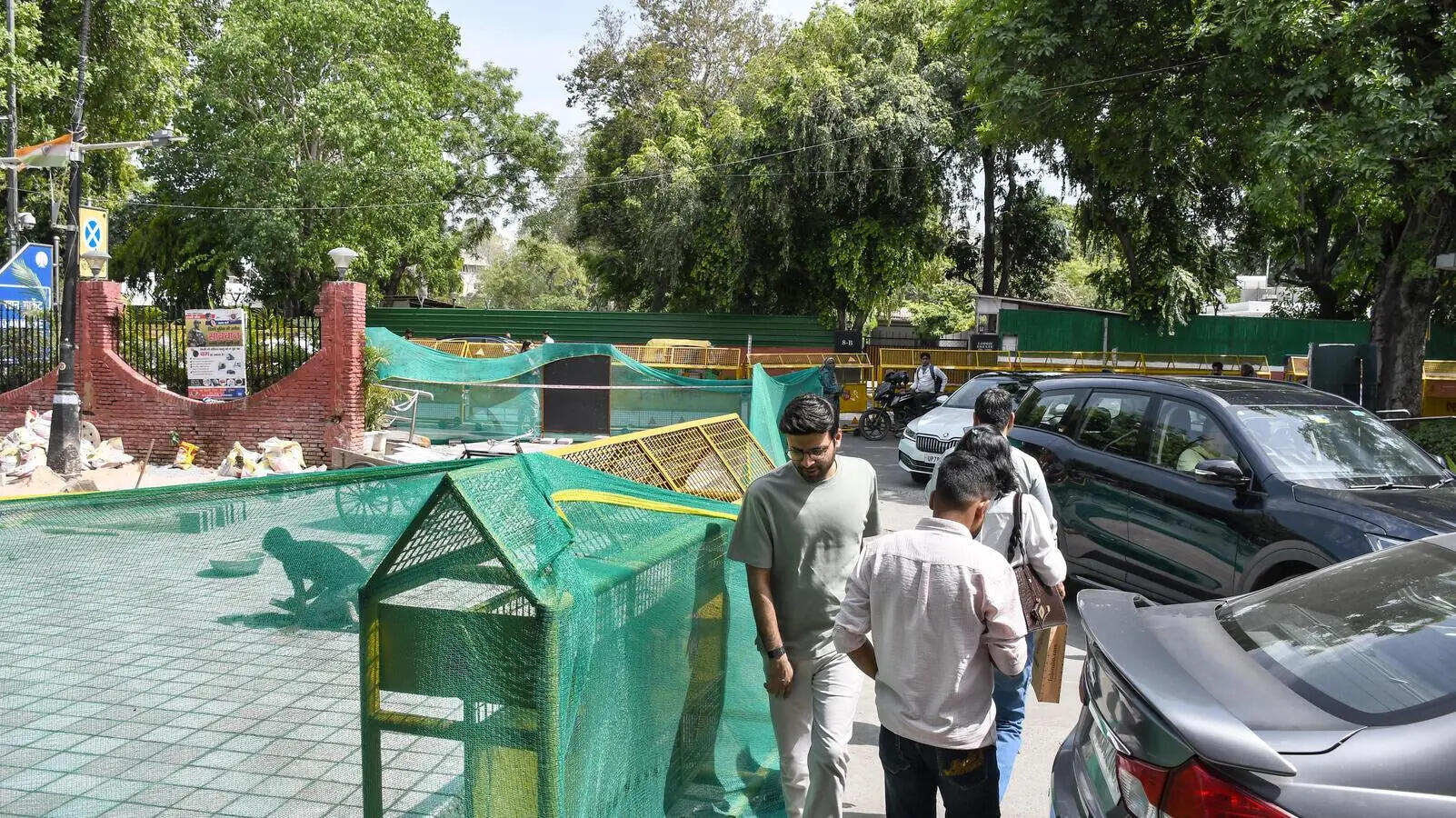
– Under construction entry gate at Khan Market. (To go with Khushi’s story) Photo: Anushka Kogta
New Delhi: Upscale dining establishments in Khan Market, long grappling with the issue of inadequate safety exits, can finally breathe easy, with Delhi High Court on Friday allowing them to operate without a fire no-objection certificate if their occupancy does not exceed 50 guests.However, the ruling has triggered fresh concerns among visitors over enforcement and compliance with the building norms. The ambiguity has deepened as New Delhi Municipal Council (NDMC) maintains that the NOC comes under the fire department’s purview, while department officials claim that the establishments with fewer than 50 occupants are not their responsibility.A visit to the market on Saturday revealed that most eateries, including those that approached the court, have kept seating capacities below the prescribed limit.
Three restaurants — Sly Granny (49 seats across two storeys), Perch (48 seats) and Khan Chacha (35 seats) — reported operating within the limit. Their managers claimed that fire safety equipment such as extinguishers, hoses, alarms and fire blankets were in place and entries were being regulated.
At another outlet, however, staff said they were unaware of the court order.Despite compliance claims, TOI observed inadequate ventilation at several outlets, especially those on terraces lacking separate exits and narrow staircases being used for both entry and exit.
While the building code prescribes a minimum staircase width of 1.5 metres for such establishments, restaurant owners argued that the norm applied specifically to “assembly buildings” that are allowed 50 or more guests. They also claimed that mechanical ventilation systems had been installed where natural ventilation was insufficient.“The court has anyway considered the building rules before giving a verdict.
If anyone has issues, they can definitely report the matter. The safety of guests is our concern too,” said Anshu Tandon, president of Khan Market Welfare Association, who claimed to have assisted restaurant owners in filing the petitions.Visitors flagged additional issues such as exposed AC units, congested passages and tightly packed outlets. “The passage to a second-floor cafe went through another outlet’s kitchen and was too narrow, getting congested even with four to five people,” said Ramesh Sharma, a 27-year-old accountant.Another visitor, Pooja Mahabadi, a 25-year-old content marketing executive, said the close clustering of outlets increased the risk. “The cafes are packed together in a small space. If something goes wrong at one outlet, the fire could quickly spread to adjacent establishments. NDMC should check these issues.”In Feb 2025, a fire broke out in two restaurants. While no casualties were reported, there were lots of combustible materials on the terraces and everything had turned to ashes.
Eyewitnesses had claimed that the blaze was caused by a short circuit. In March 2023, a fire broke out in the chimney and the false ceiling on the first and second floors of OTB restaurant. No casualty was reported.Authorities had made multiple attempts, including surveys and consultations, in the past to address the entry-exit issue, but no consensus solution emerged. Ground-floor shopkeepers opposed widening internal staircases passing through their shops, citing loss of retail space.“The external spiral staircases would have affected the market’s aesthetics, create encroachment issues and restrict shop access. However, we wanted a solution to the problem, too, and that’s why we agreed to the proposed staircase, lift cabin or ramps outside the periphery of the market, which would have served the purpose,” said Sanjiv Mehra of Khan Market Traders Association .A proposal to create a cantilevered access and walkway on the second floor with access from the pavement lift cabins or stair cabin needs the acceptance from flat owners.
According to Tandon, NDMC had proposed acquiring upper-floor space to build a common walkway, but the plan was not feasible as several units were still used for residential purposes.Tandon said the restaurants’ owners approached the court in 2020-21 when NDMC stopped renewing their licences and rejected applications. “They issued a letter stating that the restaurants’ owners having an area more than 90 sqm space might have made extra sitting arrangements and thus be eligible to apply for the fire NOC.
Since NDMC’s licence was mandatory to get other approvals, we were also unable to get an excise licence.
”Established in 1951, the U-shaped market is famous for high-end branded showrooms, renowned bookstores, artisanal shops and premium restaurants, making it a favourite for expats and locals. Traders noted that the conversion of upper-floor residential flats into commercial establishments began around 2004. The market currently has 156 ground-floor shops and about 74 upper-floor units, of which only five-six continue to be used for residential purposes.

