
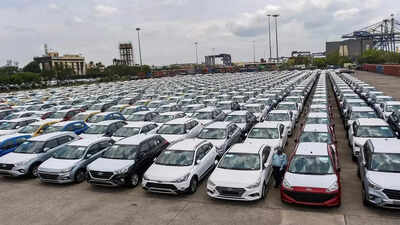
NEW DELHI: Spurred by GST 2.0 rate cuts in Sept last year and easier consumer bank lending rates, Indian car market shrugged off geopolitical tensions and concerns around US trade tariffs to close the year at a record 47 lakh units (4.7 million) in FY26, a 9% growth over the 43 lakh units (4.3 million) sold in the previous fiscal.The surge was led by SUVs, which grew their share in total industry sales from an estimated 54% in FY25 to 58% in 2025-26. SUVs have been the biggest focus for the car industry and have seen the most launches over the past few years as consumers buy them across price points – right from the sub-Rs 10 lakh Punch mini from Tata Motors to the over Rs 1 crore-plus powerful GLS by Mercedes-Benz.Mahindra & Mahindra, the biggest SUV seller in the country, had a robust 20% growth in the year as the company sold 6.6 lakh units in 2025-26 against 5.5 lakh units in FY25.
Led by models such as the Thar, Scorpio-N and XUV7OO (XUV7XO in its new avatar), the company has emerged as the biggest beneficiary of the love of consumers for SUVs. This prompted the company to even launch their electrics (BE6, XEV9E and XEV9S) with SUV body styling.Mahindra emerged as the second-biggest passenger vehicles maker in the country, pipping Hyundai from the position. The decline was severe for Hyundai which was also beaten in fiscal sales by Tata Motors as the latter finished in the third position.
Maruti Suzuki, the country’s biggest passenger vehicles maker, had total domestic sales of 18.2 lakh units against 17.6 lakh units, the numbers aided by the GST cut on small cars. The traditional small car major, which has also been growing its share in the SUV category through models such as the Brezza, Grand Vitara, and Fronx, had a 3.5% growth in its volumes.Partho Banerjee, Senior Executive Officer (Marketing & Sales) at Maruti Suzuki, said the company has been witnessing steady demand post the GST rate cuts and the repo rate reduction by the RBI, and added that there has not been any immediate impact on component supply chain due to the Iran war.
However, he said that pressure has been building up on the cost of inputs, which will see it revise vehicle prices soon.“So far, tailwinds are still there, and we don’t see headwinds. The market is pretty buoyant. There is pressure on costs partly due to commodity prices and the (Iran) war,” he said, adding, “We need to take a call on prices soon, very very soon.”Tata Motors also continued to grow strongly, led by models such as the Nexon, Punch and the newly launched Sierra.
The company closed FY26 at 6.3 lakh units on a growth of 14%.“The industry witnessed a strong rebound in the second half, posting double digit growth, supported by GST 2.0 implementation and a robust festive season,” said Tata Motors Passenger Vehicles MD & CEO Shailesh Chandra.“Looking ahead, industry momentum is expected to sustain, led by growth in SUVs, CNG and EV. At the same time, the industry will need to closely monitor geopolitical developments to mitigate potential supply-side risks.
For Tata Motors Passenger Vehicles, we expect to build on the strong momentum of FY26 second half and continue to deliver industry-beating growth in FY27, supported by recent launches, a strong pipeline of new products, and established multi-powertrain strategy,” Tata Motors said.Toyota too had a 19% growth in the fiscal year, led by its traditional strongholds of Fortuner and Innova, as well as the cross-badged shared models with compatriot Maruti Suzuki.Maruti’s Banerjee said the industry is watching the developments emanating from the Iran war, as well as supply chain concerns. He said that initial estimates peg by the FY27 growth forecast at 5%.Skoda too had a strong year as its mini SUV, the Kylaq, generated strong customer demand. “This growth is driven by a combination of a stronger and more accessible product portfolio, deeper market reach, and a sharper focus on customer-centric initiatives. The Kylaq continues to take the brand to newer customers and regions, and the new Kushaq that was recently introduced has made its mark,” Ashish Gupta, Brand Director for Skoda Auto India, said.