
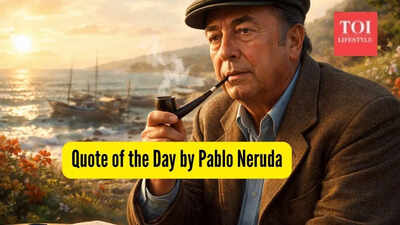
Pablo Neruda was one of the most important poets of the 20th century. His writing was very emotional, political, and full of symbols. He was born Ricardo Eliécer Neftalí Reyes Basoalto on in 1904, in Parral, Chile.
He changed his name to “Pablo Neruda” when he was a teenager, partly to avoid an issue with his father, who didn’t like that he wanted to be a writer. This fake name eventually became his legal name and the one that would make him famous around the world. Neruda’s early life had a big impact on how he wrote poetry. He grew up in the small town of Temuco, which was surrounded by forests, rivers, and wide open spaces. His mother died shortly after he was born.
His imagination was forever changed by this setting. Nature became a big part of his poems, not just as a setting but as a living, breathing thing that was connected to how people felt. His early experiences of being alone and in nature helped him become more thoughtful and sensitive, which was a big part of his work later on.His love for poetry He started writing poetry when he was very young, and in 1924, when he was only 19 years old, he published his first major book, Twenty Love Poems and a Song of Despair.
This book made him famous right away in the Spanish-speaking world. The poems dealt with love, longing, sexuality, and heartbreak in a way that was very emotional and resonated with readers. This book is still one of the best-selling poetry collections in Spanish.
One of Neruda’s best qualities was that he could express deep feelings in simple but strong words. Neruda’s work changed a lot as he got older. He started working as a diplomat in the 1930s, going to places like Burma, Sri Lanka, Spain, and Mexico.
His time in Spain during the Spanish Civil War changed him in a big way. Seeing violence, unfairness, and the pain of everyday people made him more politically aware and active. This was a big change in his poetry. His writing went from being about personal and romantic things to being about more political and group issues. Neruda became a vocal supporter of leftist politics and joined the Chilean Communist Party. His poetry started to show how much he cared about social justice, equality, and standing up to oppression.
Canto General is one of his most important works from this time. It is an epic collection that tells the history of Latin America, from its ancient civilisations to its fights against colonialism and imperialism. In this book, Neruda speaks for the land, the people, and the continent’s shared memory. It is thought to be a great work of political poetry and an important work of world literature.Style of writingNeruda never gave up his lyrical and imaginative style, even though he was involved in politics.
One of the most impressive things about his writing is how well he combines the personal and the universal. His poems always had a strong emotional core, whether they were about love, nature, or revolution. He often used strong images, metaphors, and symbols to make the reader feel things. He could use pictures of the sea, the wind, or the night to talk about love, which would make abstract feelings seem real and alive.
People also say that Neruda’s style is easy to read. Some modernist poets used complicated and hard-to-understand language, but Neruda often wrote in a way that was clear and easy to understand, but still very poetic. This made it possible for a lot of people to read his work, from regular people to literary scholars. His poems are still popular because they are both simple and deep.One thing that makes Neruda’s poetry stand out is how he celebrates everyday things.
He wrote poems about everyday things like tomatoes, onions, bread, and salt in his Elemental Odes. He made the ordinary extraordinary through these works, showing how beautiful the simplest things in life can be. He thought that poetry should not only be about big ideas, but also about the small, everyday things that people do. Neruda’s life wasn’t easy.
He was persecuted in Chile because of his political beliefs, which forced him to go into hiding and then exile.
He travelled to many different countries during this time, still writing and speaking out for what he believed in. His time in exile made him feel more connected to who he was and where he belonged, which are themes that come up a lot in his later work.The Nobel Prize in Literature, which is one of the highest honours a writer can get, was given to Neruda in 1971. The Nobel Committee gave him the award “for a poetry that, with the action of an elemental force, brings alive a continent’s destiny and dreams.”
This award made him a well-known literary figure around the world. In his later years, Neruda went back to Chile and stayed involved in both politics and literature.
He was a strong supporter of Salvador Allende, the president of Chile. But after the military coup in 1973 that brought down Allende’s government, Neruda’s health quickly got worse. He passed away just days after the coup, in 1973. There is still some disagreement about his death, with people arguing about whether it was caused by illness or something else.Pablo Neruda wrote a lot of great literature. He changed poetry by making it both very personal and important to society. He showed that poetry could be used for love, protest, remembering, and finding yourself all at the same time. People all over the world still read, study, and admire his work, and it has had an effect on many writers and readers. In short, Neruda was more than just a poet; he was a voice for all people. He wrote about the beauty of love, the pain of loss, the power of nature, and the fight for justice.
His legacy lives on as a reminder that poetry can connect the earth to the sky, even though it is based on reality and reaches for something that never ends.Quote of the DayOne of the most beautiful lines from the works of Pablo Neruda are- What did the earth teach the trees?How to speak to the sky.In this quote, Neruda is probably talking about how roots and expression are related. You can think of the “earth” as everything that keeps us grounded, like our past, who we are, our struggles, and even our pain.
Neruda went through political problems, exile, and personal problems, so for him, the “earth” could also mean the problems and realities of life. People who have grown out of that reality are the “trees.” He says that the earth teaches trees “how to talk to the sky.
” This means that our experiences shape how we dream, make things, and say what we want to say. People, like trees, grow their voices, ideas, and creativity from what they go through. In Neruda’s poems, the word “sky” can mean freedom, imagination, hope, or even something spiritual. So, “speaking to the sky” can mean: saying what you want to say, going after your goals, and connecting with something bigger than you. The difference is what makes this strong in Neruda’s style:Earth is heavy, stable, and quiet.Sky is open, limitless, and full of meaningA very common theme in Neruda’s work is poetry itself. The idea of the earth “teaching” trees to talk could stand for how art is inspired by real life. Life (earth) teaches the poet (tree) how to show beauty, emotion, and truth (sky). Neruda often thought that poetry comes from real life, not from contemplating things in a general way.